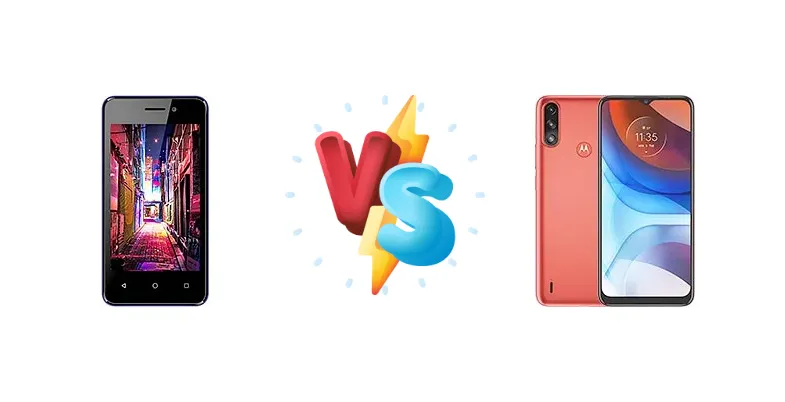
The ultra-budget smartphone segment is fiercely competitive. Both the Yezz GO 1 and Motorola Moto E7i Power aim to deliver essential smartphone functionality at the lowest possible price point. However, they take different approaches to achieving this, with the Motorola leveraging an octa-core processor while the Yezz opts for a quad-core solution. This comparison will dissect their key specifications to determine which device offers the best value for users prioritizing affordability.
🏆 Quick Verdict
For the average user, the Motorola Moto E7i Power emerges as the better choice. Its Unisoc SC9863A octa-core processor provides a significantly more responsive experience for multitasking and app usage compared to the Yezz GO 1’s quad-core Mediatek MT6580. While both phones are limited in features, the Motorola’s processing power offers a tangible improvement in daily usability.
| Network |
|---|
| 2G bands | GSM 850 / 900 / 1800 / 1900 | GSM 850 / 900 / 1800 / 1900 |
| 3G bands | HSDPA 850 / 900 / 1900 / 2100 | HSDPA 850 / 900 / 1700(AWS) / 1900 / 2100 |
| 4G bands | - | LTE |
| Speed | HSPA 21.1/5.76 Mbps | HSPA, LTE |
| Technology | GSM / HSPA | GSM / HSPA / LTE |
| Launch |
|---|
| Announced | 2020, February. Released 2020, July 28 | 2021, February 23 |
| Status | Discontinued | Available. Released 2021, March 15 |
| Body |
|---|
| Build | - | Glass front, plastic back, plastic frame |
| Dimensions | 128.5 x 65.2 x 11 mm (5.06 x 2.57 x 0.43 in) | 165.1 x 75.9 x 9.2 mm (6.5 x 2.99 x 0.36 in) |
| SIM | Nano-SIM + Nano-SIM | Nano-SIM + Nano-SIM |
| Weight | 123 g (4.34 oz) | 200 g (7.05 oz) |
| | - | Water-repellent design |
| Display |
|---|
| Resolution | 480 x 800 pixels, 5:3 ratio (~233 ppi density) | 720 x 1600 pixels, 20:9 ratio (~270 ppi density) |
| Size | 4.0 inches, 45.5 cm2 (~54.4% screen-to-body ratio) | 6.51 inches, 102.3 cm2 (~81.7% screen-to-body ratio) |
| Type | TFT LCD | IPS LCD, 380 nits (typ) |
| Platform |
|---|
| CPU | Quad-core 1.3 GHz | Octa-core (4x1.6 GHz Cortex-A55 & 4x1.2 GHz Cortex-A55) |
| Chipset | Mediatek MT6580 (28 nm) | Unisoc SC9863A (28 nm) |
| GPU | Mali-400 | IMG8322 |
| OS | Android 10 (Go edition) | Android 10 (Go edition) |
| Memory |
|---|
| Card slot | microSDXC (dedicated slot) | microSDXC (uses shared SIM slot) |
| Internal | 8GB 1GB RAM | 32GB 2GB RAM |
| | - | eMMC 5.1 |
| Main Camera |
|---|
| Dual | - | 13 MP, f/2.0, 26mm (wide), 1/3.1", 1.12µm, PDAF
2 MP (macro) |
| Features | LED flash, Panorama, HDR | LED flash, HDR, panorama |
| Single | 5 MP | - |
| Video | 720p | 1080p@30fps |
| Selfie camera |
|---|
| Features | - | HDR |
| Single | 2 MP | 5 MP, f/2.2, 27mm (wide), 1.12µm |
| Video | - | 1080p@30fps |
| Sound |
|---|
| 3.5mm jack | Yes | Yes |
| 35mm jack | Yes | Yes |
| Loudspeaker | Yes | Yes |
| Comms |
|---|
| Bluetooth | 4.0, A2DP, LE | 4.2, A2DP |
| NFC | No | No |
| Positioning | GPS | GPS, GLONASS, GALILEO |
| Radio | FM radio | Unspecified |
| USB | microUSB 2.0 | USB Type-C 2.0 |
| WLAN | Wi-Fi 802.11 a/b/g/n | Wi-Fi 802.11 b/g/n |
| Features |
|---|
| Sensors | Accelerometer | Fingerprint (rear-mounted), accelerometer, proximity |
| Battery |
|---|
| Charging | - | 10W wired |
| Type | Li-Ion 1400 mAh, removable | Li-Ion 5000 mAh |
| Misc |
|---|
| Colors | Black | Tahiti Blue, Coral Red |
| Models | - | XT2097-13 |
| Price | - | About 120 EUR |
Yezz GO 1
- Potentially lower price point
- Simple and straightforward user experience
- May be more readily available in certain regions
- Outdated quad-core processor
- Likely limited performance for multitasking
- Unknown display quality and battery capacity
Motorola Moto E7i Power
- Octa-core processor for improved performance
- More efficient processor architecture
- 10W charging support
- Slow 10W charging
- Basic display quality
- Limited camera capabilities
Display Comparison
Neither device boasts a standout display. Both utilize 28nm chipsets, suggesting a focus on cost reduction over display quality. Specific display specs (resolution, panel type, brightness) are unavailable for the Yezz GO 1, but given its price point, it likely features a basic LCD panel. The Moto E7i Power also lacks detailed display information, but its market positioning suggests a similar LCD experience. The absence of features like high refresh rates or even HD+ resolution is expected in this segment, meaning users should anticipate a basic visual experience on both devices.
Camera Comparison
Camera performance is likely to be similar on both devices – basic and functional. Details regarding camera sensors are scarce, but in this price range, expect low-resolution sensors and limited image quality. The focus should not be on photography capabilities, as both phones will struggle in low-light conditions and lack advanced features like optical image stabilization (OIS). Any marketing around camera features should be viewed with skepticism.
Performance
The core difference lies in the processors. The Yezz GO 1’s Mediatek MT6580 is a quad-core processor clocked at 1.3 GHz. This is a relatively old architecture, designed for basic smartphone functions. Conversely, the Motorola Moto E7i Power features the Unisoc SC9863A, an octa-core processor with a heterogeneous core configuration – four cores at 1.6 GHz (Cortex-A55) and four at 1.2 GHz (Cortex-A55). This octa-core setup, even with the lower clock speeds on some cores, provides a significant advantage in multitasking and handling more complex applications. The Cortex-A55 architecture is more efficient than the cores found in the MT6580, translating to better performance per watt. While neither chipset is a powerhouse, the Moto E7i Power will demonstrably feel snappier in everyday use.
Battery Life
Battery capacity details are missing for the Yezz GO 1. The Motorola Moto E7i Power includes 10W wired charging. Given the low-power chipsets in both devices, battery life should be adequate for a full day of light use. However, the 10W charging on the Motorola is slow, meaning a full charge will take a considerable amount of time. Without knowing the Yezz GO 1’s battery capacity, it’s difficult to definitively say which offers better endurance, but the Motorola’s more efficient processor may provide a slight edge.
Buying Guide
Buy the Yezz GO 1 if you absolutely need the lowest possible upfront cost and your smartphone usage is limited to basic tasks like calls, texts, and light web browsing. Buy the Motorola Moto E7i Power if you prioritize a smoother, more responsive user experience, even for moderately demanding tasks, and appreciate the benefit of an octa-core processor for improved multitasking and app performance.
Frequently Asked Questions
❓ Will the Motorola Moto E7i Power struggle with popular apps like WhatsApp and Facebook?
While the Unisoc SC9863A isn't a high-end processor, it should handle apps like WhatsApp and Facebook without significant issues. The octa-core configuration provides enough headroom for these commonly used applications, offering a smoother experience than the Yezz GO 1’s quad-core processor.
❓ Is the 10W charging on the Motorola Moto E7i Power a major drawback?
Yes, 10W charging is quite slow by modern standards. Expect a full charge to take several hours. However, given the low-power chipset and likely smaller battery capacity, this isn't a catastrophic issue, as the phone doesn't require frequent, rapid charging.
❓ Can the Yezz GO 1 handle basic video playback from YouTube?
The Yezz GO 1 should be able to handle basic YouTube video playback at lower resolutions (e.g., 480p). However, expect potential stuttering or buffering with higher resolutions due to the limitations of the Mediatek MT6580 processor.
❓ Which phone is better for someone who primarily uses their phone for calls and texts?
Both phones are adequate for calls and texts. However, the Motorola Moto E7i Power’s more responsive processor will provide a slightly better overall experience, even for these basic functions, due to faster app switching and a smoother user interface.