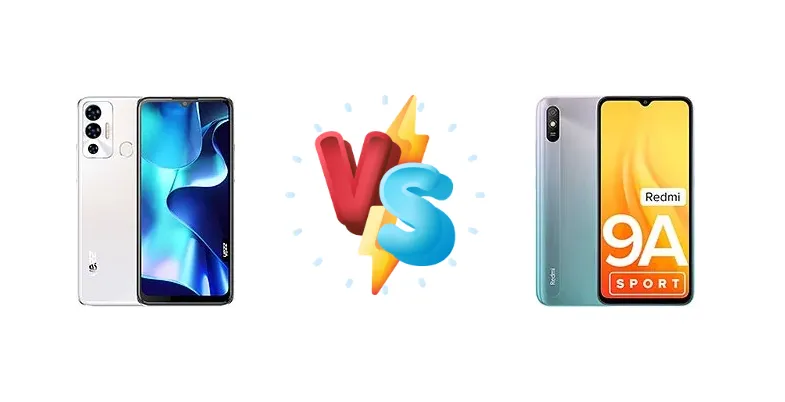
The sub-$150 smartphone market is fiercely competitive. Both the Yezz Art 3S and Xiaomi Redmi 9A Sport aim to deliver essential smartphone functionality at an incredibly affordable price. This comparison dives deep into their specifications to determine which device offers the best value for users prioritizing basic connectivity, media consumption, and light tasks.
🏆 Quick Verdict
For the average user, the Xiaomi Redmi 9A Sport is the better choice. Its more modern 12nm Helio G25 chipset provides a noticeable performance advantage over the Yezz Art 3S’s older 28nm Unisoc SC9863A, translating to smoother multitasking and app loading. While both offer similar battery and charging capabilities, the Redmi 9A Sport’s slightly more efficient processor gives it a small edge in longevity.
| Network |
|---|
| 2G bands | GSM 850 / 900 / 1800 / 1900 | GSM 850 / 900 / 1800 / 1900 |
| 3G bands | HSDPA 850 / 900 / 1900 / 2100 | HSDPA 850 / 900 / 2100 |
| 4G bands | 2, 3, 4, 5, 7, 12, 17, 28 | 1, 3, 5, 8, 40, 41 |
| Speed | HSPA, LTE | HSPA, LTE |
| Technology | GSM / HSPA / LTE | GSM / HSPA / LTE |
| Launch |
|---|
| Announced | 2022, September | 2021, September 28 |
| Status | Available. Released 2023, January | Available. Released 2021, September 28 |
| Body |
|---|
| Dimensions | 165.3 x 77 x 9.2 mm (6.51 x 3.03 x 0.36 in) | 164.9 x 77.1 x 9 mm (6.49 x 3.04 x 0.35 in) |
| SIM | Nano-SIM + Nano-SIM | Nano-SIM + Nano-SIM |
| Weight | 190 g (6.70 oz) | 194 g (6.84 oz) |
| | - | Water-repellent coating |
| Display |
|---|
| Protection | Asahi Glass | - |
| Resolution | 720 x 1600 pixels, 20:9 ratio (~269 ppi density) | 720 x 1600 pixels, 20:9 ratio (~269 ppi density) |
| Size | 6.52 inches, 102.6 cm2 (~80.6% screen-to-body ratio) | 6.53 inches, 102.9 cm2 (~81.0% screen-to-body ratio) |
| Type | IPS LCD | IPS LCD, 400 nits (typ) |
| Platform |
|---|
| CPU | Octa-core (4x1.6 GHz Cortex-A55 & 4x1.2 GHz Cortex-A55) | Octa-core (4x2.0 GHz Cortex-A53 & 4x1.5 GHz Cortex-A53) |
| Chipset | Unisoc SC9863A (28 nm) | Mediatek MT6762G Helio G25 (12 nm) |
| GPU | IMG8322 | PowerVR GE8320 |
| OS | Android 12 | Android 10, MIUI 12 |
| Memory |
|---|
| Card slot | microSDXC | microSDXC (dedicated slot) |
| Internal | 64GB 4GB RAM, 128GB 4GB RAM | 32GB 2GB RAM, 32GB 3GB RAM |
| | - | eMMC 5.1 |
| Main Camera |
|---|
| Features | LED flash, HDR, panorama | LED flash, HDR |
| Single | - | 13 MP, f/2.2, 28mm (wide), 1.0µm, PDAF |
| Triple | 16 MP, AF
2 MP
2 MP | - |
| Video | 1440p@30fps, 1080p@30fps | 1080p@30/60fps |
| Selfie camera |
|---|
| Features | HDR | HDR |
| Single | 8 MP | 5 MP, f/2.2, (wide), 1.12µm |
| Video | Yes | 1080p@30fps |
| Sound |
|---|
| 3.5mm jack | No | Yes |
| 35mm jack | No | Yes |
| Loudspeaker | Yes | Yes |
| Comms |
|---|
| Bluetooth | 5.0, A2DP, LE | 5.0, A2DP, LE |
| NFC | No | No |
| Positioning | GPS | GPS, GLONASS, BDS |
| Radio | Stereo FM radio, recording | FM radio |
| USB | USB Type-C 2.0 | microUSB 2.0, OTG |
| WLAN | Wi-Fi 802.11 b/g/n | Wi-Fi 802.11 a/b/g/n, Wi-Fi Direct |
| Features |
|---|
| Sensors | Fingerprint (rear-mounted) | Accelerometer, proximity |
| Battery |
|---|
| Charging | 10W wired | 10W wired |
| Type | Li-Po 5000 mAh | Li-Po 5000 mAh |
| Misc |
|---|
| Colors | Sunrise White, Graphite, Aqua Green, Artic Blue | Carbon Black, Coral Green, Metallic Blue |
| Price | About 110 EUR | About 100 EUR |
Yezz Art 3S
- Potentially lower price point (depending on retailer)
- May offer unique software customizations
- Availability in specific regions
- Older, less efficient Unisoc SC9863A chipset
- Slower performance compared to the Redmi 9A Sport
- Likely inferior camera image processing
Xiaomi Redmi 9A Sport
- More powerful and efficient MediaTek Helio G25 chipset
- Smoother overall user experience
- Better brand recognition and support
- May have bloatware pre-installed
- Potentially slightly higher price
Display Comparison
Neither device boasts a standout display. Both likely feature LCD panels, typical for this price bracket. The key difference lies under the hood. Without specific display specs, we can infer that the Redmi 9A Sport benefits from a more modern manufacturing process, potentially leading to slightly better color reproduction and viewing angles. However, both will likely struggle in direct sunlight.
Camera Comparison
Both devices likely feature basic camera setups. Given the market segment, image quality will be heavily reliant on software processing. Without detailed sensor information, it’s safe to assume both will struggle in low-light conditions. The presence of a 2MP macro lens on the Redmi 9A Sport is largely a marketing gimmick; its utility is limited. The primary sensor’s quality will be the deciding factor, and the Redmi 9A Sport’s more powerful ISP (Image Signal Processor) within the Helio G25 chipset likely provides better image processing capabilities.
Performance
The performance gap is the most significant differentiator. The Xiaomi Redmi 9A Sport’s MediaTek Helio G25, built on a 12nm process, is demonstrably more efficient and powerful than the Yezz Art 3S’s Unisoc SC9863A (28nm). The Helio G25’s Cortex-A53 cores, clocked at 2.0 GHz, outperform the Art 3S’s Cortex-A55 cores (1.6 GHz and 1.2 GHz). This translates to faster app launches, smoother scrolling, and a more responsive user experience. While neither is a gaming powerhouse, the Redmi 9A Sport will handle less demanding titles with greater ease. The older 28nm process of the Unisoc chip will also generate more heat under load.
Battery Life
Both the Yezz Art 3S and Xiaomi Redmi 9A Sport feature 10W wired charging, indicating similar charging speeds (expect around 3-4 hours for a full charge). Battery capacity is not specified, but both likely fall in the 5000mAh range, common for this price point. The Redmi 9A Sport’s more efficient Helio G25 chipset will likely result in slightly longer battery life during typical usage, offsetting any potential capacity differences.
Buying Guide
Buy the Yezz Art 3S if you absolutely need a device with a specific software customization or carrier compatibility not offered by Xiaomi. However, if you prioritize performance, even at a basic level, and a more widely recognized brand, the Xiaomi Redmi 9A Sport is the clear winner. It’s ideal for first-time smartphone users, those needing a reliable backup phone, or anyone on a very tight budget.
Frequently Asked Questions
❓ Will the Redmi 9A Sport struggle with popular apps like WhatsApp and Facebook?
While not a powerhouse, the Redmi 9A Sport’s Helio G25 chipset is capable of running apps like WhatsApp and Facebook smoothly. You might experience some slowdown with multiple apps open simultaneously, but for basic social media usage, it’s perfectly adequate.
❓ Is the Unisoc SC9863A in the Yezz Art 3S known for overheating during prolonged use?
The Unisoc SC9863A, being built on a 28nm process, is more prone to thermal throttling than the Redmi 9A Sport’s Helio G25. Prolonged gaming or intensive tasks may lead to noticeable performance drops as the chip heats up.
❓ Can the Redmi 9A Sport handle basic mobile games like Subway Surfers or Temple Run?
Yes, the Redmi 9A Sport should handle casual games like Subway Surfers and Temple Run without issue. However, don’t expect to run graphically demanding games at high settings.
❓ Does either phone support fast charging beyond the standard 10W?
No, both the Yezz Art 3S and Xiaomi Redmi 9A Sport are limited to 10W wired charging. This is typical for phones in this price range, and you should expect a relatively slow charging time.