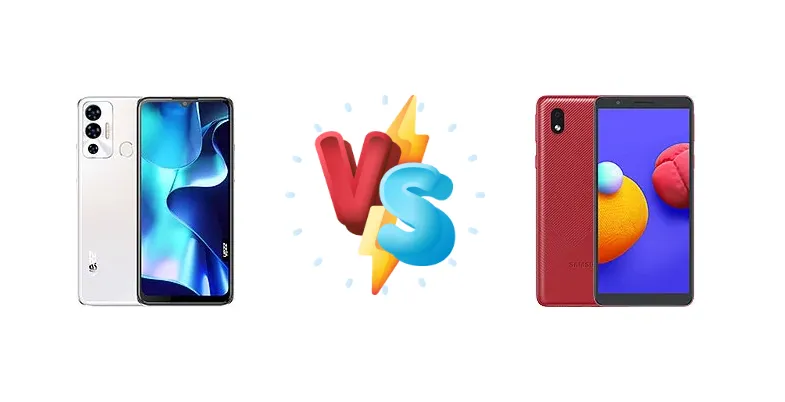
The Yezz Art 3S and Samsung Galaxy A01 Core represent the extreme lower end of the smartphone market, targeting users prioritizing affordability above all else. Both devices aim to provide basic smartphone functionality, but significant differences in their underlying hardware dictate which one delivers a smoother, more usable experience. This comparison dissects those differences, focusing on performance, battery, and overall value.
🏆 Quick Verdict
For the average user seeking a functional, albeit basic, smartphone experience, the Yezz Art 3S is the better choice. Its Unisoc SC9863A chipset, featuring a more modern octa-core CPU architecture, provides a noticeable performance advantage over the Galaxy A01 Core’s quad-core Mediatek MT6739, making everyday tasks feel more responsive.
| Network |
|---|
| 2G bands | GSM 850 / 900 / 1800 / 1900 | GSM 850 / 900 / 1800 / 1900 |
| 3G bands | HSDPA 850 / 900 / 1900 / 2100 | HSDPA 850 / 900 / 2100 |
| 4G bands | 2, 3, 4, 5, 7, 12, 17, 28 | 1, 3, 5, 7, 8, 20, 28, 38, 40, 41 |
| Speed | HSPA, LTE | HSPA 21.1/5.76 Mbps, LTE |
| Technology | GSM / HSPA / LTE | GSM / HSPA / LTE |
| Launch |
|---|
| Announced | 2022, September | 2020, July 21. Released 2020, August 06 |
| Status | Available. Released 2023, January | Discontinued |
| Body |
|---|
| Build | - | Plastic back, plastic frame |
| Dimensions | 165.3 x 77 x 9.2 mm (6.51 x 3.03 x 0.36 in) | 141.7 x 67.5 x 8.6 mm (5.58 x 2.66 x 0.34 in) |
| SIM | Nano-SIM + Nano-SIM | · Nano-SIM· Nano-SIM + Nano-SIM |
| Weight | 190 g (6.70 oz) | 150 g (5.29 oz) |
| Display |
|---|
| Protection | Asahi Glass | - |
| Resolution | 720 x 1600 pixels, 20:9 ratio (~269 ppi density) | 720 x 1480 pixels, 18.5:9 ratio (~311 ppi density) |
| Size | 6.52 inches, 102.6 cm2 (~80.6% screen-to-body ratio) | 5.3 inches, 71.3 cm2 (~74.5% screen-to-body ratio) |
| Type | IPS LCD | PLS LCD |
| Platform |
|---|
| CPU | Octa-core (4x1.6 GHz Cortex-A55 & 4x1.2 GHz Cortex-A55) | Quad-core 1.5 GHz Cortex-A53 |
| Chipset | Unisoc SC9863A (28 nm) | Mediatek MT6739 (28 nm) |
| GPU | IMG8322 | PowerVR GE8100 |
| OS | Android 12 | Android 10 (Go edition) |
| Memory |
|---|
| Card slot | microSDXC | microSDXC (dedicated slot) |
| Internal | 64GB 4GB RAM, 128GB 4GB RAM | 16GB 1GB RAM, 16GB 2GB RAM, 32GB 2GB RAM |
| | - | eMMC 5.1 |
| Main Camera |
|---|
| Features | LED flash, HDR, panorama | LED flash |
| Single | - | 8 MP, f/2.2, AF |
| Triple | 16 MP, AF
2 MP
2 MP | - |
| Video | 1440p@30fps, 1080p@30fps | 1080p@30fps |
| Selfie camera |
|---|
| Features | HDR | - |
| Single | 8 MP | 5 MP, f/2.4 |
| Video | Yes | - |
| Sound |
|---|
| 3.5mm jack | No | Yes |
| 35mm jack | No | Yes |
| Loudspeaker | Yes | Yes |
| Comms |
|---|
| Bluetooth | 5.0, A2DP, LE | 5.0, A2DP, LE |
| NFC | No | No |
| Positioning | GPS | GPS |
| Radio | Stereo FM radio, recording | FM radio |
| USB | USB Type-C 2.0 | microUSB 2.0 |
| WLAN | Wi-Fi 802.11 b/g/n | Wi-Fi 802.11 b/g/n, Wi-Fi Direct |
| Features |
|---|
| Sensors | Fingerprint (rear-mounted) | Accelerometer |
| Battery |
|---|
| Charging | 10W wired | - |
| Type | Li-Po 5000 mAh | Li-Ion 3000 mAh |
| Misc |
|---|
| Colors | Sunrise White, Graphite, Aqua Green, Artic Blue | Black, Blue, Red |
| Models | - | SM-A013F, SM-A013F/DS, SM-A013G, SM-A013G/DS, SM-A013M |
| Price | About 110 EUR | About 150 EUR |
| SAR EU | - | 0.64 W/kg (head) 1.18 W/kg (body) |
Yezz Art 3S
- More powerful octa-core processor
- Newer CPU architecture (Cortex-A55)
- Potentially better multitasking performance
- Less established brand reputation
- Likely limited software updates
Samsung Galaxy A01 Core
- Well-known Samsung brand
- Potentially more readily available
- Slightly more polished software experience (potentially)
- Older, less efficient processor
- Quad-core CPU limits multitasking
- Slower overall performance
Display Comparison
Neither device boasts a standout display. Both are likely to feature low-resolution panels, typical for this price point. Without specific display specs, it's reasonable to assume both utilize LCD technology. The focus here isn't on visual fidelity, but rather basic readability. The Yezz Art 3S's slightly newer chipset *could* translate to marginally better image processing, but the difference will be minimal. Bezels are expected to be substantial on both devices.
Camera Comparison
Camera performance on both devices will be limited. Without detailed sensor information, it’s safe to assume both feature basic sensors. The marketing materials for these phones often highlight megapixel counts, but sensor size and image processing are far more critical. Expect limited low-light performance and generally soft images from both. Any secondary cameras (often 2MP macro lenses) are likely to be of minimal practical use. The Yezz Art 3S *might* benefit from slightly better image signal processing capabilities due to its newer chipset, but the difference will be subtle.
Performance
The core difference lies in the chipsets. The Yezz Art 3S’s Unisoc SC9863A is an octa-core processor with a split core configuration (4x1.6 GHz Cortex-A55 & 4x1.2 GHz Cortex-A55). This contrasts sharply with the Samsung Galaxy A01 Core’s Mediatek MT6739, a quad-core 1.5 GHz Cortex-A53. The Cortex-A55 architecture is more efficient and offers improved performance per clock cycle compared to the older Cortex-A53. While both are built on a 28nm process, the higher core count and newer architecture of the Unisoc chip give the Art 3S a clear advantage in multitasking and app responsiveness. The A01 Core will likely struggle with more demanding applications.
Battery Life
Battery capacity is not specified for either device. However, given their target market, both likely feature batteries in the 3000-4000 mAh range. The Yezz Art 3S’s more efficient processor could translate to slightly better battery life, despite potentially having a similar capacity. Both devices support 10W wired charging, meaning slow charging speeds. Expect several hours to fully charge from 0-100%.
Buying Guide
Buy the Yezz Art 3S if you need a phone capable of handling basic multitasking and app usage without significant lag. Its octa-core processor offers a more future-proof experience, even within this budget segment. Buy the Samsung Galaxy A01 Core if you absolutely prioritize brand recognition and a slightly more polished software experience, understanding that you’ll be sacrificing performance for that familiarity.
Frequently Asked Questions
❓ Will the Mediatek MT6739 in the Galaxy A01 Core struggle with popular apps like WhatsApp and Facebook?
Yes, the Mediatek MT6739 is a relatively weak processor. While it can handle basic tasks like making calls and sending texts, you may experience noticeable lag and slowdown when using more demanding apps like WhatsApp and Facebook, especially with multiple apps open simultaneously.
❓ Does the Yezz Art 3S support software updates beyond the initial Android version?
Given the price point and Yezz's brand history, it's unlikely the Art 3S will receive extensive software updates. Expect limited security patches and potentially no major Android version upgrades. This is a common trade-off for extremely affordable smartphones.
❓ Is the 10W charging on either phone sufficient for daily use?
10W charging is quite slow by modern standards. Expect to spend several hours fully charging either device. It's best to charge overnight to ensure you have sufficient battery life for the next day.
❓ Which phone is better for playing casual games like Candy Crush?
The Yezz Art 3S will provide a smoother experience for casual gaming due to its more powerful processor. While neither phone is ideal for gaming, the Art 3S is less likely to exhibit significant lag or frame rate drops.