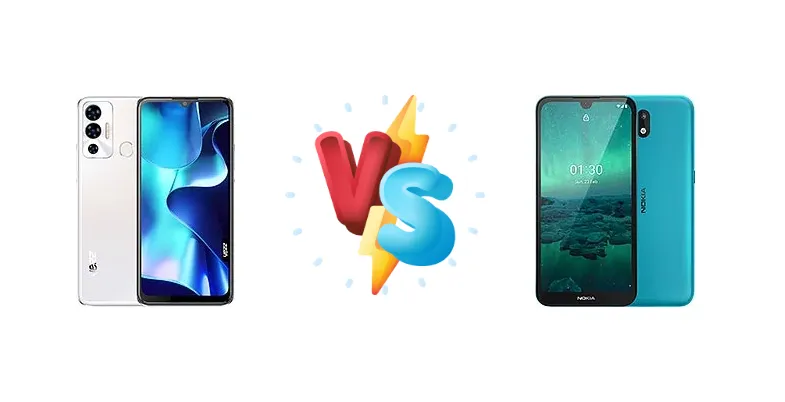
The Yezz Art 3S and Nokia 1.3 represent the very bottom of the smartphone price spectrum. Both aim to deliver basic connectivity and functionality at an incredibly affordable price point. However, significant differences in their underlying hardware – specifically the chipsets – dictate which phone offers a smoother, more responsive user experience. This comparison dissects those differences to help you choose the best option for your needs.
🏆 Quick Verdict
For the average user prioritizing responsiveness and multitasking, the Yezz Art 3S emerges as the better choice. Its Unisoc SC9863A, with its octa-core configuration, provides a noticeable performance advantage over the Nokia 1.3’s quad-core Snapdragon 215, despite both being manufactured on a 28nm process.
| Network |
|---|
| 2G bands | GSM 850 / 900 / 1800 / 1900 | GSM 850 / 900 / 1800 / 1900 |
| 3G bands | HSDPA 850 / 900 / 1900 / 2100 | HSDPA 850 / 900 / 2100 - International |
| 4G bands | 2, 3, 4, 5, 7, 12, 17, 28 | 1, 3, 5, 7, 8, 20, 28 - International |
| Speed | HSPA, LTE | HSPA 42.2/5.76 Mbps, LTE Cat4 150/50 Mbps |
| Technology | GSM / HSPA / LTE | GSM / HSPA / LTE |
| | - | 1, 2, 3, 4, 5, 7, 8, 12, 17, 28, 66 - LATAM |
| Launch |
|---|
| Announced | 2022, September | 2020, March 19. Released 2020, April 02 |
| Status | Available. Released 2023, January | Discontinued |
| Body |
|---|
| Build | - | Glass front, plastic back, plastic frame |
| Dimensions | 165.3 x 77 x 9.2 mm (6.51 x 3.03 x 0.36 in) | 147.3 x 71.2 x 9.4 mm (5.80 x 2.80 x 0.37 in) |
| SIM | Nano-SIM + Nano-SIM | · Nano-SIM· Nano-SIM + Nano-SIM |
| Weight | 190 g (6.70 oz) | 155 g (5.47 oz) |
| Display |
|---|
| Protection | Asahi Glass | - |
| Resolution | 720 x 1600 pixels, 20:9 ratio (~269 ppi density) | 720 x 1520 pixels, 19:9 ratio (~295 ppi density) |
| Size | 6.52 inches, 102.6 cm2 (~80.6% screen-to-body ratio) | 5.71 inches, 81.4 cm2 (~77.6% screen-to-body ratio) |
| Type | IPS LCD | IPS LCD, 400 nits (typ) |
| Platform |
|---|
| CPU | Octa-core (4x1.6 GHz Cortex-A55 & 4x1.2 GHz Cortex-A55) | Quad-core 1.3 GHz Cortex-A53 |
| Chipset | Unisoc SC9863A (28 nm) | Qualcomm QM215 Snapdragon 215 (28 nm) |
| GPU | IMG8322 | Adreno 308 |
| OS | Android 12 | Android 10 (Go edition), upgradable to Android 11 (Go edition), Android One |
| Memory |
|---|
| Card slot | microSDXC | microSDXC (dedicated slot) |
| Internal | 64GB 4GB RAM, 128GB 4GB RAM | 16GB 1GB RAM |
| | - | eMMC 5.1 |
| Main Camera |
|---|
| Features | LED flash, HDR, panorama | LED flash, HDR |
| Single | - | 8 MP, (wide), AF |
| Triple | 16 MP, AF
2 MP
2 MP | - |
| Video | 1440p@30fps, 1080p@30fps | 720p@30fps |
| Selfie camera |
|---|
| Features | HDR | - |
| Single | 8 MP | 5 MP |
| Video | Yes | 720p@30fps |
| Sound |
|---|
| 3.5mm jack | No | Yes |
| 35mm jack | No | Yes |
| Loudspeaker | Yes | Yes |
| Comms |
|---|
| Bluetooth | 5.0, A2DP, LE | 4.2, A2DP, LE, aptX HD |
| NFC | No | No |
| Positioning | GPS | GPS, GLONASS, BDS |
| Radio | Stereo FM radio, recording | FM radio |
| USB | USB Type-C 2.0 | microUSB 2.0, OTG |
| WLAN | Wi-Fi 802.11 b/g/n | Wi-Fi 802.11 b/g/n |
| Features |
|---|
| Sensors | Fingerprint (rear-mounted) | Accelerometer, proximity |
| Battery |
|---|
| Charging | 10W wired | - |
| Type | Li-Po 5000 mAh | Li-Po 3000 mAh, removable |
| Misc |
|---|
| Colors | Sunrise White, Graphite, Aqua Green, Artic Blue | Cyan, Charcoal, Sand |
| Models | - | TA-1216, TA-1205 |
| Price | About 110 EUR | About 170 EUR |
| SAR | - | 0.64 W/kg (head) 1.17 W/kg (body) |
| SAR EU | - | 0.38 W/kg (head) 0.86 W/kg (body) |
Yezz Art 3S
- Octa-core processor offers better performance.
- More responsive multitasking experience.
- Potentially better battery efficiency with Cortex-A55 cores.
- Brand recognition is lower than Nokia.
- Software update support may be limited.
Nokia 1.3
- Strong brand reputation for reliability.
- Optimized for Android Go, improving performance on limited hardware.
- Potential for longer software support.
- Quad-core processor feels sluggish compared to the Yezz Art 3S.
- Limited multitasking capabilities.
Display Comparison
Neither device is expected to boast a particularly impressive display. Given the price point, both likely utilize LCD panels with modest resolutions. Without specific display specs, it's reasonable to assume similar levels of brightness and color accuracy. The focus here is on functionality, not visual fidelity. Bezels are likely to be substantial on both devices, maximizing screen real estate within a compact form factor.
Camera Comparison
Camera performance is unlikely to be a strong suit for either device. Without detailed sensor information, it’s safe to assume both feature basic cameras suitable for casual snapshots in good lighting conditions. The presence of a 2MP macro camera on either device is largely a marketing tactic, offering minimal practical benefit due to the low resolution and lack of optical image stabilization. Image processing will likely be limited, resulting in images with limited dynamic range and detail. The focus should be on capturing memories, not creating professional-quality photographs.
Performance
The core difference lies in the chipsets. The Yezz Art 3S’s Unisoc SC9863A features an octa-core CPU comprised of four Cortex-A55 cores clocked at 1.6 GHz and four at 1.2 GHz. This contrasts sharply with the Nokia 1.3’s Qualcomm Snapdragon 215, which utilizes a quad-core Cortex-A53 configuration clocked at 1.3 GHz. While both are 28nm chips, the higher core count and slightly faster clock speeds of the Unisoc chip translate to superior multitasking and application launch times. The Cortex-A55 architecture is also more efficient than the older A53, potentially offering slightly better battery life under load. The Snapdragon 215 is optimized for Android Go, which helps mitigate some performance limitations, but it cannot overcome the raw processing power deficit.
Battery Life
Both devices are equipped with modest batteries, and 10W charging is standard. The actual battery life will depend heavily on usage patterns. The more efficient Cortex-A55 cores in the Yezz Art 3S might offer a slight advantage in longevity during moderate use. However, the Snapdragon 215’s optimization for Android Go could also contribute to extended battery life. Expect approximately a full day of light use from either device, with charging times exceeding 3 hours for a full 0-100% charge.
Buying Guide
Buy the Yezz Art 3S if you need a phone capable of handling more than just basic calling and messaging. Its octa-core processor will provide a smoother experience with social media, light web browsing, and running multiple apps. Buy the Nokia 1.3 if your primary need is a simple, reliable device for essential communication and you prioritize brand reputation and potential software updates within the Android Go ecosystem.
Frequently Asked Questions
❓ Will the Yezz Art 3S struggle with popular apps like WhatsApp and Facebook?
While the Yezz Art 3S won't offer a flagship-level experience, its octa-core processor should handle WhatsApp and Facebook reasonably well. Expect some loading times and occasional lag, but it's likely to be a more fluid experience than on the Nokia 1.3, especially when switching between apps.
❓ Is the Nokia 1.3 a good choice for a first smartphone for an elderly user?
The Nokia 1.3's simplicity and focus on essential functions make it a viable option for a first smartphone, particularly for users less familiar with technology. The Android Go edition simplifies the interface and reduces resource demands. However, the slower processor might frustrate users expecting instant responsiveness.
❓ Can either of these phones play modern mobile games?
Neither phone is well-suited for modern, graphically demanding mobile games. While simple 2D games might be playable at low settings, expect significant lag and frame rate drops in more complex titles. These phones are designed for basic tasks, not gaming.