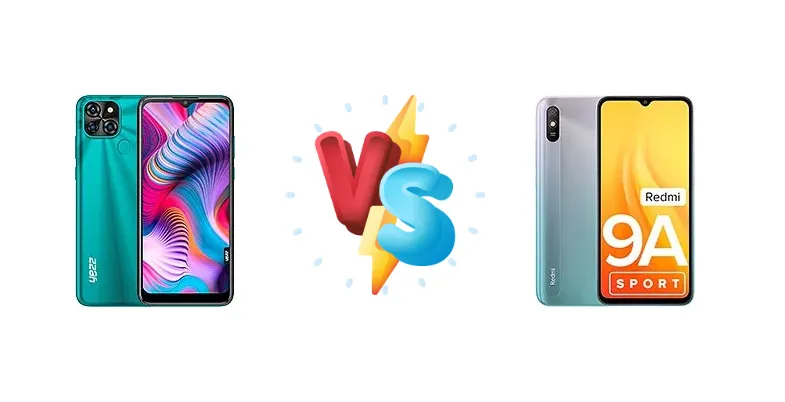
The sub-$150 smartphone market is fiercely competitive. Both the Yezz Art 3 Lite and the Xiaomi Redmi 9A Sport aim to deliver essential smartphone functionality at an accessible price. However, significant differences in their core hardware – specifically the chipset – dictate vastly different user experiences. This comparison dissects those differences to help you choose the right device.
🏆 Quick Verdict
For the average user, the Xiaomi Redmi 9A Sport is the clear winner. Its Mediatek Helio G25 chipset, with its octa-core configuration and 12nm process, provides a substantial performance uplift over the Yezz Art 3 Lite’s quad-core Unisoc SC9832E. While both offer similar battery and charging capabilities, the Redmi 9A Sport’s processing power makes it more suitable for multitasking and modern app usage.
| Network |
|---|
| 2G bands | GSM 850 / 900 / 1800 / 1900 | GSM 850 / 900 / 1800 / 1900 |
| 3G bands | HSDPA 850 / 900 / 1900 / 2100 | HSDPA 850 / 900 / 2100 |
| 4G bands | 2, 3, 4, 7, 12, 17, 28 | 1, 3, 5, 8, 40, 41 |
| Speed | HSPA, LTE | HSPA, LTE |
| Technology | GSM / HSPA / LTE | GSM / HSPA / LTE |
| Launch |
|---|
| Announced | 2022, June | 2021, September 28 |
| Status | Available. Released 2022, September | Available. Released 2021, September 28 |
| Body |
|---|
| Dimensions | 167.9 x 76.8 x 10.5 mm (6.61 x 3.02 x 0.41 in) | 164.9 x 77.1 x 9 mm (6.49 x 3.04 x 0.35 in) |
| SIM | Nano-SIM + Nano-SIM | Nano-SIM + Nano-SIM |
| Weight | 154 g (5.43 oz) | 194 g (6.84 oz) |
| | - | Water-repellent coating |
| Display |
|---|
| Protection | Panda Glass | - |
| Resolution | 720 x 1600 pixels, 20:9 ratio (~269 ppi density) | 720 x 1600 pixels, 20:9 ratio (~269 ppi density) |
| Size | 6.52 inches, 102.6 cm2 (~79.6% screen-to-body ratio) | 6.53 inches, 102.9 cm2 (~81.0% screen-to-body ratio) |
| Type | IPS LCD | IPS LCD, 400 nits (typ) |
| Platform |
|---|
| CPU | Quad-core 1.4 GHz | Octa-core (4x2.0 GHz Cortex-A53 & 4x1.5 GHz Cortex-A53) |
| Chipset | Unisoc SC9832E (28 nm) | Mediatek MT6762G Helio G25 (12 nm) |
| GPU | Mali-T820 MP1 | PowerVR GE8320 |
| OS | Android 11 (Go edition) | Android 10, MIUI 12 |
| Memory |
|---|
| Card slot | microSDXC | microSDXC (dedicated slot) |
| Internal | 64GB 2GB RAM | 32GB 2GB RAM, 32GB 3GB RAM |
| | - | eMMC 5.1 |
| Main Camera |
|---|
| Dual | 13 MP, AF
0.3 MP | - |
| Features | LED flash, HDR, panorama | LED flash, HDR |
| Single | - | 13 MP, f/2.2, 28mm (wide), 1.0µm, PDAF |
| Video | 1080p@30fps | 1080p@30/60fps |
| Selfie camera |
|---|
| Features | HDR | HDR |
| Single | 8 MP | 5 MP, f/2.2, (wide), 1.12µm |
| Video | Yes | 1080p@30fps |
| Sound |
|---|
| 3.5mm jack | Yes | Yes |
| 35mm jack | Yes | Yes |
| Loudspeaker | Yes | Yes |
| Comms |
|---|
| Bluetooth | 4.2, A2DP, LE | 5.0, A2DP, LE |
| NFC | No | No |
| Positioning | GPS | GPS, GLONASS, BDS |
| Radio | Stereo FM radio, recording | FM radio |
| USB | USB Type-C 2.0 | microUSB 2.0, OTG |
| WLAN | Wi-Fi 802.11 b/g/n | Wi-Fi 802.11 a/b/g/n, Wi-Fi Direct |
| Features |
|---|
| Sensors | Fingerprint (rear-mounted) | Accelerometer, proximity |
| Battery |
|---|
| Charging | 10W wired, PD | 10W wired |
| Type | Li-Po 5000 mAh | Li-Po 5000 mAh |
| Misc |
|---|
| Colors | Onyx Black, Majestic Blue, Emerald Green | Carbon Black, Coral Green, Metallic Blue |
| Price | About 120 EUR | About 100 EUR |
Yezz Art 3 Lite
- Potentially longer standby time due to lower processing demands.
- Simpler user experience for basic tasks.
- May be more readily available in certain regions.
- Significantly slower performance compared to the Redmi 9A Sport.
- Less capable of handling modern apps and multitasking.
- Older, less efficient chipset.
Xiaomi Redmi 9A Sport
- Faster and more responsive performance thanks to the Helio G25.
- Octa-core CPU enables smoother multitasking.
- More efficient 12nm process improves thermal management.
- May experience slightly faster battery drain under heavy use.
- Potentially less readily available in some markets.
- Camera performance is still limited by the budget sensor.
Display Comparison
Neither device boasts a standout display. Both are likely to feature LCD panels, typical for this price bracket. The absence of detailed display specifications necessitates relying on market trends; expect resolutions around 720p+. The Redmi 9A Sport’s slightly larger screen size (typically 6.53 inches vs. the Art 3 Lite’s 5.5 inches) offers a more immersive viewing experience, though neither will challenge higher-end displays in terms of color accuracy or brightness.
Camera Comparison
Given the price point, camera expectations should be tempered. Both devices likely feature a primary camera alongside basic auxiliary lenses (often 2MP macro or depth sensors). Without specific sensor details, it’s difficult to make a definitive judgment. However, the Redmi 9A Sport’s image processing capabilities, driven by the more powerful chipset, are likely to yield slightly better results, particularly in challenging lighting conditions. The 2MP macro cameras on both devices are unlikely to deliver significant detail.
Performance
The performance gap is the defining characteristic of this comparison. The Xiaomi Redmi 9A Sport’s Mediatek Helio G25, built on a 12nm process, features an octa-core CPU (4x2.0 GHz Cortex-A53 & 4x1.5 GHz Cortex-A53). This contrasts sharply with the Yezz Art 3 Lite’s Unisoc SC9832E, a quad-core 1.4 GHz processor fabricated on a larger 28nm node. The 12nm process of the Helio G25 is significantly more efficient, leading to better thermal management and sustained performance. The octa-core configuration also allows for more efficient multitasking. Users will notice a considerable difference in app loading times and overall responsiveness on the Redmi 9A Sport.
Battery Life
Both the Yezz Art 3 Lite and the Xiaomi Redmi 9A Sport feature 10W wired charging. While the battery capacity isn’t specified, typical capacities for these devices are around 5000mAh. The more efficient Helio G25 in the Redmi 9A Sport *could* lead to slightly better battery life under heavy use, but the difference will likely be marginal. Expect approximately 3-4 hours of screen-on time with moderate usage on both devices, and around 2-3 hours to fully charge from 0-100%.
Buying Guide
Buy the Yezz Art 3 Lite if you prioritize extreme simplicity and minimal app usage, primarily needing a device for calls and basic messaging. Its lower processing demands *might* translate to slightly longer standby battery life. Buy the Xiaomi Redmi 9A Sport if you want a phone capable of handling social media, light gaming, and multiple apps without significant lag. The Helio G25 provides a much more responsive and versatile experience for everyday tasks.
Frequently Asked Questions
❓ Will the Redmi 9A Sport struggle with popular apps like Facebook or WhatsApp?
While not a powerhouse, the Helio G25 in the Redmi 9A Sport is generally capable of running Facebook, WhatsApp, and similar social media apps without significant issues. You might experience some lag when switching between multiple apps, but it’s a far more comfortable experience than the Yezz Art 3 Lite would offer.
❓ Is the Unisoc SC9832E in the Yezz Art 3 Lite suitable for playing any games?
The Unisoc SC9832E is not designed for gaming. While it can handle very basic 2D games, even simple 3D titles will likely be unplayable due to low frame rates and frequent stuttering. The Redmi 9A Sport, while not a gaming phone, offers a slightly better experience with less demanding games.
❓ Does the Redmi 9A Sport support software updates?
Xiaomi generally provides software updates for their Redmi series, though the frequency and duration of support can vary. Expect at least a few Android version updates and security patches, but don't anticipate the same level of long-term support as flagship devices.
❓ What type of storage does the Redmi 9A Sport use, and is it expandable?
The Redmi 9A Sport typically uses eMMC storage, which is common in this price range. It also includes a dedicated microSD card slot, allowing you to expand the storage capacity to accommodate more photos, videos, and apps.