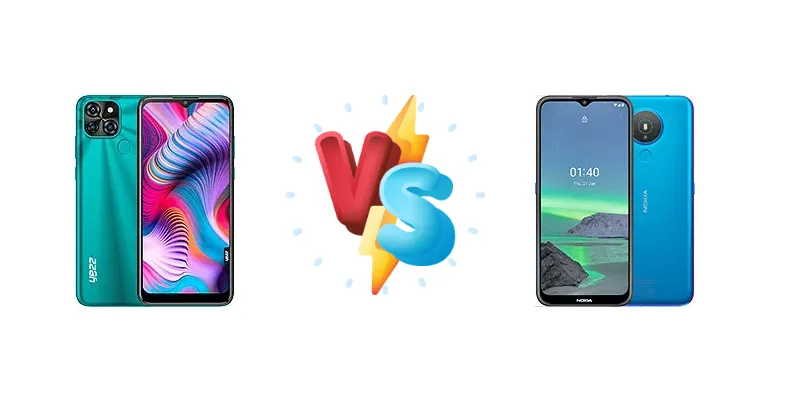
The Yezz Art 3 Lite and Nokia 1.4 represent the absolute bottom end of the smartphone market, targeting users prioritizing affordability above all else. Both devices run Android (likely Go Edition given the specs) and aim to provide basic smartphone functionality. This comparison dissects their core components to determine which offers the most for the money.
🏆 Quick Verdict
For the average user seeking a functional, ultra-budget smartphone, the Yezz Art 3 Lite edges out the Nokia 1.4. While both utilize 28nm chipsets, the Unisoc SC9832E's slightly higher clock speed and potential for optimized software integration give it a marginal performance advantage, making it better suited for everyday tasks.
| Network |
|---|
| 2G bands | GSM 850 / 900 / 1800 / 1900 | GSM 850 / 900 / 1800 / 1900 |
| 3G bands | HSDPA 850 / 900 / 1900 / 2100 | HSDPA 850 / 900 / 2100 - International |
| 4G bands | 2, 3, 4, 7, 12, 17, 28 | 1, 3, 5, 7, 8, 20, 28, 38, 40, 41 - International |
| Speed | HSPA, LTE | HSPA 42.2/5.76 Mbps, LTE Cat4 150/50 Mbps |
| Technology | GSM / HSPA / LTE | GSM / HSPA / LTE |
| | - | 1, 2, 3, 4, 5, 7, 12, 17, 28, 66 - LATAM, USA |
| Launch |
|---|
| Announced | 2022, June | 2021, February 03 |
| Status | Available. Released 2022, September | Available. Released 2021, February 03 |
| Body |
|---|
| Build | - | Glass front, plastic back, plastic frame |
| Dimensions | 167.9 x 76.8 x 10.5 mm (6.61 x 3.02 x 0.41 in) | 166.4 x 76.7 x 8.7 mm (6.55 x 3.02 x 0.34 in) |
| SIM | Nano-SIM + Nano-SIM | · Nano-SIM· Nano-SIM + Nano-SIM |
| Weight | 154 g (5.43 oz) | 178 g (6.28 oz) |
| Display |
|---|
| Protection | Panda Glass | - |
| Resolution | 720 x 1600 pixels, 20:9 ratio (~269 ppi density) | 720 x 1600 pixels, 20:9 ratio (~269 ppi density) |
| Size | 6.52 inches, 102.6 cm2 (~79.6% screen-to-body ratio) | 6.52 inches, 102.6 cm2 (~80.4% screen-to-body ratio) |
| Type | IPS LCD | IPS LCD |
| Platform |
|---|
| CPU | Quad-core 1.4 GHz | Quad-core 1.3 GHz Cortex-A53 |
| Chipset | Unisoc SC9832E (28 nm) | Qualcomm QM215 Snapdragon 215 (28 nm) |
| GPU | Mali-T820 MP1 | Adreno 308 |
| OS | Android 11 (Go edition) | Android 10 (Go edition), planned upgrade to Android 11 (Go edition) |
| Memory |
|---|
| Card slot | microSDXC | microSDXC |
| Internal | 64GB 2GB RAM | 16GB 1GB RAM, 32GB 2GB RAM, 64GB 3GB RAM |
| | - | eMMC 5.1 |
| Main Camera |
|---|
| Dual | 13 MP, AF
0.3 MP | 8 MP, (wide), AF
2 MP (macro) |
| Features | LED flash, HDR, panorama | LED flash, HDR |
| Video | 1080p@30fps | 720p@30fps |
| Selfie camera |
|---|
| Features | HDR | - |
| Single | 8 MP | 5 MP |
| Video | Yes | 720p@30fps |
| Sound |
|---|
| 3.5mm jack | Yes | Yes |
| 35mm jack | Yes | Yes |
| Loudspeaker | Yes | Yes |
| Comms |
|---|
| Bluetooth | 4.2, A2DP, LE | 4.2, A2DP, LE |
| NFC | No | No |
| Positioning | GPS | GPS |
| Radio | Stereo FM radio, recording | FM radio |
| USB | USB Type-C 2.0 | microUSB 2.0 |
| WLAN | Wi-Fi 802.11 b/g/n | Wi-Fi 802.11 b/g/n |
| Features |
|---|
| Sensors | Fingerprint (rear-mounted) | Fingerprint (rear-mounted), accelerometer, proximity |
| Battery |
|---|
| Charging | 10W wired, PD | - |
| Type | Li-Po 5000 mAh | Li-Po 4000 mAh |
| Misc |
|---|
| Colors | Onyx Black, Majestic Blue, Emerald Green | Fjord, Charcoal, Dusk |
| Models | - | TA-1322 |
| Price | About 120 EUR | About 90 EUR |
Yezz Art 3 Lite
- Slightly faster processor (1.4 GHz vs 1.3 GHz)
- 10W PD charging for potentially faster charging
- Potentially more optimized software integration with Unisoc
- Less established brand reputation than Nokia
- Software update support may be limited
Nokia 1.4
- Stronger brand recognition and trust (Nokia)
- Potentially better long-term software support
- Qualcomm chipset may have better GPU performance
- Slower processor (1.3 GHz)
- Likely slower charging (5W standard)
- May feel less responsive in everyday use
Display Comparison
Neither device boasts a standout display. Given the price point, both likely feature LCD panels with 720p+ resolution. Specifics like brightness and color accuracy are unavailable, but expect both to be adequate for indoor use. The absence of features like high refresh rates or even full lamination is standard in this segment. Bezels are likely substantial on both, maximizing screen real estate within a compact form factor.
Camera Comparison
Camera performance on both devices will be limited. Details on sensor sizes and apertures are missing, but it's safe to assume both feature basic sensors. The focus should be on capturing usable images in good lighting conditions. Any marketing around 'macro' lenses should be viewed with skepticism, as 2MP macro sensors rarely deliver meaningful results. Image processing will likely be minimal, relying heavily on software algorithms to enhance photos.
Performance
The core difference lies in the chipsets. The Yezz Art 3 Lite utilizes the Unisoc SC9832E, a quad-core processor clocked at 1.4 GHz, while the Nokia 1.4 features the Qualcomm Snapdragon 215, also quad-core but running at 1.3 GHz. While both are built on a 28nm process, the slightly higher clock speed of the Unisoc chip suggests a potential performance edge. However, Qualcomm's Snapdragon typically benefits from more optimized software support and potentially better GPU performance, though the difference will be minimal in real-world usage. Both will struggle with demanding applications and multitasking.
Battery Life
Battery capacity is not specified for either device, but given the target market, expect capacities around 3000-4000 mAh. The Yezz Art 3 Lite supports 10W wired charging with Power Delivery (PD), a slight advantage over the Nokia 1.4, which likely supports standard 5W charging. While neither offers fast charging, the PD support on the Yezz Art 3 Lite could result in slightly faster charging times and potentially broader charger compatibility.
Buying Guide
Buy the Yezz Art 3 Lite if you need a slightly more responsive experience for basic tasks like messaging, web browsing, and light social media use. Its 10W PD charging also offers a small convenience. Buy the Nokia 1.4 if you prioritize brand recognition and potentially longer software support, as Nokia historically provides more consistent updates, even for its entry-level devices. However, be prepared for a potentially slower overall experience.
Frequently Asked Questions
❓ Will either of these phones struggle with popular apps like WhatsApp or Facebook?
Yes, both the Yezz Art 3 Lite and Nokia 1.4 will likely exhibit noticeable lag and slowdown when running demanding apps like WhatsApp or Facebook, especially with multiple chats or tabs open. The limited processing power and RAM will struggle to handle the resource requirements of these applications.
❓ Are these phones suitable for mobile gaming?
Neither phone is suitable for serious mobile gaming. While simple 2D games might be playable at low settings, demanding 3D titles will experience significant frame rate drops and lag, making them largely unplayable. The GPUs in both chipsets are simply not powerful enough.
❓ What version of Android do these phones run, and will they receive updates?
Both devices likely run Android Go Edition, a lightweight version of Android designed for low-end hardware. Software update support is uncertain, but Nokia historically provides more consistent updates, even for its budget devices. Yezz's update track record is less predictable.
❓ Is the difference in processor speed (1.4 GHz vs 1.3 GHz) really noticeable in everyday use?
The 0.1 GHz difference in processor speed is unlikely to be dramatically noticeable in most everyday tasks. However, it may contribute to slightly faster app loading times and smoother multitasking on the Yezz Art 3 Lite. The overall user experience will be more affected by RAM and software optimization.