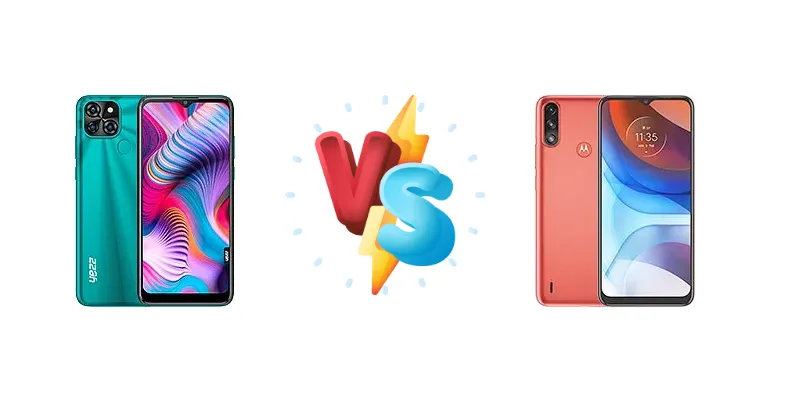
The ultra-budget smartphone segment is fiercely competitive. Both the Yezz Art 3 Lite and Motorola Moto E7i Power aim to deliver essential smartphone functionality at the lowest possible price. However, beneath the similar price points lie significant differences in processing power and overall user experience. This comparison dissects those differences to determine which device offers the best value.
🏆 Quick Verdict
For the average user prioritizing responsiveness and multitasking, the Motorola Moto E7i Power is the clear winner. Its octa-core Unisoc SC9863A chipset provides a substantial performance uplift over the Yezz Art 3 Lite’s quad-core SC9832E, making everyday tasks smoother and more enjoyable. While both offer basic functionality, the E7i Power delivers a more future-proof experience.
| Network |
|---|
| 2G bands | GSM 850 / 900 / 1800 / 1900 | GSM 850 / 900 / 1800 / 1900 |
| 3G bands | HSDPA 850 / 900 / 1900 / 2100 | HSDPA 850 / 900 / 1700(AWS) / 1900 / 2100 |
| 4G bands | 2, 3, 4, 7, 12, 17, 28 | LTE |
| Speed | HSPA, LTE | HSPA, LTE |
| Technology | GSM / HSPA / LTE | GSM / HSPA / LTE |
| Launch |
|---|
| Announced | 2022, June | 2021, February 23 |
| Status | Available. Released 2022, September | Available. Released 2021, March 15 |
| Body |
|---|
| Build | - | Glass front, plastic back, plastic frame |
| Dimensions | 167.9 x 76.8 x 10.5 mm (6.61 x 3.02 x 0.41 in) | 165.1 x 75.9 x 9.2 mm (6.5 x 2.99 x 0.36 in) |
| SIM | Nano-SIM + Nano-SIM | Nano-SIM + Nano-SIM |
| Weight | 154 g (5.43 oz) | 200 g (7.05 oz) |
| | - | Water-repellent design |
| Display |
|---|
| Protection | Panda Glass | - |
| Resolution | 720 x 1600 pixels, 20:9 ratio (~269 ppi density) | 720 x 1600 pixels, 20:9 ratio (~270 ppi density) |
| Size | 6.52 inches, 102.6 cm2 (~79.6% screen-to-body ratio) | 6.51 inches, 102.3 cm2 (~81.7% screen-to-body ratio) |
| Type | IPS LCD | IPS LCD, 380 nits (typ) |
| Platform |
|---|
| CPU | Quad-core 1.4 GHz | Octa-core (4x1.6 GHz Cortex-A55 & 4x1.2 GHz Cortex-A55) |
| Chipset | Unisoc SC9832E (28 nm) | Unisoc SC9863A (28 nm) |
| GPU | Mali-T820 MP1 | IMG8322 |
| OS | Android 11 (Go edition) | Android 10 (Go edition) |
| Memory |
|---|
| Card slot | microSDXC | microSDXC (uses shared SIM slot) |
| Internal | 64GB 2GB RAM | 32GB 2GB RAM |
| | - | eMMC 5.1 |
| Main Camera |
|---|
| Dual | 13 MP, AF
0.3 MP | 13 MP, f/2.0, 26mm (wide), 1/3.1", 1.12µm, PDAF
2 MP (macro) |
| Features | LED flash, HDR, panorama | LED flash, HDR, panorama |
| Video | 1080p@30fps | 1080p@30fps |
| Selfie camera |
|---|
| Features | HDR | HDR |
| Single | 8 MP | 5 MP, f/2.2, 27mm (wide), 1.12µm |
| Video | Yes | 1080p@30fps |
| Sound |
|---|
| 3.5mm jack | Yes | Yes |
| 35mm jack | Yes | Yes |
| Loudspeaker | Yes | Yes |
| Comms |
|---|
| Bluetooth | 4.2, A2DP, LE | 4.2, A2DP |
| NFC | No | No |
| Positioning | GPS | GPS, GLONASS, GALILEO |
| Radio | Stereo FM radio, recording | Unspecified |
| USB | USB Type-C 2.0 | USB Type-C 2.0 |
| WLAN | Wi-Fi 802.11 b/g/n | Wi-Fi 802.11 b/g/n |
| Features |
|---|
| Sensors | Fingerprint (rear-mounted) | Fingerprint (rear-mounted), accelerometer, proximity |
| Battery |
|---|
| Charging | 10W wired, PD | 10W wired |
| Type | Li-Po 5000 mAh | Li-Ion 5000 mAh |
| Misc |
|---|
| Colors | Onyx Black, Majestic Blue, Emerald Green | Tahiti Blue, Coral Red |
| Models | - | XT2097-13 |
| Price | About 120 EUR | About 120 EUR |
Yezz Art 3 Lite
- Potentially lower price point
- Simple and straightforward user experience
- Functional for basic tasks
- Significantly slower processor
- Limited multitasking capabilities
- May struggle with modern app demands
Motorola Moto E7i Power
- Faster octa-core processor
- Improved multitasking performance
- More responsive user experience
- May be slightly more expensive
- 10W charging is slow
- Camera performance is likely basic
Display Comparison
Neither device boasts a standout display. Both utilize panels manufactured for cost-effectiveness, and detailed specifications like resolution and brightness are not provided. However, given the target market, we can assume both are 720p LCDs. The focus here isn't on visual fidelity, but on basic readability. Bezels are likely to be substantial on both devices, maximizing screen real estate within a compact form factor.
Camera Comparison
Camera performance is likely to be similar on both devices, leaning towards basic functionality. Without detailed sensor information, it’s safe to assume both feature a primary camera and potentially a secondary depth or macro sensor. Image processing will be limited, and low-light performance will be subpar. The absence of Optical Image Stabilization (OIS) on either device further limits image quality in challenging conditions. Focusing on the primary sensor resolution would be more informative than speculating on the utility of any secondary sensors.
Performance
The core difference lies in the chipsets. The Motorola Moto E7i Power’s Unisoc SC9863A is an octa-core processor, featuring four Cortex-A55 cores clocked at 1.6 GHz and another four at 1.2 GHz. This configuration allows for more efficient multitasking and handling of demanding applications compared to the Yezz Art 3 Lite’s Unisoc SC9832E, a quad-core 1.4 GHz processor. The E7i Power’s architecture, while still entry-level, provides a significant advantage in CPU-intensive tasks. Both chipsets are fabricated on a 28nm process, indicating similar power efficiency concerns, but the E7i Power’s extra cores will draw more power under load.
Battery Life
Both devices feature 10W wired charging, indicating similar charging speeds. While battery capacity isn't specified, the Motorola Moto E7i Power’s more efficient chipset and octa-core architecture may allow for slightly better battery life despite potentially similar capacity. Expect a full charge to take over two hours on both devices. The 10W charging standard is a limitation for both, but typical for this price bracket.
Buying Guide
Buy the Yezz Art 3 Lite if you need a very basic smartphone for calls, texts, and light app usage, and are extremely price-sensitive. It's a functional device for minimal smartphone needs. Buy the Motorola Moto E7i Power if you prefer a more responsive experience for social media, browsing, and occasional gaming, and value having more processing headroom for future app updates and multitasking. The E7i Power offers a better long-term user experience.
Frequently Asked Questions
❓ Will the Motorola Moto E7i Power struggle with popular apps like Facebook or WhatsApp?
While not a powerhouse, the Moto E7i Power’s octa-core processor should handle Facebook and WhatsApp without significant issues. However, running multiple apps simultaneously or using resource-intensive features within these apps may lead to some slowdown. The Yezz Art 3 Lite would likely struggle more noticeably with these tasks.
❓ Is the 10W charging speed on either phone acceptable for daily use?
10W charging is slow by modern standards, and both phones will take over two hours to fully charge from 0%. This is typical for phones in this price range. It’s best to charge overnight to ensure the phone is ready for the day.
❓ Can the Motorola Moto E7i Power handle light gaming?
The Moto E7i Power can handle very light gaming, such as simple puzzle games or older titles. However, demanding 3D games will likely experience significant frame rate drops and may be unplayable. The Yezz Art 3 Lite would struggle even more with gaming.