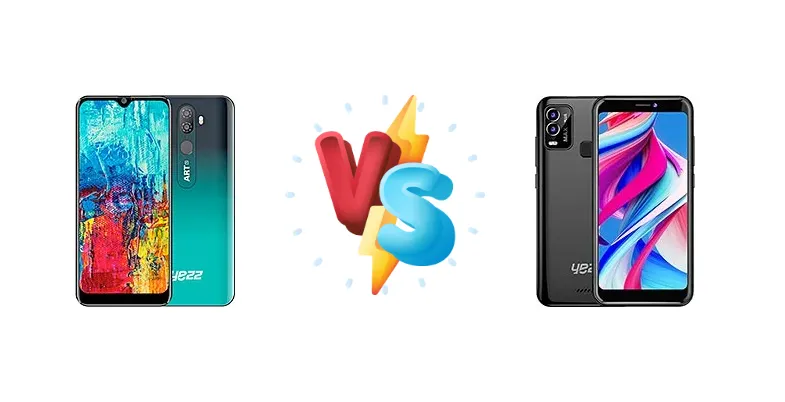
The Yezz Art 1 and Yezz Max 2 Plus represent Yezz’s attempts to capture the ultra-budget smartphone market. While both devices operate within a similar price bracket, they diverge significantly in their core hardware, particularly in their chipsets and charging capabilities. This comparison will dissect these differences to determine which device offers the best experience for users prioritizing performance or convenience.
🏆 Quick Verdict
For the average user, the Yezz Art 1 emerges as the slightly better choice. Its Mediatek MT6739 chipset, clocked at 1.5 GHz, provides a noticeable performance edge over the Yezz Max 2 Plus’s 1.3 GHz Unisoc SC9832E, making it more responsive for everyday tasks. While the Max 2 Plus gains USB Power Delivery, the performance trade-off isn't ideal.
| Network |
|---|
| 2G bands | GSM 850 / 900 / 1800 / 1900 | GSM 850 / 900 / 1800 / 1900 |
| 3G bands | HSDPA 900 / 1900 / 850 | HSDPA 850 / 900 / 1900 / 2100 |
| 4G bands | 2, 3, 4, 7, 12, 17, 28 | 2, 3, 4, 7, 12, 17, 28 |
| Speed | HSPA 21.1/5.76 Mbps, LTE Cat4 150/50 Mbps | HSPA 21.1/5.76 Mbps, LTE Cat4 150/50 Mbps |
| Technology | GSM / HSPA / LTE | GSM / HSPA / LTE |
| Launch |
|---|
| Announced | 2020, March. Released 2020, August | 2021, April. Released 2021, July |
| Status | Discontinued | Discontinued |
| Body |
|---|
| Dimensions | 155.2 x 72.9 x 9.7 mm (6.11 x 2.87 x 0.38 in) | 149.7 x 72.2 x 9.7 mm (5.89 x 2.84 x 0.38 in) |
| SIM | Nano-SIM + Nano-SIM | Nano-SIM + Nano-SIM |
| Weight | 120 g (4.23 oz) | 150 g (5.29 oz) |
| Display |
|---|
| Protection | AGC glass | Asahi Glass |
| Resolution | 720 x 1560 pixels, 19.5:9 ratio (~282 ppi density) | 720 x 1440 pixels, 18:9 ratio (~293 ppi density) |
| Size | 6.1 inches, 91.3 cm2 (~80.7% screen-to-body ratio) | 5.5 inches, 78.1 cm2 (~72.2% screen-to-body ratio) |
| Type | TFT LCD | IPS LCD |
| Platform |
|---|
| CPU | Quad-core 1.5 GHz Cortex-A53 | Quad-core 1.3 GHz |
| Chipset | Mediatek MT6739 (28 nm) | Unisoc SC9832E (28 nm) |
| GPU | Mali-T720MP2 | Mali-T820 MP1 |
| OS | Android 10 | Android 11 |
| Memory |
|---|
| Card slot | microSDXC (dedicated slot) | microSDXC |
| Internal | 32GB 3GB RAM | 32GB 2GB RAM |
| | eMMC 5.1 | eMMC 5.1 |
| Main Camera |
|---|
| Dual | 13 MP, AF
0.3 MP | 13 MP, AF
0.3 MP |
| Features | Dual-LED flash, panorama, HDR | LED flash, HDR, panorama |
| Single | 8 MP, AF | - |
| Video | 1080p@30fps | 1080p@30fps |
| Selfie camera |
|---|
| Single | 8 MP | 8 MP |
| Sound |
|---|
| 3.5mm jack | Yes | Yes |
| 35mm jack | Yes | Yes |
| Loudspeaker | Yes | Yes |
| Comms |
|---|
| Bluetooth | 4.0, A2DP, LE | 4.0, A2DP, LE |
| NFC | No | No |
| Positioning | GPS | GPS |
| Radio | Stereo FM radio | Stereo FM radio, recording |
| USB | microUSB 2.0 | microUSB 2.0 |
| WLAN | Wi-Fi 802.11 b/g/n | Wi-Fi 802.11 b/g/n |
| Features |
|---|
| Sensors | Fingerprint (rear-mounted), accelerometer, gyro, proximity | Fingerprint (rear-mounted), accelerometer |
| Battery |
|---|
| Charging | - | USB Power Delivery |
| Type | Li-Ion 3000 mAh, removable | Li-Ion 2600 mAh, removable |
| Misc |
|---|
| Colors | Green, Blue | Black Panther, Pacific Blue |
| Price | About 110 EUR | About 70 EUR |
| SAR | - | 0.77 W/kg (head) 0.59 W/kg (body) |
Yezz Art 1
- Faster processor for smoother performance
- Likely better multitasking capabilities
- Potentially more responsive user interface
- Uses older micro-USB charging standard
- Lacks USB Power Delivery for faster charging
Yezz Max 2 Plus
- USB Power Delivery for faster and standardized charging
- Convenience of USB-PD ecosystem compatibility
- Potentially better battery management with USB-PD
- Slower processor resulting in reduced performance
- Less responsive user interface
- Potentially lower multitasking performance
Display Comparison
Neither Yezz provides display specifications beyond size, so a detailed comparison is limited. Given the price point, both likely utilize IPS LCD panels. The absence of information regarding resolution, brightness, or color gamut suggests both displays are geared towards basic functionality rather than media consumption. Bezels are likely substantial on both devices, typical for this segment.
Camera Comparison
Without detailed camera specifications, a meaningful comparison is difficult. Both phones likely feature basic camera setups geared towards casual photography. The absence of information regarding sensor size, aperture, or image stabilization suggests image quality will be limited, particularly in low-light conditions. Any mention of megapixel count beyond the primary sensor should be viewed with skepticism, as these are often low-resolution auxiliary cameras.
Performance
The core difference lies in the chipsets. The Yezz Art 1’s Mediatek MT6739, built on a 28nm process, features a quad-core Cortex-A53 CPU clocked at 1.5 GHz. This offers a higher clock speed than the Yezz Max 2 Plus’s Unisoc SC9832E, also on 28nm, which runs at 1.3 GHz. While both are entry-level CPUs, the 200 MHz difference, coupled with potential architectural optimizations within the Mediatek chip, will result in snappier app launches and smoother multitasking on the Art 1. The Unisoc SC9832E is generally considered to be slightly less efficient, potentially impacting battery life under sustained load. Neither chipset is suited for demanding gaming.
Battery Life
Battery capacity is not specified for either device. However, the Yezz Max 2 Plus’s inclusion of USB Power Delivery (USB-PD) is a significant advantage. USB-PD allows for faster and more efficient charging with compatible chargers, and simplifies cable management. The Art 1 likely relies on standard micro-USB charging, which is slower and less versatile. While the Art 1 might have a slightly larger battery, the faster charging speeds of the Max 2 Plus could offset this difference in real-world usage.
Buying Guide
Buy the Yezz Art 1 if you need a phone that feels more responsive for basic tasks like browsing, social media, and messaging. Its faster processor will translate to a smoother user experience. Buy the Yezz Max 2 Plus if you prioritize the convenience of USB Power Delivery for faster and more standardized charging, and are willing to accept a slight performance decrease in return. This is especially relevant if you have a USB-PD charger ecosystem.
Frequently Asked Questions
❓ Will the Yezz Max 2 Plus charge with my existing USB-C charger?
The Yezz Max 2 Plus supports USB Power Delivery, meaning it *should* be compatible with most USB-C chargers that also support the USB-PD standard. However, charging speeds will vary depending on the charger's power output. Ensure your charger supports at least 10W for optimal charging.
❓ Can the Yezz Art 1 handle popular social media apps like Facebook and Instagram?
The Mediatek MT6739 in the Yezz Art 1 is capable of running social media apps like Facebook and Instagram, but performance may be sluggish with multiple apps open simultaneously. Expect some loading times and occasional lag, especially with image and video-heavy content. It's best suited for light social media use.
❓ Is either phone suitable for playing mobile games?
Neither the Yezz Art 1 nor the Yezz Max 2 Plus are well-suited for gaming. Their processors are entry-level and lack the graphical power to run demanding games smoothly. Simple, less graphically intensive games may be playable at low settings, but expect significant frame rate drops and lag.