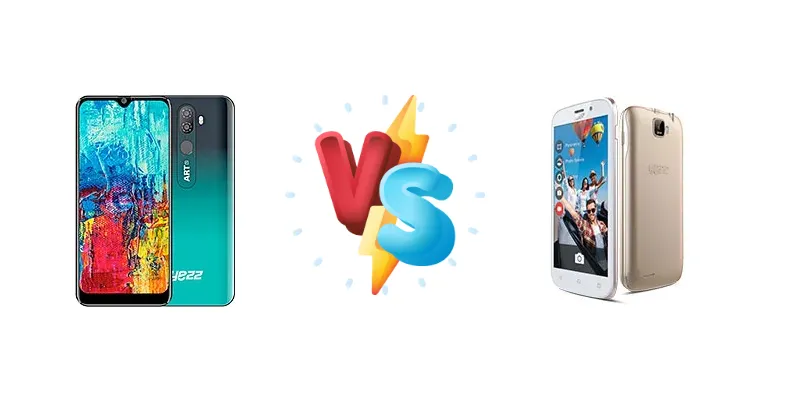
The Yezz Art 1 and Andy 5EI3 (2016) represent Yezz's attempts to capture the ultra-budget smartphone market. While both devices target cost-conscious consumers, they differ significantly in their underlying hardware. This comparison dissects those differences, focusing on the impact of their respective chipsets on everyday performance and usability.
🏆 Quick Verdict
For the average user, the Yezz Art 1 is the better choice. Its Mediatek MT6739 chipset, featuring a quad-core 1.5 GHz Cortex-A53 CPU, offers a noticeable performance advantage over the Andy 5EI3’s MT6580M and 1.3 GHz Cortex-A7 cores, translating to smoother multitasking and app loading times.
| Network |
|---|
| 2G bands | GSM 850 / 900 / 1800 / 1900 | GSM 850 / 900 / 1800 / 1900 - SIM 1 & SIM 2 |
| 3G bands | HSDPA 900 / 1900 / 850 | HSDPA 900 / 2100 - AM5E047 |
| 4G bands | 2, 3, 4, 7, 12, 17, 28 | - |
| Speed | HSPA 21.1/5.76 Mbps, LTE Cat4 150/50 Mbps | HSPA 21.1/5.76 Mbps |
| Technology | GSM / HSPA / LTE | GSM / HSPA |
| Launch |
|---|
| Announced | 2020, March. Released 2020, August | 2016, June. Released 2016, August |
| Status | Discontinued | Discontinued |
| Body |
|---|
| Dimensions | 155.2 x 72.9 x 9.7 mm (6.11 x 2.87 x 0.38 in) | 145.5 x 74.8 x 8.9 mm (5.73 x 2.94 x 0.35 in) |
| SIM | Nano-SIM + Nano-SIM | Dual SIM (Mini-SIM/ Micro-SIM) |
| Weight | 120 g (4.23 oz) | 153 g (5.40 oz) |
| Display |
|---|
| Protection | AGC glass | - |
| Resolution | 720 x 1560 pixels, 19.5:9 ratio (~282 ppi density) | 480 x 854 pixels, 16:9 ratio (~196 ppi density) |
| Size | 6.1 inches, 91.3 cm2 (~80.7% screen-to-body ratio) | 5.0 inches, 68.9 cm2 (~63.3% screen-to-body ratio) |
| Type | TFT LCD | TFT |
| Platform |
|---|
| CPU | Quad-core 1.5 GHz Cortex-A53 | Quad-core 1.3 GHz Cortex-A7 |
| Chipset | Mediatek MT6739 (28 nm) | Mediatek MT6580M (28 nm) |
| GPU | Mali-T720MP2 | Mali-400MP2 |
| OS | Android 10 | Android 6.0 (Marshmallow) |
| Memory |
|---|
| Card slot | microSDXC (dedicated slot) | microSDXC (dedicated slot) |
| Internal | 32GB 3GB RAM | 8GB 512MB RAM |
| | eMMC 5.1 | - |
| Main Camera |
|---|
| Dual | 13 MP, AF
0.3 MP | - |
| Features | Dual-LED flash, panorama, HDR | LED flash, panorama |
| Single | 8 MP, AF | 5 MP |
| Video | 1080p@30fps | 720p@30fps |
| Selfie camera |
|---|
| Single | 8 MP | 2 MP |
| Sound |
|---|
| 3.5mm jack | Yes | Yes |
| 35mm jack | Yes | Yes |
| Loudspeaker | Yes | Yes |
| Comms |
|---|
| Bluetooth | 4.0, A2DP, LE | 4.0, LE |
| NFC | No | No |
| Positioning | GPS | GPS |
| Radio | Stereo FM radio | Stereo FM radio |
| USB | microUSB 2.0 | microUSB 2.0 |
| WLAN | Wi-Fi 802.11 b/g/n | Wi-Fi 802.11 a/b/g/n, Wi-Fi Direct |
| Features |
|---|
| Sensors | Fingerprint (rear-mounted), accelerometer, gyro, proximity | Accelerometer |
| Battery |
|---|
| Stand-by | - | Up to 333 h (3G) |
| Talk time | - | Up to 8 h (3G) |
| Type | Li-Ion 3000 mAh, removable | Li-Ion 2000 mAh battery |
| Misc |
|---|
| Colors | Green, Blue | Black, Blue, Red, Gun Metal, White, Silver, Pink |
| Price | About 110 EUR | - |
Yezz Art 1
- More powerful CPU (Cortex-A53)
- Newer chipset architecture
- Potentially smoother multitasking
- Limited detailed specifications available
- Likely basic camera performance
Yezz Andy 5EI3 (2016)
- Lower price point (likely)
- Simple and straightforward operation
- Acceptable for very basic tasks
- Slower CPU (Cortex-A7)
- Older chipset architecture
- Noticeably slower app loading times
Display Comparison
Neither Yezz provides detailed display specifications. Given their market positioning, both likely utilize LCD panels with resolutions around 480x854 or similar. The absence of information regarding brightness, color accuracy, or panel technology suggests a focus on cost reduction. Expect basic viewing experiences on both devices, with limited outdoor visibility.
Camera Comparison
Detailed camera specifications are unavailable for either device. However, based on the typical configurations of phones in this price range, expect basic 5MP or 8MP primary cameras. Image quality will likely be subpar, especially in low-light conditions. Any differences in camera performance will likely be attributable to software processing rather than hardware capabilities. The presence of a 2MP macro camera on either device is largely a marketing gimmick and offers minimal practical benefit.
Performance
The core difference lies in the chipsets. The Yezz Art 1’s Mediatek MT6739, built on a 28nm process, utilizes a quad-core 1.5 GHz Cortex-A53 CPU. This architecture, while still entry-level, is a generation newer and clocked higher than the Andy 5EI3’s MT6580M with its 1.3 GHz Cortex-A7 cores. The Cortex-A53 offers improved performance per clock cycle compared to the A7, meaning the Art 1 will handle multitasking and app launches more efficiently. While both are 28nm, the A53's architecture provides a tangible benefit. The GPU within the MT6739 will also offer a slightly better graphical experience, though neither phone is designed for demanding games.
Battery Life
Battery capacity information is missing for both devices. Given their similar form factors and target market, they likely house batteries in the 2000-2500 mAh range. Charging wattage is also unknown, but likely falls within the 5W-10W range. Real-world battery life will depend heavily on usage patterns, but expect to need daily charging with moderate use. The slightly more efficient MT6739 in the Art 1 *may* translate to marginally better battery life, but the difference will likely be minimal.
Buying Guide
Buy the Yezz Art 1 if you prioritize responsiveness and a slightly more modern user experience, even within the budget segment. It’s suitable for users who need a phone for basic tasks like calling, texting, social media, and light web browsing. Buy the Yezz Andy 5EI3 (2016) if you are looking for the absolute cheapest possible option and are willing to accept slower performance and potentially longer app loading times. It's best suited for minimal smartphone usage.
Frequently Asked Questions
❓ Will the Yezz Art 1 handle popular social media apps like Facebook and WhatsApp smoothly?
Yes, the Mediatek MT6739 chipset in the Yezz Art 1 should provide a reasonably smooth experience with social media apps like Facebook and WhatsApp. While not a powerhouse, the Cortex-A53 cores are sufficient for these everyday tasks. Expect some slowdown with multiple apps open simultaneously.
❓ Is the Yezz Andy 5EI3 (2016) suitable for playing mobile games?
The Yezz Andy 5EI3 (2016) is not well-suited for playing mobile games. The older MT6580M chipset and Cortex-A7 cores will struggle with even less demanding titles. Expect low frame rates, lag, and a generally poor gaming experience. It's best to stick to basic apps and communication on this device.
❓ Can I expect software updates on either of these phones?
Software update support is highly unlikely for both the Yezz Art 1 and the Yezz Andy 5EI3 (2016). Yezz, like many budget brands, typically provides limited or no long-term software support for its devices. Expect to be stuck with the original Android version that came pre-installed.