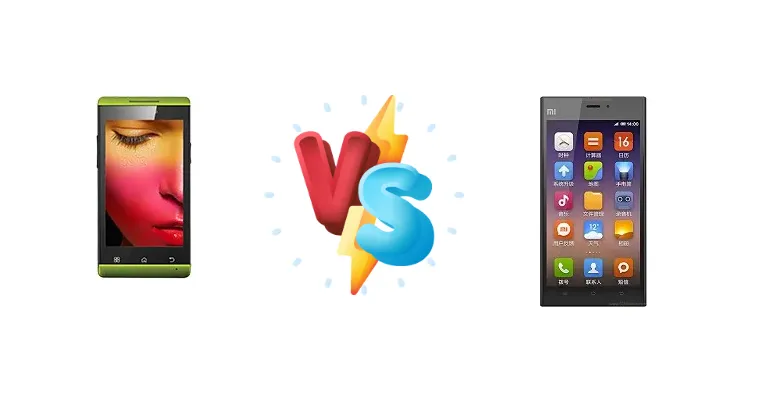
The XOLO Q500s IPS and Xiaomi Mi 3 were popular budget contenders in their time. Both offered compelling features for their price, but significant differences exist. This comparison dives deep into their specs and performance to help you understand which phone was the better choice.
🏆 Quick Verdict
The Xiaomi Mi 3 decisively wins this comparison. Its Snapdragon 800 chipset provides significantly better performance, while its impressive battery life and excellent sunlight display contrast give it a clear edge over the XOLO Q500s IPS, despite both being budget options.
| Network |
|---|
| 2G bands | GSM 900 / 1800 - SIM 1 & SIM 2 | GSM 850 / 900 / 1800 / 1900 |
| 3G bands | HSDPA 2100 | HSDPA 850 / 900 / 1900 / 2100 |
| Speed | HSPA 21.1/5.76 Mbps | HSPA 42.2/5.76 Mbps |
| Technology | GSM / HSPA | GSM / HSPA |
| Launch |
|---|
| Announced | 2014, July. Released 2014, July | 2013, September. Released 2013, December |
| Status | Discontinued | Discontinued |
| Body |
|---|
| Build | - | Glass front (Gorilla Glass 3), plastic back, plastic frame |
| Dimensions | 125 x 63.2 x 9 mm (4.92 x 2.49 x 0.35 in) | 144 x 73.6 x 8.1 mm (5.67 x 2.90 x 0.32 in) |
| SIM | Dual SIM | Mini-SIM |
| Weight | - | 145 g (5.11 oz) |
| Display |
|---|
| Protection | - | Corning Gorilla Glass 3 |
| Resolution | 480 x 800 pixels, 5:3 ratio (~233 ppi density) | 1080 x 1920 pixels, 16:9 ratio (~441 ppi density) |
| Size | 4.0 inches, 45.5 cm2 (~57.6% screen-to-body ratio) | 5.0 inches, 68.9 cm2 (~65.0% screen-to-body ratio) |
| Type | IPS LCD | IPS LCD |
| Platform |
|---|
| CPU | Quad-core 1.3 GHz Cortex-A7 | Quad-core 2.3 GHz Krait 400 |
| Chipset | Mediatek MT6582M (28 nm) | Qualcomm MSM8274AB Snapdragon 800 (28 nm) |
| GPU | Mali-400MP2 | Adreno 330 |
| OS | Android 4.4.2 (KitKat) | Android 4.3 (Jelly Bean), upgradable to 6.0 (Marshmallow), MIUI 5 |
| Memory |
|---|
| Card slot | microSDHC | No |
| Internal | 4GB 512MB RAM | 16GB 2GB RAM, 64GB 2GB RAM |
| | - | eMMC 4.5 |
| Main Camera |
|---|
| Features | LED flash, panorama, HDR | Dual-LED flash, HDR |
| Single | 5 MP | 13 MP, f/2.2, 28mm (wide), AF |
| Video | 1080p@30fps | 1080p@30fps, HDR |
| Selfie camera |
|---|
| Single | VGA | 2 MP, f/2.2 |
| Video | - | 1080p@30fps |
| Sound |
|---|
| 3.5mm jack | Yes | Yes |
| 35mm jack | Yes | Yes |
| Loudspeaker | Yes | Yes |
| Comms |
|---|
| Bluetooth | 3.0 | 4.0, A2DP |
| NFC | No | Yes |
| Positioning | GPS | GPS, GLONASS |
| Radio | No | FM radio |
| USB | microUSB 2.0 | microUSB 2.0, OTG |
| WLAN | Wi-Fi 802.11 b/g/n, hotspot | Wi-Fi 802.11 a/b/g/n, dual-band, Wi-Fi Direct, hotspot |
| Features |
|---|
| Sensors | Accelerometer, proximity | Accelerometer, gyro, proximity, compass, barometer |
| Battery |
|---|
| Charging | - | 18W wired, QC2 |
| Music play | - | Up to 50 h |
| Stand-by | Up to 700 h (2G) / Up to 383 h (3G) | Up to 500 h |
| Talk time | Up to 16 h (2G) / Up to 7 h 40 min (3G) | Up to 25 h |
| Type | Li-Ion 1500 mAh, removable | Li-Ion 3050 mAh, non-removable |
| Misc |
|---|
| Colors | Black, White | White, Gray, Black, Yellow, Pink, Blue, Gold, Green |
| Price | - | About 200 EUR |
| SAR EU | 0.78 W/kg (head) 0.49 W/kg (body) | - |
| Tests |
|---|
| Audio quality | - |
Noise -91.5dB / Crosstalk -44.2dB |
| Battery life | - | Endurance rating 66h |
| Camera | - |
Photo / Video |
| Display | - |
Contrast ratio: 907 (nominal), 2.001 (sunlight) |
| Loudspeaker | - |
Voice 69dB / Noise 66dB / Ring 75dB |
XOLO Q500s IPS
- Potentially lower price (used)
- IPS Display
- Compact Size (likely)
- Weaker Processor
- Lower Performance
- Unknown Battery Life
- Limited Availability
- Likely Inferior Camera
Xiaomi Mi 3
- Powerful Snapdragon 800 Chipset
- Excellent Battery Life (66h Endurance)
- Superior Display Contrast
- QC2 Charging
- Better Performance
- Older Device
- Limited Software Updates (likely)
- Availability (may be difficult to find new)
Display Comparison
Both phones feature IPS displays, offering decent viewing angles. The Xiaomi Mi 3 boasts a remarkable contrast ratio of 907 (nominal) and 2.001 in sunlight, indicating excellent visibility even outdoors. The XOLO Q500s IPS likely had a lower contrast ratio, though specific figures are hard to find. The Mi 3's display is noticeably superior.
Camera Comparison
Camera quality was generally decent for both phones given their price range. The Xiaomi Mi 3 likely offered slightly better image quality due to its more advanced processor and potentially better image processing algorithms. Both phones featured Photo/Video capabilities, but detailed camera specs are scarce for the XOLO Q500s IPS.
Performance
This is where the Xiaomi Mi 3 truly shines. Its Qualcomm Snapdragon 800 chipset with a 2.3 GHz Krait 400 quad-core CPU is significantly more powerful than the XOLO Q500s IPS's Mediatek MT6582M with a 1.3 GHz Cortex-A7 quad-core CPU. Expect smoother multitasking, faster app loading, and better gaming performance on the Mi 3.
Battery Life
The Xiaomi Mi 3's endurance rating of 66 hours is exceptional for its time and a significant advantage over the XOLO Q500s IPS. While the XOLO's battery capacity is unknown, the Mi 3's superior power efficiency and larger battery likely contributed to its impressive battery life.
Buying Guide
The XOLO Q500s IPS might appeal to users prioritizing a simple, basic smartphone experience and a potentially lower price point (if found used). The Xiaomi Mi 3 is ideal for users who value performance, battery life, and a superior display, even if it's an older device.
Frequently Asked Questions
❓ Is the XOLO Q500s IPS still worth buying?
Unless you're on an extremely tight budget and can find it for very cheap, the Xiaomi Mi 3 is a better choice due to its superior performance and battery life. The XOLO is quite dated now.
❓ Where can I find a Xiaomi Mi 3?
Finding a new Xiaomi Mi 3 is unlikely. You'll likely need to search on used marketplaces like eBay or local classifieds. Be sure to check the device's condition carefully.