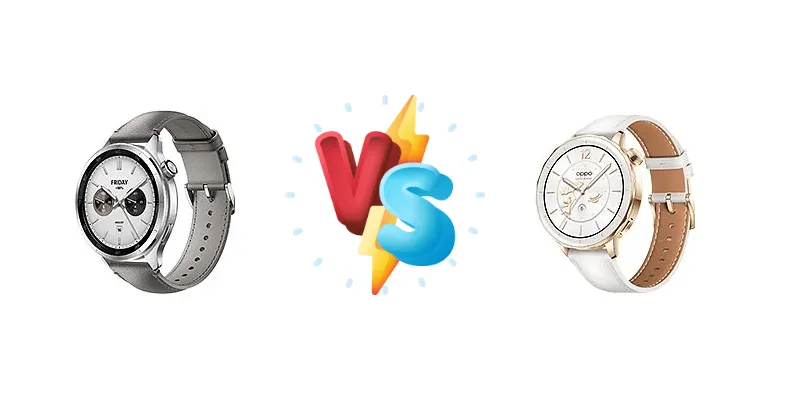
The smartwatch market is flooded with options, but finding a balance between features and affordability can be challenging. We pit the Xiaomi Watch S4 against the Oppo Watch X2 Mini, two contenders aiming to deliver a compelling experience without breaking the bank. This comparison focuses on how the X2 Mini’s newer chipset impacts real-world performance and battery life compared to the S4.
🏆 Quick Verdict
For most users, the Oppo Watch X2 Mini is the superior choice. Its Qualcomm Snapdragon W5 Gen 1 chipset provides a noticeably smoother and more responsive experience, justifying the likely price premium. However, the Xiaomi Watch S4 remains a viable option for those prioritizing extreme budget constraints.
| Network |
|---|
| 2G bands | GSM 850 / 900 / 1800 / 1900 | N/A |
| 3G bands | HSDPA | N/A |
| 4G bands | LTE | LTE - cellular model only |
| EDGE | No | No |
| GPRS | No | No |
| Speed | HSPA, LTE | - |
| Technology | GSM / HSPA / LTE | LTE |
| Launch |
|---|
| Announced | 2024, October 29 | 2025, April 10 |
| Status | Available. Released 2024, October 29 | Available. Released 2025, April 10 |
| Body |
|---|
| Build | Aluminum alloy frame, stainless steel bezel | Stainless steel frame or 18K gold plated frame, plastic back |
| Dimensions | 47.3 x 47.3 x 12 mm (1.86 x 1.86 x 0.47 in) | 43.2 x 43.2 x 11 mm (1.70 x 1.70 x 0.43 in) |
| SIM | eSIM (market/region dependent) | eSIM - cellular model only |
| Weight | 44.5 g (1.59 oz) | 37.8 g (1.34 oz) |
| Display |
|---|
| Protection | Scratch/drop-proof glass | - |
| Resolution | 466 x 466 pixels (~326 ppi density) | 466 x 466 pixels (~352 ppi density) |
| Size | 1.43 inches | 1.32 inches |
| Type | AMOLED, 1500 nits (HBM), 2200 nits (peak) | AMOLED, 1000 nits (peak) |
| Platform |
|---|
| Chipset | - | Qualcomm Snapdragon W5 Gen 1 (4 nm) |
| OS | HyperOS 2 | ColorOS Watch 7.0 + Wear OS 5.0 |
| Memory |
|---|
| Card slot | No | No |
| Internal | - | 32GB 2GB RAM |
| Sound |
|---|
| 35mm jack | No | No |
| Loudspeaker | Yes | Yes |
| Comms |
|---|
| Bluetooth | 5.3, A2DP, LE | 5.2, A2DP, LE |
| NFC | Yes (market/region dependent) | Yes |
| Positioning | GPS (L1+L5), GLONASS, GALILEO, BDS, QZSS | GPS, GLONASS, GALILEO, BDS, QZSS |
| Radio | No | No |
| USB | No | No |
| WLAN | No | Wi-Fi 802.11 a/b/g/n, dual-band |
| Features |
|---|
| Sensors | Accelerometer, gyro, compass, barometer, heart rate, SpO2 | Accelerometer, gyro, barometer, compass, heart rate, SpO2 |
| Battery |
|---|
| Type | Li-Po 486 mAh | Li-Ion 354 mAh |
| Misc |
|---|
| Colors | Black, Silver, Rainbow | Black, Silver, Gold |
| Models | M2424W1, M2425W1 | - |
| Price | About 130 EUR | About 220 EUR |
Xiaomi Watch S4
- Likely the most affordable option
- Functional smartwatch features for basic use
- Potentially longer battery life due to less powerful chipset (speculation)
- Significantly slower performance
- Outdated chipset architecture
- Limited future software support
Oppo Watch X2 Mini
- Superior performance with Snapdragon W5 Gen 1
- Improved power efficiency
- Smoother user interface and faster app loading
- Likely more expensive
- Potentially shorter battery life under heavy use (though mitigated by efficiency)
- May have limited storage space
Display Comparison
Specific display details for the Xiaomi Watch S4 are unavailable. However, given its market positioning, it likely utilizes an AMOLED panel with a resolution around 360x360 pixels. The Oppo Watch X2 Mini features a 1.75-inch AMOLED display. The key differentiator is the underlying processing power driving the display; the Snapdragon W5 Gen 1 in the X2 Mini will likely result in smoother animations and faster response times when interacting with the interface. Without knowing the S4’s peak brightness, it’s difficult to assess outdoor visibility, but the X2 Mini’s panel is expected to deliver adequate brightness for most conditions.
Camera Comparison
Neither device is marketed for its camera capabilities, and detailed camera specs are unavailable for either. Smartwatches generally offer limited camera functionality, primarily for quick scans or remote control features. Therefore, this section is largely irrelevant to the core comparison.
Performance
The Oppo Watch X2 Mini’s Qualcomm Snapdragon W5 Gen 1 (4nm) chipset is the defining advantage in this comparison. The 4nm process node offers significantly improved power efficiency and performance compared to the likely older, less efficient chipset found in the Xiaomi Watch S4. This translates to faster app launches, smoother multitasking, and a more responsive user experience overall. While RAM specifications are unknown for both devices, the Snapdragon W5 Gen 1’s architecture is optimized for wearable devices, providing a substantial performance boost. The S4 will likely struggle with more demanding tasks or complex watch faces.
Battery Life
Battery capacity for both devices is currently unknown. However, the Oppo Watch X2 Mini’s Snapdragon W5 Gen 1 chipset, built on a 4nm process, is inherently more power-efficient. This suggests the X2 Mini will likely achieve longer battery life despite potentially having a similar or even smaller battery capacity compared to the Xiaomi Watch S4. The efficiency gains from the 4nm node will be particularly noticeable during active use, such as GPS tracking or continuous heart rate monitoring. Charging speeds are also unknown, but the X2 Mini’s chipset may support faster charging protocols.
Buying Guide
Buy the Xiaomi Watch S4 if you need a functional smartwatch at the absolute lowest possible price and aren't concerned with cutting-edge performance. It's ideal for basic notifications and step tracking. Buy the Oppo Watch X2 Mini if you prioritize a fluid user interface, faster app loading times, and a more future-proof platform thanks to the Snapdragon W5 Gen 1, even if it means spending a bit more.
Frequently Asked Questions
❓ Will the Snapdragon W5 Gen 1 in the Oppo Watch X2 Mini provide a noticeable performance improvement over older smartwatches?
Yes, the Snapdragon W5 Gen 1 is a significant upgrade. Its 4nm process and optimized architecture deliver faster app launches, smoother animations, and a more responsive user interface. Users coming from older smartwatches will immediately notice the difference, especially when multitasking or using more demanding apps.
❓ How does the power efficiency of the Snapdragon W5 Gen 1 impact real-world battery life on the Oppo Watch X2 Mini?
The 4nm process node of the Snapdragon W5 Gen 1 dramatically improves power efficiency. This means the X2 Mini can deliver comparable or even better battery life than the Xiaomi Watch S4, even if the battery capacity is similar. You'll see the biggest gains during active use, such as GPS tracking or continuous heart rate monitoring.
❓ Is the Xiaomi Watch S4 still a good option if I only need basic smartwatch functionality?
If your needs are limited to basic notifications, step tracking, and timekeeping, the Xiaomi Watch S4 is a functional and affordable option. However, be prepared for a slower and less responsive experience compared to the Oppo Watch X2 Mini.