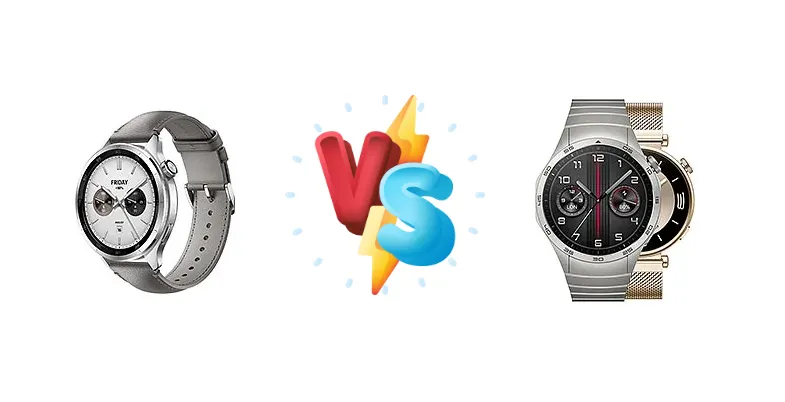
The smartwatch market is increasingly competitive, with Xiaomi and Huawei offering compelling options at various price points. The Xiaomi Watch S4 aims to deliver a stylish and feature-rich experience, while the Huawei Watch GT 4 focuses on extended battery life and a refined design. This comparison dives deep into their strengths and weaknesses to determine which smartwatch best suits your needs.
🏆 Quick Verdict
For the average user prioritizing battery life and a premium aesthetic, the Huawei Watch GT 4 emerges as the stronger contender. Its wireless charging and likely more mature software experience (given Huawei's smartwatch history) provide a smoother overall experience. However, the Xiaomi Watch S4 may appeal to those deeply invested in the Xiaomi ecosystem.
| Network |
|---|
| 2G bands | GSM 850 / 900 / 1800 / 1900 | N/A |
| 3G bands | HSDPA | N/A |
| 4G bands | LTE | N/A |
| EDGE | No | No |
| GPRS | No | No |
| Speed | HSPA, LTE | No |
| Technology | GSM / HSPA / LTE | No cellular connectivity |
| Launch |
|---|
| Announced | 2024, October 29 | 2023, September 14 |
| Status | Available. Released 2024, October 29 | Available. Released 2023, October 02 |
| Body |
|---|
| Build | Aluminum alloy frame, stainless steel bezel | Glass front, plastic back, stainless steel frame |
| Dimensions | 47.3 x 47.3 x 12 mm (1.86 x 1.86 x 0.47 in) | 46 x 46 x 10.9 mm (1.81 x 1.81 x 0.43 in) |
| SIM | eSIM (market/region dependent) | No |
| Weight | 44.5 g (1.59 oz) | 37 g (41mm) / 48 g (46mm) (1.31 oz) |
| Display |
|---|
| Protection | Scratch/drop-proof glass | - |
| Resolution | 466 x 466 pixels (~326 ppi density) | 466 x 466 pixels (~326 ppi density) |
| Size | 1.43 inches | 1.43 inches |
| Type | AMOLED, 1500 nits (HBM), 2200 nits (peak) | AMOLED |
| Platform |
|---|
| OS | HyperOS 2 | HarmonyOS 4.0 |
| Memory |
|---|
| Card slot | No | No |
| Internal | - | Unspecified |
| Sound |
|---|
| 35mm jack | No | No |
| Loudspeaker | Yes | Yes |
| Comms |
|---|
| Bluetooth | 5.3, A2DP, LE | 5.2, A2DP, LE |
| NFC | Yes (market/region dependent) | Yes |
| Positioning | GPS (L1+L5), GLONASS, GALILEO, BDS, QZSS | GPS (L1+L5), GLONASS, BDS, GALILEO, QZSS |
| Radio | No | No |
| USB | No | No |
| WLAN | No | No |
| Features |
|---|
| Sensors | Accelerometer, gyro, compass, barometer, heart rate, SpO2 | Accelerometer, gyro, heart rate, barometer, compass, SpO2, thermometer (body temperature) |
| Battery |
|---|
| Charging | - | Wireless |
| Type | Li-Po 486 mAh | Li-Ion 524 mAh |
| Misc |
|---|
| Colors | Black, Silver, Rainbow | Black, Steel, Silver, Gold |
| Models | M2424W1, M2425W1 | ARA-B19, PNX-B19 |
| Price | About 130 EUR | About 270 EUR |
Xiaomi Watch S4
- Likely more affordable price point
- Potential for deeper Xiaomi ecosystem integration
- Stylish design (assumed)
- Lack of specific specs hinders detailed comparison
- No wireless charging
- Potentially less refined software experience
Huawei Watch GT 4
- Wireless charging for added convenience
- Likely longer battery life based on GT series history
- Mature HarmonyOS smartwatch platform
- Potentially higher price point
- HarmonyOS may not appeal to all users
- Limited app ecosystem compared to Wear OS
Display Comparison
Given the lack of specific display specs for the Xiaomi Watch S4, we can infer it likely utilizes an AMOLED panel, common in this price segment. The Huawei Watch GT 4, while not specifying display technology, benefits from Huawei’s experience in smartwatch displays. The GT 4’s design suggests a focus on maximizing screen real estate, potentially offering a slightly larger viewing area. The presence of wireless charging on the GT 4 implies a more premium build quality, potentially extending to a more durable display glass. Color accuracy and brightness will be key differentiators, but without specific data, it’s difficult to assess which device excels.
Camera Comparison
Neither device is expected to feature a camera, a trend in modern smartwatches. Focusing on core smartwatch functionality allows for smaller form factors and improved battery life. The absence of a camera simplifies the design and reduces potential points of failure.
Performance
Without chipset details for the Xiaomi Watch S4, it’s reasonable to assume it employs a low-power processor optimized for smartwatch functions. Huawei, with the GT 4, likely leverages its Kirin chipset expertise, potentially offering a more responsive user interface and smoother animations. The GT 4’s HarmonyOS, while not Android Wear OS, is a mature smartwatch operating system. RAM capacity is unknown for both devices, but sufficient RAM is crucial for handling notifications and background apps. Thermal management is unlikely to be a significant concern for either device, given their intended use cases.
Battery Life
The Huawei Watch GT 4’s standout feature is its emphasis on battery life, a hallmark of the GT series. The inclusion of wireless charging adds convenience, allowing users to top up the battery without cables. While the mAh capacity of the GT 4 is unspecified, Huawei’s history suggests a battery exceeding 400mAh. The Xiaomi Watch S4’s battery life is unknown, but it likely prioritizes a balance between features and longevity. Wireless charging is absent, suggesting a more cost-conscious design. The GT 4’s wireless charging capability will appeal to users who prefer a clutter-free charging experience.
Buying Guide
Buy the Xiaomi Watch S4 if you are already heavily invested in the Xiaomi ecosystem and value seamless integration with other Xiaomi devices. Its likely lower price point will also be attractive. Buy the Huawei Watch GT 4 if you prioritize long battery life, a sophisticated design, and the convenience of wireless charging. The GT 4 is ideal for users who want a smartwatch that can last for days on a single charge and offers a more polished user experience.
Frequently Asked Questions
❓ Does the Huawei Watch GT 4 support third-party app installations like Wear OS?
No, the Huawei Watch GT 4 runs on HarmonyOS, which has a limited app ecosystem compared to Wear OS. While it offers essential smartwatch features and integrates with Huawei’s app gallery, you won’t find the same breadth of third-party apps available on Google’s platform.
❓ How does the wireless charging on the Huawei Watch GT 4 compare to traditional charging in terms of speed?
Wireless charging on the GT 4 is likely to be slightly slower than traditional wired charging. However, the convenience of simply placing the watch on a charging pad outweighs the minor speed difference for many users. Huawei likely optimizes the wireless charging profile to minimize heat and maximize battery health.
❓ Is the Xiaomi Watch S4 compatible with iPhones?
Compatibility with iPhones is likely limited. While basic notification mirroring may be possible, full feature parity and access to all smartwatch functions are typically reserved for Android devices within the Xiaomi ecosystem.
❓ What health tracking features are expected on the Huawei Watch GT 4?
The Huawei Watch GT 4 is expected to offer comprehensive health tracking features, including heart rate monitoring, SpO2 (blood oxygen) measurement, sleep tracking, and stress monitoring. Huawei often incorporates advanced algorithms for accurate data analysis and personalized insights.