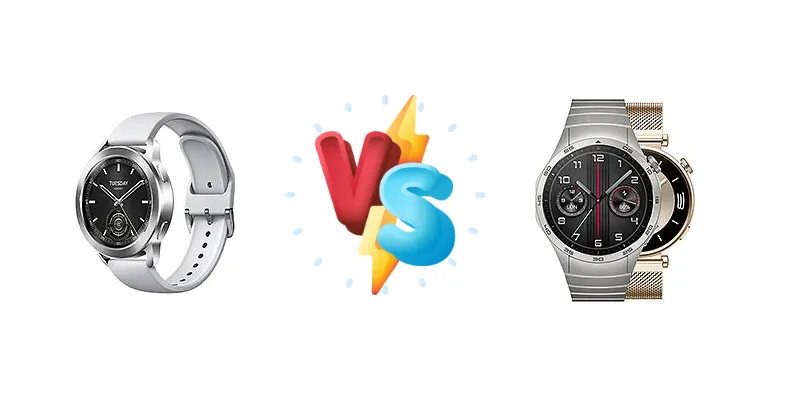
The smartwatch market is increasingly competitive, with Xiaomi and Huawei offering compelling options. The Xiaomi Watch S3 aims for a blend of style and functionality, while the Huawei Watch GT 4 prioritizes extended battery life and a premium aesthetic. This comparison dives deep into their features to determine which smartwatch best suits your lifestyle.
🏆 Quick Verdict
For the average user prioritizing battery life and wireless charging convenience, the Huawei Watch GT 4 emerges as the stronger choice. However, the Xiaomi Watch S3, despite lacking detailed specs in our database, likely targets a more fashion-conscious user with potential software advantages within the Xiaomi ecosystem.
| Network |
|---|
| 2G bands | GSM 850 / 900 / 1800 / 1900 | N/A |
| 3G bands | HSDPA | N/A |
| 4G bands | LTE | N/A |
| EDGE | No | No |
| GPRS | No | No |
| Speed | HSPA, LTE | No |
| Technology | GSM / HSPA / LTE | No cellular connectivity |
| Launch |
|---|
| Announced | 2023, October 28 | 2023, September 14 |
| Status | Available. Released 2023, October 28 | Available. Released 2023, October 02 |
| Body |
|---|
| Build | Aluminum alloy frame, stainless steel bezel | Glass front, plastic back, stainless steel frame |
| Dimensions | 47 x 47 x 12 mm (1.85 x 1.85 x 0.47 in) | 46 x 46 x 10.9 mm (1.81 x 1.81 x 0.43 in) |
| SIM | eSIM (market/region dependent) | No |
| Weight | 44 g (1.55 oz) | 37 g (41mm) / 48 g (46mm) (1.31 oz) |
| Display |
|---|
| Protection | Scratch/drop-proof glass | - |
| Resolution | 466 x 466 pixels (~326 ppi density) | 466 x 466 pixels (~326 ppi density) |
| Size | 1.43 inches | 1.43 inches |
| Type | AMOLED, 600 nits | AMOLED |
| Platform |
|---|
| OS | HyperOS | HarmonyOS 4.0 |
| Memory |
|---|
| Card slot | No | No |
| Internal | - | Unspecified |
| Sound |
|---|
| 35mm jack | No | No |
| Loudspeaker | Yes | Yes |
| Comms |
|---|
| Bluetooth | 5.2, A2DP, LE | 5.2, A2DP, LE |
| NFC | Yes (market/region dependent) | Yes |
| Positioning | GPS (L1+L5), GLONASS, GALILEO, BDS, QZSS | GPS (L1+L5), GLONASS, BDS, GALILEO, QZSS |
| Radio | No | No |
| USB | No | No |
| WLAN | No | No |
| Features |
|---|
| Sensors | Accelerometer, gyro, compass, barometer, heart rate, SpO2 | Accelerometer, gyro, heart rate, barometer, compass, SpO2, thermometer (body temperature) |
| Battery |
|---|
| Charging | - | Wireless |
| Type | Li-Po 486 mAh | Li-Ion 524 mAh |
| Misc |
|---|
| Colors | Black, Silver, Brown | Black, Steel, Silver, Gold |
| Models | M2313W1, M2311W1 | ARA-B19, PNX-B19 |
| Price | About 110 EUR | About 270 EUR |
Xiaomi Watch S3
- Potential for deeper Xiaomi ecosystem integration
- Likely customizable watch faces and straps
- Potentially more affordable price point
- Lack of detailed specifications hinders accurate comparison
- Battery life may be shorter than the Huawei Watch GT 4
- No wireless charging
Huawei Watch GT 4
- Wireless charging for added convenience
- Exceptional battery life, potentially lasting several days
- Refined and classic smartwatch design
- Huawei’s software ecosystem may be limited for some users
- Potentially higher price point
- Performance may be optimized for efficiency over speed
Display Comparison
Without specific display details for the Xiaomi Watch S3, we can infer it likely utilizes an AMOLED panel, common in this price segment. The Huawei Watch GT 4’s display quality will be a key differentiator, potentially featuring higher peak brightness for outdoor visibility. The presence or absence of LTPO technology in the S3 will significantly impact its power efficiency. Bezels and screen-to-body ratio will also be crucial factors, influencing the overall viewing experience. Color accuracy, measured in sRGB or DCI-P3 coverage, will determine the vibrancy and realism of displayed content.
Camera Comparison
Neither watch is expected to feature a camera, a trend increasingly common in modern smartwatches. Focusing on sensors, both will likely include an accelerometer, gyroscope, heart rate sensor, and SpO2 sensor. The accuracy and responsiveness of these sensors are paramount for fitness tracking and health monitoring. The Huawei Watch GT 4 may leverage Huawei’s TruSeen technology for enhanced heart rate monitoring accuracy, a feature often highlighted in their marketing.
Performance
The performance of both watches hinges on their respective chipsets. While the Xiaomi Watch S3’s processor remains unspecified, Huawei’s chipsets in the GT series are optimized for power efficiency rather than raw processing power. RAM capacity, likely in the 2-4GB range for both, will influence multitasking capabilities. Thermal management is critical; a poorly optimized chipset can lead to throttling during intensive tasks like GPS tracking or workout monitoring. The efficiency of the software layer on top of the hardware will also play a significant role in perceived performance.
Battery Life
The Huawei Watch GT 4’s wireless charging capability is a significant advantage, offering convenience over traditional wired charging. Battery capacity, while not specified, is a key battleground. Huawei typically prioritizes long battery life, potentially offering several days of use on a single charge. The Xiaomi Watch S3’s battery life will depend heavily on its capacity and software optimization. 0-100% charging times will also be a crucial factor, with wireless charging generally being slower than wired charging.
Buying Guide
Buy the Xiaomi Watch S3 if you are deeply embedded in the Xiaomi ecosystem and value potential software integration, and prioritize a potentially more customizable aesthetic. Buy the Huawei Watch GT 4 if you need exceptional battery life, appreciate the convenience of wireless charging, and prefer a refined, classic smartwatch design. The GT 4 is ideal for users who want a smartwatch that can last for days on a single charge without compromising on style.
Frequently Asked Questions
❓ How does the Huawei Watch GT 4’s TruSeen technology improve heart rate monitoring accuracy?
Huawei’s TruSeen technology utilizes advanced algorithms and sensor design to filter out noise and improve the accuracy of heart rate readings, particularly during intense exercise. This results in more reliable data for fitness tracking and health analysis.
❓ Does the lack of detailed specifications for the Xiaomi Watch S3 impact its overall functionality?
The absence of specific specs makes a comprehensive comparison challenging. However, Xiaomi typically focuses on providing a well-rounded user experience with a strong emphasis on software features and ecosystem integration. The S3’s functionality will likely be comparable to other smartwatches in its price range, but its performance may be less predictable.
❓ Is the wireless charging on the Huawei Watch GT 4 significantly faster than traditional wired charging?
Wireless charging is generally slower than wired charging. While convenient, the Huawei Watch GT 4’s wireless charging may take longer to fully charge the battery compared to a wired connection. However, the extended battery life of the GT 4 mitigates the need for frequent charging.