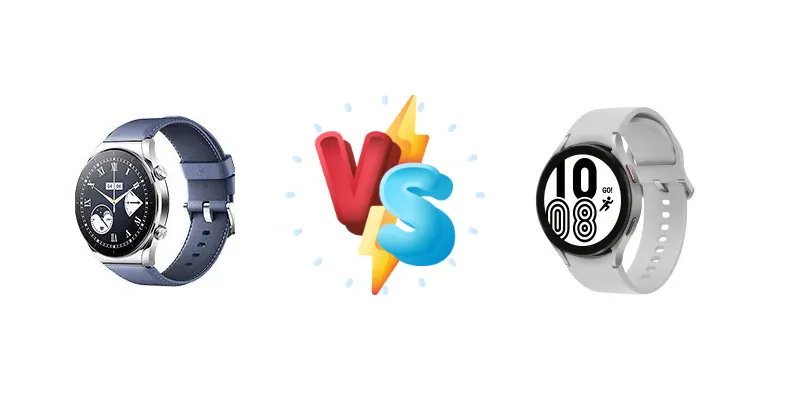
The smartwatch market is booming, and choosing the right one can be overwhelming. Today, we're pitting two popular contenders against each other: the Xiaomi Watch S1 and the Samsung Galaxy Watch4. Both offer a blend of style and functionality, but which one reigns supreme?
🏆 Quick Verdict
The Samsung Galaxy Watch4 takes the crown for overall performance and feature richness, thanks to its robust chipset and Wear OS integration. However, the Xiaomi Watch S1 offers a more premium design and potentially longer battery life, making it a strong contender for those prioritizing aesthetics and longevity.
| Network |
|---|
| 2G bands | N/A | GSM 850 / 900 / 1800 / 1900 |
| 3G bands | N/A | HSDPA 850 / 900 / 2100 |
| 4G bands | N/A | 1, 3, 5, 7, 8, 20 |
| EDGE | No | - |
| GPRS | No | - |
| Speed | No | HSPA, LTE |
| Technology | No cellular connectivity | GSM / HSPA / LTE |
| Launch |
|---|
| Announced | 2021, December 28 | 2021, August 11 |
| Status | Available. Released 2021, December 31 | Available. Released 2021, August 27 |
| Body |
|---|
| Build | Sapphire crystal front, stainless steel frame, plastic back | Glass front (Gorilla Glass DX+), aluminum frame |
| Dimensions | 46.5 x 46.5 x 11 mm (1.83 x 1.83 x 0.43 in) | 44.4 x 43.3 x 9.8 mm (1.75 x 1.70 x 0.39 in) |
| SIM | No | eSIM |
| Weight | 53 g (1.87 oz) | 30.3 g (44mm), 25.9 g (40mm) (1.06 oz) |
| | Waterproof (5ATM) | MIL-STD-810G compliant*
50m water resistant (IP68)
Compatible with standard 20mm straps
ECG certified
Blood pressure monitor
*does not guarantee ruggedness or use in extreme conditions |
| Display |
|---|
| Protection | - | Corning Gorilla Glass DX+ |
| Resolution | 466 x 466 pixels (~326 ppi density) | 450 x 450 pixels (~321 ppi density) |
| Size | 1.43 inches | 1.4 inches |
| Type | AMOLED | Super AMOLED |
| | - | Always-on display |
| Platform |
|---|
| CPU | - | Dual-core 1.18 GHz Cortex-A55 |
| Chipset | - | Exynos W920 (5 nm) |
| GPU | - | Mali-G68 |
| OS | Proprietary OS | Android Wear OS 4, One UI Watch 5 |
| Memory |
|---|
| Card slot | No | No |
| Internal | Unspecified storage | 16GB 1.5GB RAM |
| Sound |
|---|
| 3.5mm jack | No | No |
| 35mm jack | No | No |
| Loudspeaker | Yes | Yes |
| Comms |
|---|
| Bluetooth | 5.2, A2DP, LE | 5.0, A2DP, LE |
| NFC | Yes | Yes |
| Positioning | GPS (L1+L5), GLONASS, GALILEO, BDS, QZSS | GPS, GLONASS, GALILEO, BDS |
| Radio | No | No |
| USB | No | No |
| WLAN | Wi-Fi 802.11 b/g/n (China only) | Wi-Fi 802.11 a/b/g/n, dual-band |
| Features |
|---|
| Sensors | Accelerometer, gyro, compass, barometer, heart rate, SpO2 | Accelerometer, gyro, compass, barometer, heart rate, SpO2 |
| | - | Natural language commands and dictation
Samsung Pay |
| Battery |
|---|
| Charging | Wireless | Wireless |
| Type | Li-Po 470 mAh | Li-Ion 361 mAh |
| Misc |
|---|
| Colors | Black, Silver | Black, Pink Gold, Silver, Green, Thom Browne Edition, Bespoke Edition, PXG Golf Edition |
| Models | M2108W1 | SM-R860, SM-R870 |
| Price | About 270 EUR | About 110 EUR |
Xiaomi Watch S1
- Premium design and build quality
- Longer battery life (7-12 days)
- Classic watch aesthetic
- Wireless charging
- Less powerful processor
- Limited app ecosystem compared to Wear OS
- Fewer advanced fitness tracking features
Samsung Galaxy Watch4
- Faster performance with Exynos W920
- Wear OS integration and app support
- Advanced health and fitness tracking (ECG, SpO2)
- Rotating bezel for easy navigation
- Shorter battery life (2-4 days)
- Can be pricier than the Xiaomi Watch S1
- Some features require a Samsung phone
Display Comparison
Both watches feature vibrant AMOLED displays, but the Galaxy Watch4 generally offers slightly better brightness and color accuracy. The Xiaomi Watch S1's display is crisp and clear, but the Samsung's screen feels more refined. The Galaxy Watch4 also has a rotating bezel which is a great navigation tool.
Camera Comparison
Neither watch has a built-in camera, so this is a draw. Both rely on smartphone connectivity for photography.
Performance
The Samsung Galaxy Watch4's Exynos W920 chipset provides significantly faster and smoother performance compared to the Xiaomi Watch S1. App loading times are quicker, and the overall user experience is more responsive. The Wear OS integration also contributes to a more fluid experience.
Battery Life
The Xiaomi Watch S1 typically offers longer battery life, often lasting 7-12 days on a single charge, while the Galaxy Watch4 usually lasts 2-4 days depending on usage. This is a significant advantage for the Xiaomi device.
Buying Guide
The Xiaomi Watch S1 is ideal for users who value a classic, elegant design and appreciate longer battery life. It's a good choice for those less invested in advanced fitness tracking or a fully-featured smartwatch OS. The Samsung Galaxy Watch4 is perfect for fitness enthusiasts and Android users seeking a comprehensive smartwatch experience with access to a wide range of apps and advanced health metrics.
Frequently Asked Questions
❓ Does the Xiaomi Watch S1 work with iPhones?
Yes, the Xiaomi Watch S1 is compatible with both Android and iOS devices, but functionality may be limited on iOS compared to Android.
❓ Is the Samsung Galaxy Watch4 waterproof?
Yes, the Galaxy Watch4 is water-resistant up to 50 meters (5 ATM), making it suitable for swimming.
❓ Which watch has better health tracking features?
The Samsung Galaxy Watch4 offers more comprehensive health tracking features, including ECG, SpO2 monitoring, and body composition analysis.
❓ Can I install apps on both watches?
Yes, both watches support app installation. The Galaxy Watch4 has a much larger app ecosystem due to Wear OS.