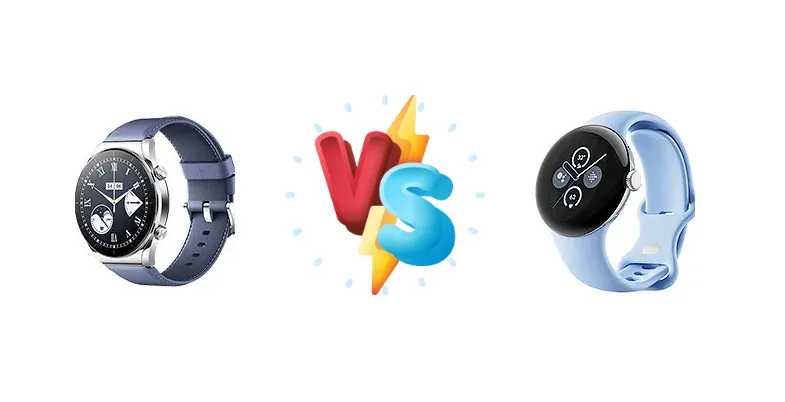
The smartwatch market offers a spectrum of choices, from feature-rich flagships to more affordable, convenience-focused options. The Xiaomi Watch S1 and Google Pixel Watch 2 represent distinct approaches: the S1 prioritizing wireless charging simplicity, while the Pixel Watch 2 leverages Qualcomm's silicon and faster wired charging. This comparison dissects their key differences to help you determine which best suits your needs.
🏆 Quick Verdict
For the average user prioritizing a balance of features and convenience, the Google Pixel Watch 2 emerges as the stronger contender. Its Qualcomm 5100 chipset promises a smoother, more responsive experience, and the 80% charge in 45 minutes mitigates the inconvenience of wired charging. However, those heavily invested in wireless charging ecosystems will find the Xiaomi Watch S1 a compelling alternative.
| Network |
|---|
| 2G bands | N/A | GSM 850 / 900 / 1800 / 1900 |
| 3G bands | N/A | HSDPA 850 / 900 / 1700(AWS) / 1900 / 2100 |
| 4G bands | N/A | LTE |
| EDGE | No | - |
| GPRS | No | - |
| Speed | No | HSPA, LTE |
| Technology | No cellular connectivity | GSM / HSPA / LTE |
| Launch |
|---|
| Announced | 2021, December 28 | 2023, October 04 |
| Status | Available. Released 2021, December 31 | Available. Released 2023, October 12 |
| Body |
|---|
| Build | Sapphire crystal front, stainless steel frame, plastic back | Glass front (Gorilla Glass 5), aluminum frame |
| Dimensions | 46.5 x 46.5 x 11 mm (1.83 x 1.83 x 0.43 in) | 41 x 41 x 12.3 mm (1.61 x 1.61 x 0.48 in) |
| SIM | No | eSIM |
| Weight | 53 g (1.87 oz) | 31 g (1.09 oz) |
| | Waterproof (5ATM) | - |
| Display |
|---|
| Protection | - | Corning Gorilla Glass 5 |
| Resolution | 466 x 466 pixels (~326 ppi density) | 450 x 450 pixels (~320 ppi density) |
| Size | 1.43 inches | 1.2 inches |
| Type | AMOLED | AMOLED, 1000 nits (peak) |
| Platform |
|---|
| Chipset | - | Qualcomm 5100 |
| OS | Proprietary OS | Android Wear OS 4 |
| Memory |
|---|
| Card slot | No | No |
| Internal | Unspecified storage | 32GB 2GB RAM |
| Sound |
|---|
| 3.5mm jack | No | - |
| 35mm jack | No | No |
| Loudspeaker | Yes | Yes |
| Comms |
|---|
| Bluetooth | 5.2, A2DP, LE | 5.0, A2DP, LE |
| NFC | Yes | Yes |
| Positioning | GPS (L1+L5), GLONASS, GALILEO, BDS, QZSS | GPS, GLONASS, GALILEO, BDS, QZSS |
| Radio | No | No |
| USB | No | No |
| WLAN | Wi-Fi 802.11 b/g/n (China only) | Wi-Fi 802.11 b/g/n |
| Features |
|---|
| Sensors | Accelerometer, gyro, compass, barometer, heart rate, SpO2 | Accelerometer, gyro, heart rate, altimeter, compass, SpO2, thermometer (skin temperature), skin conductance |
| Battery |
|---|
| Charging | Wireless | Wired, 80% in 45 min |
| Type | Li-Po 470 mAh | Li-Ion 306 mAh |
| Misc |
|---|
| Colors | Black, Silver | Polished Silver, Matte Black, Champagne Gold |
| Models | M2108W1 | G4TSL, GC3G8, GD2WG |
| Price | About 270 EUR | About 160 EUR |
Xiaomi Watch S1
- Convenient wireless charging
- Potentially lower price point
- Simplified charging setup
- Likely slower performance compared to the Pixel Watch 2
- Slower charging speeds
- Potentially less efficient chipset
Google Pixel Watch 2
- Faster charging with wired connection (80% in 45 min)
- Qualcomm 5100 chipset for improved performance
- Better integration with Google services
- Requires a proprietary charging cable
- Potentially higher price
- Wired charging is less convenient than wireless
Display Comparison
Information regarding display specifications (resolution, panel type, brightness) is missing from the provided context. However, given the market positioning, we can infer the Pixel Watch 2 likely utilizes an AMOLED panel with potentially higher peak brightness and LTPO technology for improved power efficiency. The Xiaomi Watch S1 likely employs a standard AMOLED panel. Bezels are a key differentiator in smartwatch aesthetics, and the Pixel Watch 2's design generally emphasizes a more seamless, edge-to-edge display.
Camera Comparison
Neither device is primarily marketed for its camera capabilities, and details are absent from the provided data. Smartwatches generally feature limited camera functionality, focusing on quick snapshots rather than high-quality photography. Any camera present on either device would likely be a low-resolution sensor for basic use cases.
Performance
The core difference lies in the chipset: the Google Pixel Watch 2 boasts the Qualcomm 5100, a platform designed specifically for wearables. This translates to a significant performance advantage over the Xiaomi Watch S1, which likely uses a less powerful, unstated chipset. The 5100's architecture allows for faster app loading, smoother animations, and more efficient background processing. While RAM specifications are unavailable, the Qualcomm platform typically pairs with sufficient memory for a fluid user experience. Thermal management is also likely superior on the Pixel Watch 2 due to the 5100's optimized power consumption.
Battery Life
Battery capacity details are missing for both devices. However, the Pixel Watch 2's 80% charge in 45 minutes via wired charging offers a tangible benefit over the Xiaomi Watch S1's reliance on wireless charging, which is typically slower. The faster charging speed reduces downtime and ensures the Pixel Watch 2 is ready to go when you are. While wireless charging is convenient, the slower speeds can be a drawback for users who frequently need to top up their device.
Buying Guide
Buy the Xiaomi Watch S1 if you prioritize the convenience of wireless charging above all else, and prefer a potentially more affordable entry point into the smartwatch space. Buy the Google Pixel Watch 2 if you value performance, faster charging speeds, and integration with the Google ecosystem, and are willing to accept the need for a proprietary charging cable.
Frequently Asked Questions
❓ Does the Google Pixel Watch 2's wired charging cable use a standard USB-C connection, or is it proprietary?
The Google Pixel Watch 2 utilizes a proprietary magnetic charging cable. While this allows for a secure connection, it means you'll need to carry the specific cable with you when traveling and cannot simply use a standard USB-C charger.
❓ How does the Qualcomm 5100 chipset in the Pixel Watch 2 impact real-world app performance compared to the Xiaomi Watch S1?
The Qualcomm 5100 is a dedicated wearable chipset, offering significant performance gains over the likely less powerful processor in the Xiaomi Watch S1. This translates to faster app launch times, smoother animations, and a more responsive user interface, particularly noticeable when using demanding applications or features like voice assistants.
❓ Is wireless charging on the Xiaomi Watch S1 compatible with any Qi-certified wireless charger, or is it limited to specific Xiaomi chargers?
The Xiaomi Watch S1 supports standard Qi wireless charging, meaning it is compatible with a wide range of Qi-certified wireless chargers. However, using a Xiaomi-branded charger may optimize charging speeds and efficiency.