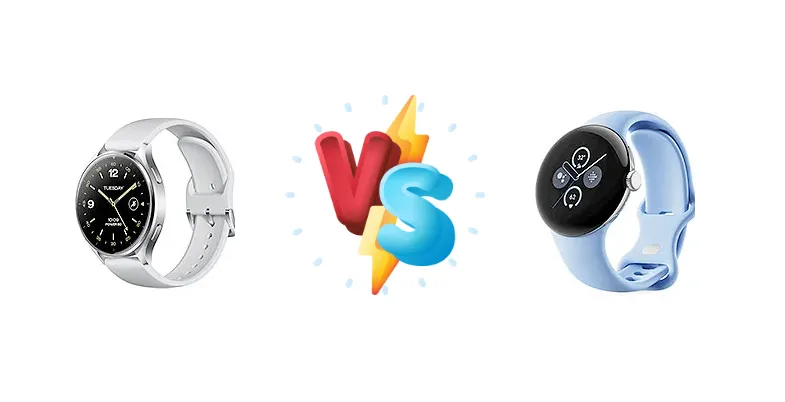
The smartwatch market is heating up, with the Xiaomi Watch 2 challenging Google's Pixel Watch 2. While both run Wear OS, they diverge significantly in their core hardware. This comparison focuses on the critical differences – the Qualcomm Snapdragon W5+ Gen 1 in the Xiaomi versus the Qualcomm 5100 in the Pixel Watch 2 – and how these impact performance, battery life, and the overall user experience.
🏆 Quick Verdict
For most users, the Xiaomi Watch 2 offers a compelling package. Its Snapdragon W5+ Gen 1 chipset, built on a more efficient 4nm process, promises better performance and potentially longer battery life than the Pixel Watch 2’s Qualcomm 5100. While the Pixel Watch 2 boasts faster charging, the Xiaomi Watch 2’s superior chipset architecture gives it the edge.
| Network |
|---|
| 2G bands | N/A | GSM 850 / 900 / 1800 / 1900 |
| 3G bands | N/A | HSDPA 850 / 900 / 1700(AWS) / 1900 / 2100 |
| 4G bands | N/A | LTE |
| EDGE | No | - |
| GPRS | No | - |
| Speed | - | HSPA, LTE |
| Technology | No cellular connectivity | GSM / HSPA / LTE |
| Launch |
|---|
| Announced | 2024, February 12 | 2023, October 04 |
| Status | Available. Released 2024, February 22 | Available. Released 2023, October 12 |
| Body |
|---|
| Build | Aluminum frame | Glass front (Gorilla Glass 5), aluminum frame |
| Dimensions | 47.5 x 45.9 x 11.8 mm (1.87 x 1.81 x 0.46 in) | 41 x 41 x 12.3 mm (1.61 x 1.61 x 0.48 in) |
| SIM | No | eSIM |
| Weight | 36.8 g (1.31 oz) | 31 g (1.09 oz) |
| Display |
|---|
| Protection | - | Corning Gorilla Glass 5 |
| Resolution | 466 x 466 pixels (~326 ppi density) | 450 x 450 pixels (~320 ppi density) |
| Size | 1.43 inches | 1.2 inches |
| Type | AMOLED, 600 nits | AMOLED, 1000 nits (peak) |
| Platform |
|---|
| Chipset | Qualcomm Snapdragon W5+ Gen 1 (4 nm) | Qualcomm 5100 |
| OS | Android Wear OS | Android Wear OS 4 |
| Memory |
|---|
| Card slot | No | No |
| Internal | 32GB 2GB RAM | 32GB 2GB RAM |
| Sound |
|---|
| 35mm jack | No | No |
| Loudspeaker | Yes | Yes |
| Comms |
|---|
| Bluetooth | 5.2, A2DP, LE | 5.0, A2DP, LE |
| NFC | Yes (market/region dependent) | Yes |
| Positioning | GPS (L1+L5), GLONASS, GALILEO, BDS, QZSS | GPS, GLONASS, GALILEO, BDS, QZSS |
| Radio | No | No |
| USB | No | No |
| WLAN | Wi-Fi 802.11 a/b/g/n/ac, dual-band | Wi-Fi 802.11 b/g/n |
| Features |
|---|
| Sensors | Accelerometer, gyro, compass, barometer, heart rate, SpO2 | Accelerometer, gyro, heart rate, altimeter, compass, SpO2, thermometer (skin temperature), skin conductance |
| Battery |
|---|
| Charging | - | Wired, 80% in 45 min |
| Type | Li-Po 495 mAh | Li-Ion 306 mAh |
| Misc |
|---|
| Colors | Black, Silver | Polished Silver, Matte Black, Champagne Gold |
| Models | M2320W1 | G4TSL, GC3G8, GD2WG |
| Price | About 70 EUR | About 160 EUR |
Xiaomi Watch 2
- More efficient Snapdragon W5+ Gen 1 chipset
- Potentially longer battery life
- Likely better sustained performance
- Charging speed not specified, potentially slower than Pixel Watch 2
- Integration with Google services may not be as seamless
Google Pixel Watch 2
- Faster charging (80% in 45 minutes)
- Deep integration with Fitbit and Google ecosystem
- Potentially brighter display (speculation)
- Less efficient Qualcomm 5100 chipset
- Potential for thermal throttling under heavy load
- May have shorter battery life
Display Comparison
Details regarding display technology (AMOLED, LTPO) and resolution are missing from the provided data. However, both watches likely utilize AMOLED panels for vibrant colors. The key difference will be in brightness and potentially refresh rate. Given Google’s focus on visual clarity, the Pixel Watch 2 may have a slight edge in peak brightness, but without specific nits values, this remains speculative. Bezels are also a critical factor, and visual inspection would be needed to determine which watch offers a more immersive experience.
Camera Comparison
Neither device is marketed for its camera capabilities, and details are absent from the provided data. Smartwatches generally feature limited camera functionality, primarily for quick voice calls or remote control features. Therefore, this section is largely irrelevant for this comparison.
Performance
The Xiaomi Watch 2’s Qualcomm Snapdragon W5+ Gen 1 (4nm) represents a substantial architectural advantage over the Google Pixel Watch 2’s Qualcomm 5100. The 4nm fabrication process inherently delivers greater transistor density and improved power efficiency compared to the 5100’s likely larger node. This translates to better sustained performance under load, less thermal throttling during demanding tasks like GPS tracking or app usage, and potentially longer battery life. While the 5100 is a capable chip, the W5+ Gen 1 is designed specifically for wearables and offers a more modern architecture.
Battery Life
Battery capacity figures are missing, making a direct mAh comparison impossible. However, the Xiaomi Watch 2’s more efficient Snapdragon W5+ Gen 1 chipset will likely result in superior battery life, even with a similar capacity battery to the Pixel Watch 2. The Pixel Watch 2 compensates with faster charging – 80% in 45 minutes – which is a significant convenience. Users prioritizing all-day battery life will likely favor the Xiaomi, while those who frequently top up their watch may prefer the Pixel’s quicker charging.
Buying Guide
Buy the Xiaomi Watch 2 if you prioritize performance, battery efficiency, and value for money. Its Snapdragon W5+ Gen 1 chipset is a significant upgrade, making it ideal for fitness tracking and app usage. Buy the Google Pixel Watch 2 if you are deeply embedded in the Google ecosystem and value seamless integration with Fitbit’s health tracking features, and the convenience of faster charging outweighs the potential performance benefits of the Xiaomi.
Frequently Asked Questions
❓ Will the Qualcomm 5100 in the Pixel Watch 2 overheat during extended GPS tracking for activities like running or cycling?
The Qualcomm 5100, while capable, is built on a less efficient process than the Snapdragon W5+ Gen 1. This means it's more susceptible to thermal throttling during prolonged, demanding tasks like GPS tracking. Users engaging in long-duration activities may experience performance slowdowns or reduced battery life on the Pixel Watch 2 compared to the Xiaomi Watch 2.
❓ How does the Snapdragon W5+ Gen 1 impact app loading times and responsiveness on the Xiaomi Watch 2?
The Snapdragon W5+ Gen 1’s advanced architecture and 4nm process result in significantly faster app loading times and a more responsive user interface. The increased processing power and efficiency allow for smoother animations, quicker transitions, and a generally more fluid experience when navigating apps and features on the Xiaomi Watch 2.
❓ Is the 45-minute charging time on the Pixel Watch 2 truly a game-changer, or is it offset by the Xiaomi Watch 2’s potentially longer battery life?
The 45-minute charging time is convenient, but its value depends on your usage habits. If you consistently need to top up your watch throughout the day, the Pixel Watch 2’s faster charging is a significant benefit. However, if you prefer to charge your watch less frequently, the Xiaomi Watch 2’s potentially longer battery life, thanks to the Snapdragon W5+ Gen 1, may be more valuable.