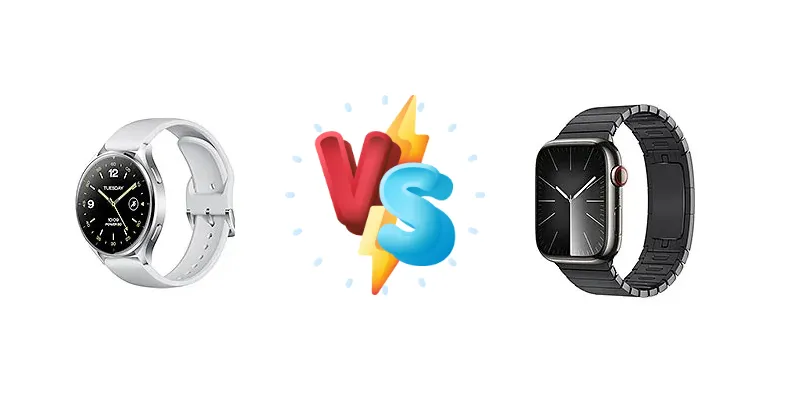
The smartwatch market is bifurcated: premium, ecosystem-locked experiences versus more open, value-driven alternatives. The Xiaomi Watch 2, powered by Qualcomm’s Snapdragon W5+ Gen 1, directly challenges Apple’s dominance with the Series 9 and its custom S9 chip. This comparison dissects the core differences, focusing on performance, efficiency, and the user experience each delivers.
🏆 Quick Verdict
For the average user prioritizing seamless ecosystem integration and advanced health features, the Apple Watch Series 9 remains the superior choice. However, the Xiaomi Watch 2 offers compelling performance thanks to the Snapdragon W5+ Gen 1 at a significantly lower price point, making it ideal for Android users or those seeking a feature-rich smartwatch without the Apple premium.
| Network |
|---|
| 2G bands | N/A | GSM 850 / 900 / 1800 / 1900 |
| 3G bands | N/A | HSDPA 850 / 900 / 1700(AWS) / 1900 / 2100 - International, China, HK |
| 4G bands | N/A | 1, 2, 3, 4, 5, 6, 7, 8, 18, 19, 20, 25, 26, 28, 39, 40, 41, 66 - International, China, HK |
| EDGE | No | - |
| GPRS | No | - |
| Speed | - | HSPA, LTE |
| Technology | No cellular connectivity | GSM / HSPA / LTE |
| Launch |
|---|
| Announced | 2024, February 12 | 2023, September 12 |
| Status | Available. Released 2024, February 22 | Available. Released 2023, September 22 |
| Body |
|---|
| Build | Aluminum frame | Sapphire crystal front, ceramic/sapphire crystal back, stainless steel frame |
| Dimensions | 47.5 x 45.9 x 11.8 mm (1.87 x 1.81 x 0.46 in) | 45 x 38 x 10.7 mm (1.77 x 1.50 x 0.42 in) |
| SIM | No | eSIM |
| Weight | 36.8 g (1.31 oz) | 42.3 g (41mm), 51.5 g (45mm) (1.48 oz) |
| Display |
|---|
| Protection | - | Sapphire crystal glass |
| Resolution | 466 x 466 pixels (~326 ppi density) | 484 x 396 pixels (~326 ppi density) |
| Size | 1.43 inches | 1.9 inches |
| Type | AMOLED, 600 nits | Retina LTPO OLED, 2000 nits (peak) |
| Platform |
|---|
| CPU | - | Dual-core |
| Chipset | Qualcomm Snapdragon W5+ Gen 1 (4 nm) | Apple S9 |
| GPU | - | PowerVR |
| OS | Android Wear OS | watchOS 10, upgradable to watchOS 26.1 |
| Memory |
|---|
| Card slot | No | No |
| Internal | 32GB 2GB RAM | 64GB |
| Sound |
|---|
| 35mm jack | No | No |
| Loudspeaker | Yes | Yes |
| Comms |
|---|
| Bluetooth | 5.2, A2DP, LE | 5.3, A2DP, LE |
| NFC | Yes (market/region dependent) | Yes |
| Positioning | GPS (L1+L5), GLONASS, GALILEO, BDS, QZSS | GPS, GLONASS, GALILEO, QZSS, BDS |
| Radio | No | No |
| USB | No | No |
| WLAN | Wi-Fi 802.11 a/b/g/n/ac, dual-band | Wi-Fi 802.11 b/g/n, dual-band |
| Features |
|---|
| Sensors | Accelerometer, gyro, compass, barometer, heart rate, SpO2 | Accelerometer, gyro, heart rate, barometer, always-on altimeter, compass, SpO2, VO2max, temperature (body) |
| Battery |
|---|
| Charging | - | Wireless, 0-80% in 45 min |
| Type | Li-Po 495 mAh | Li-Ion 308 mAh |
| Misc |
|---|
| Colors | Black, Silver | Graphite, Silver, Gold, Red |
| Models | M2320W1 | A2982, A2984, A2983, A2985, Watch7,3, Watch7,4 |
| Price | About 70 EUR | About 630 EUR |
| SAR | - | 1.02 W/kg (head) |
| SAR EU | - | 0.64 W/kg (head) |
Xiaomi Watch 2
- Potentially longer battery life due to Snapdragon W5+ Gen 1 efficiency
- More affordable price point
- Open ecosystem and Android compatibility
- Likely lacks advanced health features like ECG
- Potentially slower charging speeds
Apple Watch Series 9
- Seamless integration with the Apple ecosystem
- Advanced health monitoring features (ECG, Blood Oxygen)
- Optimized performance through hardware-software integration
- Higher price point
- Limited compatibility with Android devices
Display Comparison
Neither device's display specifications are provided, but based on market positioning, the Apple Watch Series 9 likely features an LTPO display for variable refresh rates and improved power efficiency. This contrasts with the Xiaomi Watch 2, which may utilize a standard AMOLED panel. The Series 9’s display is expected to have higher peak brightness for outdoor visibility, while the Xiaomi Watch 2 will likely focus on color accuracy and power conservation. Bezels are expected to be minimal on both, but Apple typically leads in display refinement.
Camera Comparison
Neither device is marketed for its camera capabilities, and neither is expected to have a significant camera feature. This comparison section is largely irrelevant.
Performance
The core difference lies in the chipsets. The Xiaomi Watch 2 leverages the 4nm Qualcomm Snapdragon W5+ Gen 1, a dedicated wearable platform known for its efficiency and performance gains over previous generations. The Apple Watch Series 9 utilizes Apple’s custom S9 dual-core CPU. While core count isn’t everything, Apple’s tight hardware-software integration allows for optimized performance. The Snapdragon W5+ Gen 1’s 4nm process node provides a thermal advantage, potentially leading to sustained performance during demanding tasks. However, Apple’s S9 likely benefits from a more advanced architecture and faster memory (likely LPDDR5X), resulting in quicker app loading and smoother animations. The lack of RAM specifications for both devices makes a direct comparison difficult, but Apple typically allocates more RAM to its watches.
Battery Life
Battery life is a critical factor. While mAh ratings are absent, the Snapdragon W5+ Gen 1’s efficiency should translate to longer battery life for the Xiaomi Watch 2. The Apple Watch Series 9 offers wireless charging, reaching 80% charge in 45 minutes. The Xiaomi Watch 2’s charging speed is unknown, but a slower charging rate could be a trade-off for its potentially superior battery endurance. The S9’s power management is optimized for watchOS, but the Snapdragon’s inherent efficiency could still provide a noticeable advantage in real-world usage.
Buying Guide
Buy the Xiaomi Watch 2 if you need a powerful, feature-packed smartwatch that seamlessly integrates with Android, prioritizes battery life, and offers excellent value for money. Buy the Apple Watch Series 9 if you are deeply invested in the Apple ecosystem, require advanced health monitoring features like ECG and blood oxygen tracking, and value a polished, refined user experience.
Frequently Asked Questions
❓ Does the Snapdragon W5+ Gen 1 in the Xiaomi Watch 2 offer sufficient performance for smooth app usage and fitness tracking?
Yes, the Snapdragon W5+ Gen 1 is a dedicated wearable platform designed for efficient and responsive performance. It’s capable of handling typical smartwatch tasks, including fitness tracking, notifications, and running third-party apps, without significant lag. Its 4nm process contributes to sustained performance and reduced thermal throttling.
❓ How does the Apple Watch Series 9’s S9 chip benefit from Apple’s software optimization?
Apple’s control over both hardware and software allows for deep optimization. The S9 chip is tightly integrated with watchOS, resulting in smoother animations, faster app loading times, and efficient power management. This synergy is a key advantage that Apple leverages to deliver a refined user experience.
❓ Is the 45-minute 0-80% charging time on the Apple Watch Series 9 a significant drawback compared to potentially slower charging on the Xiaomi Watch 2?
It depends on your usage habits. If you frequently need to top up your watch quickly, the Apple Watch Series 9’s faster charging is beneficial. However, if the Xiaomi Watch 2 offers significantly longer battery life, the slower charging speed may be less of a concern, especially for overnight charging.