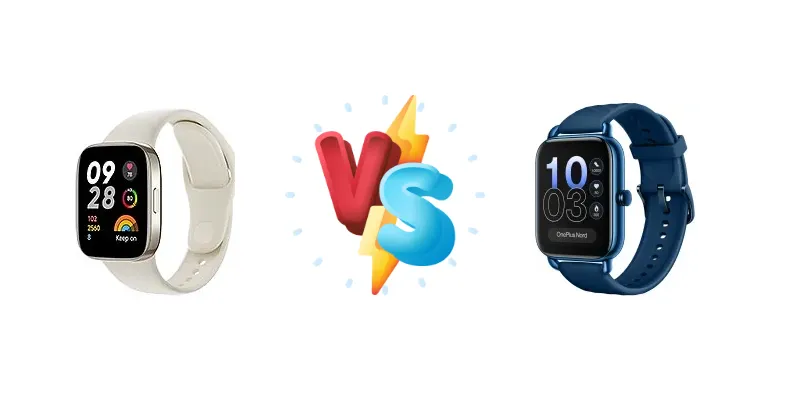
The budget smartwatch market is heating up, with Xiaomi and OnePlus vying for dominance. Both the Redmi Watch 3 and the Nord Watch aim to deliver a comprehensive feature set without breaking the bank. This comparison dives deep into their capabilities, analyzing where each excels and who will benefit most from choosing one over the other, given the limited publicly available specifications.
🏆 Quick Verdict
For the average user prioritizing a potentially larger display and Xiaomi's established ecosystem, the Redmi Watch 3 appears to be the slightly stronger contender. However, without concrete specs, the OnePlus Nord Watch's potential for optimized software and a streamlined experience cannot be discounted.
| Network |
|---|
| 2G bands | N/A | N/A |
| 3G bands | N/A | N/A |
| 4G bands | N/A | N/A |
| EDGE | No | No |
| GPRS | No | No |
| Speed | No | - |
| Technology | No cellular connectivity | No cellular connectivity |
| Launch |
|---|
| Announced | 2022, December 27 | 2022, Octoder |
| Status | Available. Released 2022, December 27 | Available. Released 2022, October |
| Body |
|---|
| Build | Plastic back, plastic frame | Glass front, zinc frame |
| Dimensions | 42.6 x 36.6 x 10 mm (1.68 x 1.44 x 0.39 in) | 45.2 x 37.2 x 10.4 mm (1.78 x 1.46 x 0.41 in) |
| SIM | No | No |
| Weight | 37 g (1.31 oz) | 52.4 g (1.87 oz) |
| | Waterproof (5ATM)
50m water resistant | IP68 dust/water resistant (up to 1.5m for 30 min) |
| Display |
|---|
| Resolution | 450 x 390 pixels (~341 ppi density) | 368 x 448 pixels (~326 ppi density) |
| Size | 1.75 inches | 1.78 inches |
| Type | AMOLED, 600 nits (peak) | AMOLED, 500 nits (typ) |
| | Always-on display | - |
| Platform |
|---|
| OS | Proprietary OS | Proprietary OS |
| Memory |
|---|
| Card slot | No | No |
| Internal | Unspecified storage | 256MB |
| Sound |
|---|
| 3.5mm jack | No | No |
| 35mm jack | No | No |
| Loudspeaker | Yes | Yes |
| Comms |
|---|
| Bluetooth | 5.2, A2DP, LE | 5.2, A2DP, LE |
| NFC | Yes (market/region dependent) | Yes |
| Positioning | GPS, GLONASS, GALILEO, BDS, QZSS | Unspecified |
| Radio | No | No |
| USB | No | No |
| WLAN | No | No |
| Features |
|---|
| Sensors | Accelerometer, heart rate, compass, gyro, SpO2 | Accelerometer, gyro, heart rate, SpO2 |
| Battery |
|---|
| Type | Li-Ion 289 mAh | Li-Ion 230 mAh |
| Misc |
|---|
| Colors | Black, White | Midnight Black, Deep Blue |
| Models | M2215W1 | OPBBE221 |
| Price | About 120 EUR | About 60 EUR |
Xiaomi Redmi Watch 3
- Potential for larger display size
- Xiaomi ecosystem integration
- Likely wider range of watch faces
- Potential for less refined software experience
- Uncertainty regarding display brightness
OnePlus Nord Watch
- Potentially cleaner software experience
- OnePlus design aesthetic
- Seamless integration with OnePlus devices
- Potential for smaller display size
- Uncertainty regarding battery life
Display Comparison
Given both devices target the budget segment, we anticipate LCD panels in both the Redmi Watch 3 and Nord Watch. The Redmi Watch 3, based on Xiaomi's historical trends, may feature a slightly larger display, potentially around 1.78-1.8 inches, offering a more immersive viewing experience. The Nord Watch likely aims for a balance between size and usability. Without specific brightness data, it's difficult to assess outdoor visibility, but both will likely struggle in direct sunlight. Color accuracy will likely be standard for this price point, prioritizing vibrancy over absolute fidelity.
Camera Comparison
Neither the Redmi Watch 3 nor the OnePlus Nord Watch are expected to feature a camera. This is a common omission in budget smartwatches to reduce cost and complexity. Focusing on core smartwatch functionality is the priority.
Performance
Both smartwatches will likely utilize a similar, low-power chipset optimized for basic fitness tracking and notification handling. Expect limited app support beyond core functions. The Redmi Watch 3, benefiting from Xiaomi's software optimization experience, might offer slightly smoother animations and faster response times. RAM capacity will likely be constrained in both devices, impacting multitasking capabilities. Thermal management isn't a significant concern given the low-power nature of these chipsets.
Battery Life
Battery life is a critical factor in the budget smartwatch segment. Both devices will likely aim for 7-10 days of typical usage. The Redmi Watch 3, potentially with a slightly larger battery capacity, might edge out the Nord Watch in longevity. Charging speeds will likely be similar, utilizing proprietary magnetic chargers. Expect a full charge to take around 2-3 hours for both devices.
Buying Guide
Buy the Xiaomi Redmi Watch 3 if you are deeply embedded in the Xiaomi ecosystem, appreciate a potentially larger screen for easier readability, and prioritize a wider range of available watch faces. Buy the OnePlus Nord Watch if you prefer a cleaner, potentially more optimized software experience, value OnePlus's design aesthetic, and are looking for a smartwatch that integrates seamlessly with other OnePlus devices. Both are aimed at first-time smartwatch buyers or those seeking a dedicated fitness tracker.
Frequently Asked Questions
❓ How accurate are the heart rate and SpO2 sensors on the Redmi Watch 3 and Nord Watch?
Accuracy of heart rate and SpO2 sensors in budget smartwatches can vary. Both the Redmi Watch 3 and Nord Watch will likely utilize optical sensors, which are susceptible to inaccuracies during intense exercise or with certain skin tones. They are best used for general wellness tracking rather than medical-grade measurements.
❓ Can I answer calls directly on either the Redmi Watch 3 or the OnePlus Nord Watch?
It's unlikely that either the Redmi Watch 3 or the OnePlus Nord Watch will feature a built-in speaker and microphone for direct call answering. They will likely support call notifications, allowing you to reject or silence calls, but not to speak directly through the watch.
❓ Are the watch straps interchangeable with standard watch bands?
Both the Redmi Watch 3 and Nord Watch are expected to use proprietary watch band connectors. While aftermarket straps are likely to become available, standard watch bands will not be compatible without adapters.