
Redmi Turbo 4 vs iQOO Neo 7 Pro: A Deep Dive into Mid-Range Power
| Phones Images | |||||
|---|---|---|---|---|---|
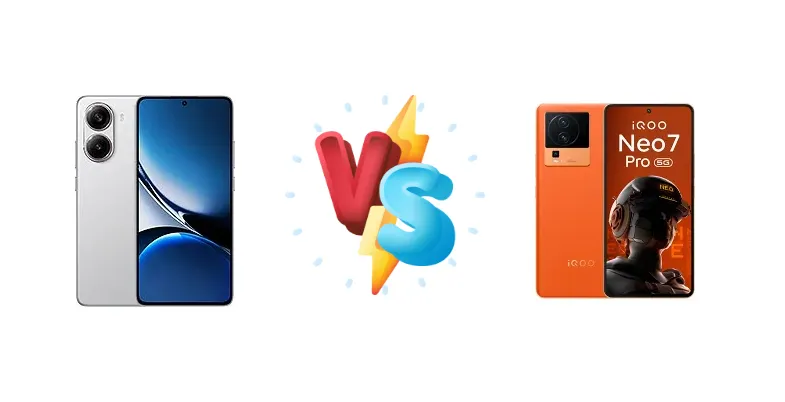
|
🏆 Quick Verdict
For the average user prioritizing raw CPU performance and incredibly fast charging, the vivo iQOO Neo 7 Pro emerges as the winner. Its Snapdragon 8+ Gen 1 offers a slight edge in demanding tasks, and the 120W charging is significantly faster than the Redmi Turbo 4’s 90W. However, the Turbo 4’s Dimensity 8400 Ultra provides excellent value and efficiency.
| PHONES | ||
|---|---|---|
| Phone Names | Xiaomi Redmi Turbo 4 | vivo iQOO Neo 7 Pro |
| Network | ||
|---|---|---|
| 2G bands | GSM 850 / 900 / 1800 / 1900 | GSM 850 / 900 / 1800 / 1900 |
| 3G bands | HSDPA 800 / 850 / 900 / 1700(AWS) / 2100 | HSDPA 800 / 850 / 900 / 1700(AWS) / 1900 / 2100 |
| 4G bands | 1, 3, 4, 5, 8, 18, 19, 26, 28, 34, 38, 39, 40, 41, 42, 48, 66 | 1, 2, 3, 4, 5, 8, 28, 34, 38, 39, 40, 41 |
| 5G bands | 1, 3, 5, 8, 28, 38, 40, 41, 48, 66, 77, 78 SA/NSA/Sub6 | 1, 3, 5, 8, 28, 40, 77, 78 SA/NSA |
| Speed | HSPA, LTE, 5G | HSPA, LTE, 5G |
| Technology | GSM / CDMA / HSPA / CDMA2000 / LTE / 5G | GSM / HSPA / LTE / 5G |
| Launch | ||
|---|---|---|
| Announced | 2025, January 02 | 2023, July 04 |
| Status | Available. Released 2025, January 02 | Available. Released 2023, July 15 |
| Body | ||
|---|---|---|
| Build | - | Glass front, plastic frame, glass or leather back |
| Dimensions | 161 x 75.2 x 8.1 mm (6.34 x 2.96 x 0.32 in) | 164.8 x 76.9 x 8.5 mm or 8.9 mm |
| SIM | Nano-SIM + Nano-SIM | Nano-SIM + Nano-SIM |
| Weight | 203.5 g (7.20 oz) | 197 g or 202 g (6.95 oz) |
| Display | ||
|---|---|---|
| Resolution | 1220 x 2712 pixels, 20:9 ratio (~446 ppi density) | 1080 x 2400 pixels, 20:9 ratio (~388 ppi density) |
| Size | 6.67 inches, 107.4 cm2 (~88.7% screen-to-body ratio) | 6.78 inches, 111.0 cm2 (~87.6% screen-to-body ratio) |
| Type | AMOLED, 68B colors, 120Hz, 1920Hz PWM, Dolby Vision, HDR10+, HDR Vivid, 1400 nits (HBM), 3200 nits (peak) | AMOLED, 1B colors, 120Hz, HDR10+, 1300 nits (peak) |
| Platform | ||
|---|---|---|
| CPU | Octa-core (1x3.25 GHz Cortex-A725 & 3x3.0 GHz Cortex-A725 & 4x2.1 GHz Cortex-A725) | Octa-core (1x3.19 GHz Cortex-X2 & 3x2.75 GHz Cortex-A710 & 4x2.0 GHz Cortex-A510) |
| Chipset | Mediatek Dimensity 8400 Ultra (4 nm) | Qualcomm SM8475 Snapdragon 8+ Gen 1 (4 nm) |
| GPU | G720 MC7 | Adreno 730 |
| OS | Android 15, HyperOS 2 | Android 13, Funtouch 13 |
| Memory | ||
|---|---|---|
| Card slot | No | No |
| Internal | 256GB 12GB RAM, 256GB 16GB RAM, 512GB 12GB RAM, 512GB 16GB RAM | 128GB 8GB RAM, 256GB 12GB RAM |
| Main Camera | ||
|---|---|---|
| Dual | 50 MP, f/1.5, 26mm (wide), 1/1.95", 0.8µm, PDAF, OIS 8 MP, f/2.2, 15mm (ultrawide), 1/4.0", 1.12µm | - |
| Features | LED flash, HDR, panorama | LED flash, HDR, panorama |
| Triple | - | 50 MP, f/1.9, 24mm (wide), 1/1.57", 1.0µm, PDAF, OIS 8 MP, f/2.2, 16mm (ultrawide), 1/4.0", 1.12µm 2 MP (macro) |
| Video | 4K@24/30/60fps, 1080p@30/60/120/240/960fps, gyro-EIS | 4K@30fps, 1080p@30fps |
| Selfie camera | ||
|---|---|---|
| Features | - | HDR |
| Single | 20 MP, f/2.2, (wide), 1/4" | 16 MP, f/2.5, (wide), 1/3.1", 1.0µm |
| Video | 1080p@30fps | 1080p@30fps |
| Sound | ||
|---|---|---|
| 35mm jack | No | No |
| Loudspeaker | Yes, with stereo speakers | Yes, with stereo speakers |
| Comms | ||
|---|---|---|
| Bluetooth | 6.0, A2DP, LE, aptX, LHDC 5 | 5.3, A2DP, LE, aptX HD, aptX Adaptive |
| Infrared port | Yes | Yes |
| NFC | Yes | No |
| Positioning | GPS (L1+L5), GLONASS (G1), BDS (B1I+B1c+B2a), GALILEO (E1+E5a), QZSS (L1+L5), NavIC (L5) | GPS, GLONASS, GALILEO, BDS, QZSS, NavIC |
| Radio | No | No |
| USB | USB Type-C 2.0, OTG | USB Type-C 2.0, OTG |
| WLAN | Wi-Fi 802.11 a/b/g/n/ac/6, dual-band, Wi-Fi Direct | Wi-Fi 802.11 a/b/g/n/ac/6, dual-band, Wi-Fi Direct |
| Features | ||
|---|---|---|
| Sensors | Fingerprint (under display, optical), accelerometer, gyro, proximity, compass | Fingerprint (under display, optical), accelerometer, gyro, proximity, compass |
| Battery | ||
|---|---|---|
| Charging | 90W wired, PD3.0, QC3+, 100% in 45 min | 120W wired, 50% in 8 min |
| Type | Si/C Li-Ion 6550 mAh | 5000 mAh |
| Misc | ||
|---|---|---|
| Colors | Black, White, Blue | Fearless Flame, Dark Storm |
| Models | 24129RT7CC | I2217 |
| Price | About 270 EUR | About 380 EUR |
Xiaomi Redmi Turbo 4
- Potentially better battery efficiency with Dimensity 8400 Ultra
- Competitive price point offering excellent value
- 90W charging is still very fast and convenient
- Slightly lower peak CPU performance compared to Snapdragon 8+ Gen 1
- Charging speed is slower than the iQOO Neo 7 Pro
vivo iQOO Neo 7 Pro
- Faster CPU performance with Snapdragon 8+ Gen 1
- Industry-leading 120W charging for minimal downtime
- Potentially better GPU performance for gaming
- Snapdragon 8+ Gen 1 may run warmer and throttle under heavy load
- Potentially higher price compared to the Redmi Turbo 4
Display Comparison
While both phones likely feature high refresh rate AMOLED displays (data not provided), the core difference lies in the processing power driving them. The chipset impacts the smoothness of animations and responsiveness. Without specific display specs, it's difficult to compare brightness or color accuracy, but both brands typically deliver vibrant panels in this segment. The iQOO Neo 7 Pro’s processor may allow for more consistent high refresh rate performance during graphically intensive games.
Camera Comparison
Without detailed camera specifications, a direct comparison is limited. However, both phones likely feature multi-camera systems. The iQOO Neo 7 Pro, given its positioning, may prioritize a larger main sensor for improved low-light performance. Image processing philosophies differ between vivo and Xiaomi; vivo often leans towards vibrant, saturated colors, while Xiaomi tends towards a more natural look. The absence of information regarding OIS (Optical Image Stabilization) is a key omission; its presence would significantly impact video recording and low-light photography on either device.
Performance
The iQOO Neo 7 Pro’s Qualcomm Snapdragon 8+ Gen 1 (4nm) boasts a Cortex-X2 prime core clocked at 3.19 GHz, designed for peak performance. This contrasts with the Redmi Turbo 4’s Mediatek Dimensity 8400 Ultra (4nm) which utilizes three Cortex-A725 cores at 3.0 GHz and a single Cortex-A725 at 3.25 GHz. While the Dimensity 8400 Ultra’s core configuration is unique, the Snapdragon 8+ Gen 1 generally holds a performance advantage in benchmarks and sustained workloads due to Qualcomm’s optimizations. The Snapdragon’s Adreno GPU is also typically more powerful than the Mali-G710 MC4 found in the Dimensity 8400 Ultra, benefiting gaming. Thermal management will be crucial; the Snapdragon 8+ Gen 1 is known to run warmer, potentially leading to throttling under prolonged stress, while the Dimensity 8400 Ultra’s efficiency may offer better sustained performance.
Battery Life
The iQOO Neo 7 Pro’s 120W wired charging is a standout feature, promising a 50% charge in just 8 minutes. This is a significant advantage over the Redmi Turbo 4’s 90W charging, which takes 45 minutes for a full charge. While the Redmi Turbo 4’s battery capacity isn’t specified, the faster charging of the iQOO Neo 7 Pro mitigates the impact of a potentially smaller battery. The Dimensity 8400 Ultra’s efficiency may contribute to longer battery life during typical usage, but the iQOO Neo 7 Pro’s charging speed offers unparalleled convenience.
Buying Guide
Buy the Xiaomi Redmi Turbo 4 if you need a balanced phone with strong all-around performance, excellent battery life, and a more efficient chipset for everyday tasks. Buy the vivo iQOO Neo 7 Pro if you prioritize peak CPU performance for gaming or demanding applications, and absolutely require the fastest possible charging speeds – minimizing downtime is key.