
Xiaomi Redmi Turbo 4 vs. Nothing Phone (2): A Deep Dive into Performance and Value
| Phones Images | |||||
|---|---|---|---|---|---|
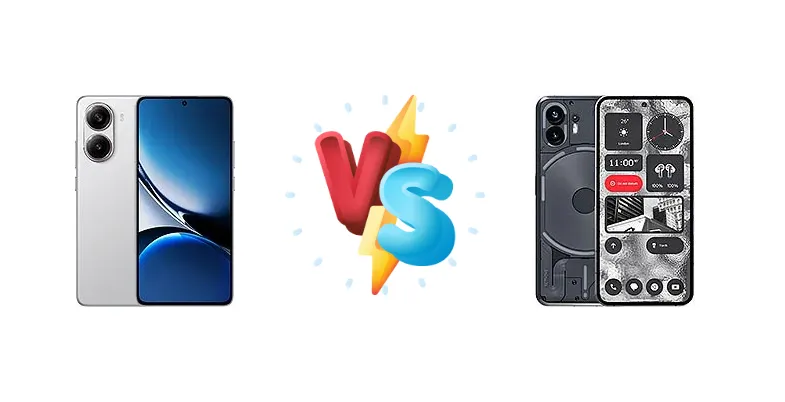
|
🏆 Quick Verdict
For users prioritizing raw performance and rapid charging, the Xiaomi Redmi Turbo 4 is the clear winner. Its Dimensity 8400 Ultra offers competitive power, and the 90W charging is significantly faster than the Nothing Phone (2)'s 45W. However, the Nothing Phone (2) provides a more refined software experience and a distinctive aesthetic.
| PHONES | ||
|---|---|---|
| Phone Names | Xiaomi Redmi Turbo 4 | Nothing Phone (2) |
| Network | ||
|---|---|---|
| 2G bands | GSM 850 / 900 / 1800 / 1900 | GSM 850 / 900 / 1800 / 1900 |
| 3G bands | HSDPA 800 / 850 / 900 / 1700(AWS) / 2100 | HSDPA 800 / 850 / 900 / 1700(AWS) / 1900 / 2100 |
| 4G bands | 1, 3, 4, 5, 8, 18, 19, 26, 28, 34, 38, 39, 40, 41, 42, 48, 66 | 1, 2, 3, 4, 5, 7, 8, 12, 17, 18, 19, 20, 25, 26, 28, 30, 32, 34, 38, 39, 40, 41, 42, 48, 66, 71 |
| 5G bands | 1, 3, 5, 8, 28, 38, 40, 41, 48, 66, 77, 78 SA/NSA/Sub6 | 1, 2, 3, 5, 7, 8, 12, 20, 25, 28, 30, 38, 40, 41, 66, 71, 75, 77, 78 SA/NSA |
| Speed | HSPA, LTE, 5G | HSPA, LTE, 5G |
| Technology | GSM / CDMA / HSPA / CDMA2000 / LTE / 5G | GSM / HSPA / LTE / 5G |
| Launch | ||
|---|---|---|
| Announced | 2025, January 02 | 2023, July 11 |
| Status | Available. Released 2025, January 02 | Available. Released 2023, July 17 |
| Body | ||
|---|---|---|
| Build | - | Glass front (Gorilla Glass 5), glass back (Gorilla Glass 5), aluminum frame |
| Dimensions | 161 x 75.2 x 8.1 mm (6.34 x 2.96 x 0.32 in) | 162.1 x 76.4 x 8.6 mm (6.38 x 3.01 x 0.34 in) |
| SIM | Nano-SIM + Nano-SIM | Nano-SIM + Nano-SIM |
| Weight | 203.5 g (7.20 oz) | 201.2 g (7.09 oz) |
| Display | ||
|---|---|---|
| Protection | - | Corning Gorilla Glass 5 |
| Resolution | 1220 x 2712 pixels, 20:9 ratio (~446 ppi density) | 1080 x 2412 pixels, 20:9 ratio (~394 ppi density) |
| Size | 6.67 inches, 107.4 cm2 (~88.7% screen-to-body ratio) | 6.7 inches, 108.0 cm2 (~87.2% screen-to-body ratio) |
| Type | AMOLED, 68B colors, 120Hz, 1920Hz PWM, Dolby Vision, HDR10+, HDR Vivid, 1400 nits (HBM), 3200 nits (peak) | LTPO OLED, 1B colors, 120Hz, 1920Hz PWM, HDR10+, 1600 nits (HBM), 1600 nits (peak) |
| Platform | ||
|---|---|---|
| CPU | Octa-core (1x3.25 GHz Cortex-A725 & 3x3.0 GHz Cortex-A725 & 4x2.1 GHz Cortex-A725) | Octa-core (1x3.0 GHz Cortex-X2 & 3x2.5 GHz Cortex-A710 & 4x1.80 GHz Cortex-A510) |
| Chipset | Mediatek Dimensity 8400 Ultra (4 nm) | Qualcomm SM8475 Snapdragon 8+ Gen 1 (4 nm) |
| GPU | G720 MC7 | Adreno 730 |
| OS | Android 15, HyperOS 2 | Android 13, upgradable to Android 15, up to 3 major Android upgrades, Nothing OS 3.0 |
| Memory | ||
|---|---|---|
| Card slot | No | No |
| Internal | 256GB 12GB RAM, 256GB 16GB RAM, 512GB 12GB RAM, 512GB 16GB RAM | 128GB 8GB RAM, 256GB 12GB RAM, 512GB 12GB RAM |
| Main Camera | ||
|---|---|---|
| Dual | 50 MP, f/1.5, 26mm (wide), 1/1.95", 0.8µm, PDAF, OIS 8 MP, f/2.2, 15mm (ultrawide), 1/4.0", 1.12µm | 50 MP, f/1.9, 24mm (wide), 1/1.56", 1.0µm, PDAF, OIS 50 MP, f/2.2, 114˚ (ultrawide), 1/2.76", 0.64µm, AF |
| Features | LED flash, HDR, panorama | LED flash, panorama, HDR |
| Video | 4K@24/30/60fps, 1080p@30/60/120/240/960fps, gyro-EIS | 4K@30/60fps, 1080p@30/60fps, gyro-EIS, live HDR, OIS |
| Selfie camera | ||
|---|---|---|
| Features | - | HDR |
| Single | 20 MP, f/2.2, (wide), 1/4" | 32 MP, f/2.5, (wide), 1/2.74", 0.8µm |
| Video | 1080p@30fps | 1080p@30fps |
| Sound | ||
|---|---|---|
| 35mm jack | No | No |
| Loudspeaker | Yes, with stereo speakers | Yes, with stereo speakers |
| Comms | ||
|---|---|---|
| Bluetooth | 6.0, A2DP, LE, aptX, LHDC 5 | 5.3, A2DP, LE, aptX HD, aptX Adaptive |
| Infrared port | Yes | - |
| NFC | Yes | Yes |
| Positioning | GPS (L1+L5), GLONASS (G1), BDS (B1I+B1c+B2a), GALILEO (E1+E5a), QZSS (L1+L5), NavIC (L5) | GPS (L1+L5), GLONASS (L1), BDS (B1I+B1c), GALILEO (E1), QZSS (L1), NavIC |
| Radio | No | No |
| USB | USB Type-C 2.0, OTG | USB Type-C 2.0, OTG |
| WLAN | Wi-Fi 802.11 a/b/g/n/ac/6, dual-band, Wi-Fi Direct | Wi-Fi 802.11 a/b/g/n/ac/6, dual-band, Wi-Fi Direct |
| Features | ||
|---|---|---|
| Sensors | Fingerprint (under display, optical), accelerometer, gyro, proximity, compass | Fingerprint (under display, optical), accelerometer, proximity, gyro, compass |
| Battery | ||
|---|---|---|
| Charging | 90W wired, PD3.0, QC3+, 100% in 45 min | 45W wired, PD3.0, PPS, QC4, 100% in 55 min 15W wireless, 100% in 130 min 5W reverse wireless |
| Type | Si/C Li-Ion 6550 mAh | Li-Ion 4700 mAh |
| Misc | ||
|---|---|---|
| Colors | Black, White, Blue | White, Dark Gray |
| Models | 24129RT7CC | A065 |
| Price | About 270 EUR | $ 379.99 / £ 370.00 |
Xiaomi Redmi Turbo 4
- Significantly faster 90W wired charging
- Potentially superior CPU performance with Dimensity 8400 Ultra
- Likely more aggressive pricing for comparable specs
- Limited information on display quality
- Camera specs are unknown, potentially lagging behind competitors
Nothing Phone (2)
- Excellent battery life (14:21h active use)
- Unique and recognizable design
- Wireless charging and reverse wireless charging support
- Slower 45W wired charging
- Snapdragon 8+ Gen 1 is a generation older than the Dimensity 8400 Ultra
Display Comparison
The Nothing Phone (2) boasts a measured peak brightness of 998 nits, suggesting excellent outdoor visibility. While the Redmi Turbo 4’s display specifications aren’t provided, Xiaomi typically equips its devices with vibrant AMOLED panels. The Phone (2)'s design prioritizes a seamless experience, and the lack of detailed Turbo 4 display specs suggests it may not match the Phone (2)'s brightness. The Phone (2)'s 120Hz refresh rate is standard for this class, and the Turbo 4 is expected to offer a similar experience.
Camera Comparison
The context data for both phones is limited regarding camera specifics. The Nothing Phone (2) simply mentions 'Photo / Video' capabilities. Given Nothing’s focus on design, the camera is likely tuned for a balanced, natural look. The Redmi Turbo 4’s camera specs are also absent, but Xiaomi often prioritizes high megapixel counts. Without sensor size or aperture information, it’s difficult to make a definitive judgment. However, the absence of detail suggests neither phone will challenge flagship camera performance.
Performance
The core difference lies in the chipsets. The Redmi Turbo 4 utilizes the Mediatek Dimensity 8400 Ultra (4nm), featuring a unique CPU configuration with a 3.25 GHz Cortex-A725 prime core and three additional Cortex-A725 cores at 3.0 GHz, alongside four efficiency cores. This contrasts with the Nothing Phone (2)'s Qualcomm Snapdragon 8+ Gen 1 (4nm), which employs a more traditional architecture with a Cortex-X2 prime core. While the Snapdragon 8+ Gen 1 is a proven performer, the Dimensity 8400 Ultra’s newer architecture and higher clock speeds suggest a potential edge in CPU-intensive tasks. Both utilize a 4nm process, indicating good thermal efficiency, but the Turbo 4’s architecture may offer a slight advantage in sustained performance. The Turbo 4’s RAM configuration (likely LPDDR5X) will further contribute to its responsiveness.
Battery Life
The Nothing Phone (2) shines in battery endurance, achieving an active use score of 14:21h and an endurance rating of 103h. This indicates excellent real-world battery life. The Redmi Turbo 4’s battery capacity is not specified, but its 90W wired charging is a significant advantage, achieving a full charge in just 45 minutes. The Phone (2) takes 55 minutes for a full wired charge at 45W, and a considerably slower 130 minutes for a full wireless charge at 15W. The Turbo 4 also offers reverse wireless charging, a feature absent on the Phone (2).
Buying Guide
Buy the Xiaomi Redmi Turbo 4 if you need uncompromising performance for gaming and demanding tasks, and value incredibly fast charging speeds. You're willing to trade some software polish and a unique design for maximum bang for your buck. Buy the Nothing Phone (2) if you prefer a more aesthetically pleasing and user-friendly experience, appreciate a balanced feature set, and value wireless charging and a longer-lasting battery in typical use.