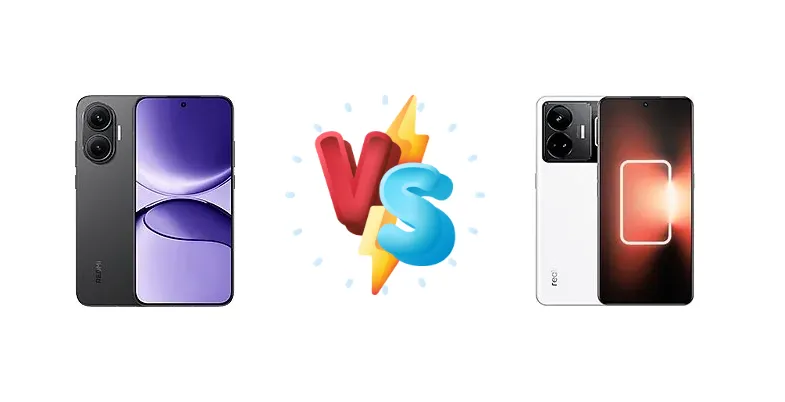
The Xiaomi Redmi Turbo 4 Pro and Realme GT3 represent compelling options in the increasingly competitive mid-to-high range smartphone market. The Turbo 4 Pro arrives with the latest Snapdragon 8s Gen 4, promising a leap in efficiency and performance, while the GT3 leverages the proven Snapdragon 8+ Gen 1 and a headline-grabbing 240W charging capability. This comparison dissects the key differences to determine which device best suits your needs.
🏆 Quick Verdict
For most users, the Xiaomi Redmi Turbo 4 Pro emerges as the better overall choice. Its newer Snapdragon 8s Gen 4 chipset delivers improved CPU and GPU performance, alongside better power efficiency. While the Realme GT3’s 240W charging is undeniably impressive, the Turbo 4 Pro’s 90W charging is still very fast and paired with a more modern processor.
| Network |
|---|
| 2G bands | GSM 850 / 900 / 1800 / 1900 | GSM 850 / 900 / 1800 / 1900 |
| 3G bands | HSDPA 800 / 850 / 900 / 1700(AWS) / 2100 | HSDPA 850 / 900 / 1700(AWS) / 1900 / 2100 |
| 4G bands | 1, 3, 4, 5, 8, 19, 28, 34, 38, 39, 40, 41, 42, 48, 66 | LTE |
| 5G bands | 1, 3, 5, 8, 28, 38, 40, 41, 48, 66, 77, 78 SA/NSA/Sub6 | SA/NSA |
| Speed | HSPA, LTE, 5G | HSPA, LTE, 5G |
| Technology | GSM / CDMA / HSPA / CDMA2000 / LTE / 5G | GSM / HSPA / LTE / 5G |
| Launch |
|---|
| Announced | 2025, April 24 | 2023, February 28 |
| Status | Available. Released 2025, April 24 | Available. Released 2023, July 08 |
| Body |
|---|
| Build | Glass front, aluminum frame, glass back | Glass front, plastic frame, glass back |
| Dimensions | 163.1 x 77.9 x 8 mm (6.42 x 3.07 x 0.31 in) | 163.9 x 75.8 x 8.9 mm (6.45 x 2.98 x 0.35 in) |
| SIM | Nano-SIM + Nano-SIM | Nano-SIM + Nano-SIM |
| Weight | 219 g (7.72 oz) | 199 g (7.02 oz) |
| | - | Illuminated RGB (on the back) |
| Display |
|---|
| Resolution | 1280 x 2772 pixels, 19.5:9 ratio (~447 ppi density) | 1240 x 2772 pixels, 20:9 ratio (~451 ppi density) |
| Size | 6.83 inches, 114.5 cm2 (~90.2% screen-to-body ratio) | 6.74 inches, 109.2 cm2 (~87.9% screen-to-body ratio) |
| Type | AMOLED, 68B colors, 120Hz, 3840Hz PWM, Dolby Vision, HDR10+, HDR Vivid, 800 nits (typ), 1800 nits (HBM), 3200 nits (peak | AMOLED, 1B colors, 144Hz, HDR10+, 500 nits (typ), 1100 nits (HBM), 1400 nits (peak) |
| Platform |
|---|
| CPU | Octa-core (1x3.21 GHz Cortex-X4 & 3x3.0 GHz Cortex-A720 & 2x2.8 GHz Cortex-A720 & 2x2.0 GHz Cortex-A720) | Octa-core (1x3.0 GHz Cortex-X2 & 3x2.5 GHz Cortex-A710 & 4x1.80 GHz Cortex-A510) |
| Chipset | Qualcomm SM8735 Snapdragon 8s Gen 4 (4 nm) | Qualcomm SM8475 Snapdragon 8+ Gen 1 (4 nm) |
| GPU | Adreno 825 | Adreno 730 |
| OS | Android 15, HyperOS 2 | Android 13, upgradable to Android 14, Realme UI 5.0 |
| Memory |
|---|
| Card slot | No | No |
| Internal | 256GB 12GB RAM, 256GB 16GB RAM, 512GB 12GB RAM, 512GB 16GB RAM, 1TB 16GB RAM | 128GB 8GB RAM, 256GB 12GB RAM, 256GB 16GB RAM, 512GB 16GB RAM, 1TB 16GB RAM |
| | - | UFS 3.1 |
| Main Camera |
|---|
| Dual | 50 MP, f/1.5, 26mm (wide), 1/1.95", 0.8µm, PDAF, OIS
8 MP, f/2.2, 15mm (ultrawide), 1/4.0", 1.12µm | - |
| Features | LED flash, HDR, panorama | Dual-LED dual-tone flash, HDR, panorama |
| Single | - | 16 MP, f/2.5, 25mm (wide), 1/3.09", 1.0µm |
| Triple | - | 50 MP, f/1.9, 24mm (wide), 1/1.56", 1.0µm, PDAF, OIS
8 MP, f/2.2, 16mm, 112˚ (ultrawide), 1/4.0", 1.12µm
2 MP, f/3.3, 20mm (microscope) |
| Video | 4K@30/60fps, 1080p@30/60/120/240/960fps, gyro-EIS | 4K@30/60fps, 1080p@30/60fps, gyro-EIS |
| Selfie camera |
|---|
| Features | - | HDR, panorama |
| Single | 20 MP, f/2.2, (wide), 1/4" | 16 MP, f/2.5, 25mm (wide), 1/3.09", 1.0µm |
| Video | 1080p@30/60fps | 1080p@30fps, gyro-EIS |
| Sound |
|---|
| 3.5mm jack | - | No |
| 35mm jack | No | No |
| Loudspeaker | Yes, with stereo speakers | Yes, with stereo speakers |
| | - | 24-bit/192kHz audio |
| Comms |
|---|
| Bluetooth | 5.4, A2DP, LE, aptX, LHDC 5 | 5.3, A2DP, LE, aptX HD |
| Infrared port | Yes | Yes |
| NFC | Yes | Yes (dual side) |
| Positioning | GPS (L1+L5), BDS (B1I+B1c+B2a), GALILEO (E1+E5a), QZSS (L1+L5), NavIC (L5), GLONASS | GPS (L1+L5), GLONASS, BDS, GALILEO, QZSS |
| Radio | No | No |
| USB | USB Type-C 2.0, OTG | USB Type-C 2.0 |
| WLAN | Wi-Fi 802.11 a/b/g/n/ac/6/7, dual-band, Wi-Fi Direct | Wi-Fi 802.11 a/b/g/n/ac, dual-band |
| Features |
|---|
| Sensors | Fingerprint (under display, optical), accelerometer, gyro, proximity, compass | Fingerprint (under display, optical), accelerometer, gyro, proximity, compass |
| Battery |
|---|
| Charging | 90W wired, PD3.0, QC3+
22.5W reverse wired | 240W wired, PD, 50% in 4 min, 100% in 10 min |
| Type | Si/C Li-Ion 7550 mAh | 4600 mAh |
| Misc |
|---|
| Colors | Black, White, Green, Harry Potter edition | Pulse White, Booster Black |
| Models | 25053RT47C | RMX3709 |
| Price | About 240 EUR | About 600 EUR |
| Tests |
|---|
| Battery life | - |
Endurance rating 117h
|
| Camera | - |
Photo / Video |
| Display | - |
Contrast ratio: Infinite (nominal) |
| Loudspeaker | - |
-26.9 LUFS (Good)
|
| Performance | - |
AnTuTu: 1074427 (v9)
GeekBench: 3898 (v5.1), 3980 (v6)
GFXBench: 59fps (ES 3.1 onscreen) |
Xiaomi Redmi Turbo 4 Pro
- Newer Snapdragon 8s Gen 4 chipset for improved performance
- More efficient 4nm process for better thermal management
- 90W fast charging with PD3.0 and QC3+ support
- Charging speed is slower than the Realme GT3
- Camera specifications are currently unknown
Realme GT3
- Blazing-fast 240W charging (50% in 4 min, 100% in 10 min)
- High peak display brightness (974 nits)
- Proven Snapdragon 8+ Gen 1 performance
- Older Snapdragon 8+ Gen 1 chipset
- Potentially higher power consumption compared to the 8s Gen 4
Display Comparison
The Realme GT3 boasts a measured peak brightness of 974 nits, suggesting a vibrant viewing experience, though the Redmi Turbo 4 Pro’s display specifications are currently unavailable. Both displays feature an infinite (nominal) contrast ratio, typical of OLED panels. Without knowing the Turbo 4 Pro’s panel technology (LTPO or not) and refresh rate, it’s difficult to definitively declare a winner. However, the GT3’s high peak brightness is a clear advantage for outdoor visibility.
Camera Comparison
Both devices are listed as having Photo/Video capabilities, but specific details regarding sensor size, OIS, and lens apertures are absent. Without this information, a meaningful comparison is impossible. However, given the market positioning, it’s reasonable to expect both phones to offer competitive camera systems, likely focusing on computational photography to enhance image quality. The absence of detail suggests neither phone is aiming to be a camera-centric flagship.
Performance
The core difference lies in the chipsets. The Xiaomi Redmi Turbo 4 Pro utilizes the Qualcomm SM8735 Snapdragon 8s Gen 4 (4nm), featuring a Cortex-X4 prime core clocked at 3.21 GHz. This architecture represents a significant upgrade over the Realme GT3’s Snapdragon 8+ Gen 1 (4nm), which has a Cortex-X2 prime core at 3.0 GHz. The 8s Gen 4’s newer CPU cores (Cortex-A720) and more efficient 4nm process should translate to better multi-core performance and improved thermal management during prolonged intensive tasks. While the 8+ Gen 1 remains a capable performer, the 8s Gen 4 offers a clear generational advantage.
Battery Life
Both phones share an endurance rating of 117 hours, indicating similar overall battery life despite differing charging capabilities. The Realme GT3’s standout feature is its 240W wired charging, capable of reaching 50% charge in just 4 minutes and 100% in 10 minutes. The Redmi Turbo 4 Pro offers a more modest 90W wired charging, supporting PD3.0 and QC3+, alongside 22.5W reverse wired charging. While 90W is still fast, the GT3’s 240W charging is in a different league, catering to users who prioritize minimizing downtime.
Buying Guide
Buy the Xiaomi Redmi Turbo 4 Pro if you prioritize sustained performance for gaming and demanding applications, and value a more future-proof chipset. Buy the Realme GT3 if your absolute top priority is the fastest possible charging speeds and you frequently find yourself needing to top up your battery in minimal time. The GT3 is also a strong contender if you find a significant price difference favoring it.
Frequently Asked Questions
❓ Will the Snapdragon 8s Gen 4 in the Redmi Turbo 4 Pro handle demanding games like Genshin Impact at high settings?
Yes, the Snapdragon 8s Gen 4 is designed for high-performance gaming. Its Cortex-X4 prime core and improved GPU architecture should deliver a smooth and enjoyable experience even with graphically intensive titles like Genshin Impact at high settings. The 4nm process also helps mitigate thermal throttling during extended gaming sessions.
❓ Is the 240W charging on the Realme GT3 safe for the battery's long-term health?
Realme has implemented several safety measures to protect the battery during 240W charging, including advanced temperature control and optimized charging algorithms. While extremely fast charging *can* theoretically contribute to faster battery degradation over years of use, the GT3’s charging system is designed to minimize this effect. However, users prioritizing maximum battery lifespan might prefer the slower, but still fast, 90W charging of the Turbo 4 Pro.
❓ Does the Redmi Turbo 4 Pro support expandable storage via microSD card?
Unfortunately, this information is not available in the provided context data. However, based on recent trends in flagship and mid-range smartphones, it is unlikely that the Redmi Turbo 4 Pro supports microSD card expansion. Users should consider the internal storage options carefully before purchasing.