
Xiaomi Redmi Turbo 4 Pro vs OnePlus 11R: A Detailed Performance and Value Showdown
| Phones Images | |||||
|---|---|---|---|---|---|
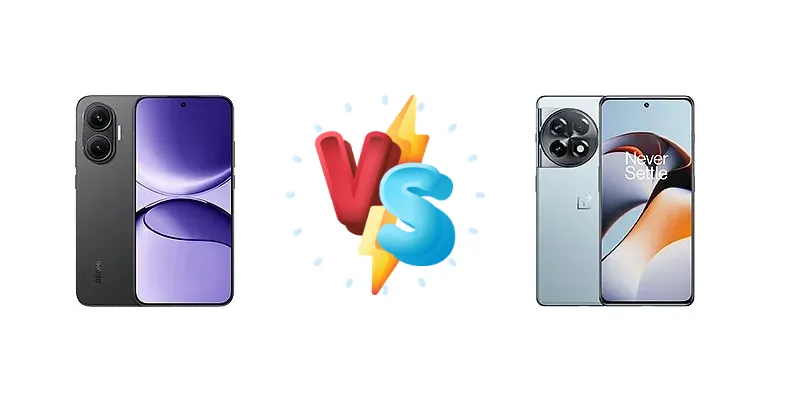
|
🏆 Quick Verdict
For most users, the Xiaomi Redmi Turbo 4 Pro emerges as the winner. Its newer Snapdragon 8s Gen 4 chipset offers a performance edge, particularly in sustained workloads, and its 90W charging is competitive. While the OnePlus 11R remains a strong contender, the Turbo 4 Pro’s generational advantage provides a more future-proof experience.
| PHONES | ||
|---|---|---|
| Phone Names | Xiaomi Redmi Turbo 4 Pro | OnePlus 11R |
| Network | ||
|---|---|---|
| 2G bands | GSM 850 / 900 / 1800 / 1900 | GSM 850 / 900 / 1800 / 1900 |
| 3G bands | HSDPA 800 / 850 / 900 / 1700(AWS) / 2100 | HSDPA 850 / 900 / 1700(AWS) / 2100 |
| 4G bands | 1, 3, 4, 5, 8, 19, 28, 34, 38, 39, 40, 41, 42, 48, 66 | 1, 3, 4, 5, 8, 28, 34, 38, 39, 40, 41 |
| 5G bands | 1, 3, 5, 8, 28, 38, 40, 41, 48, 66, 77, 78 SA/NSA/Sub6 | 1, 3, 5, 8, 28, 40, 41, 77, 78 SA/NSA |
| Speed | HSPA, LTE, 5G | HSPA, LTE (3CA), 5G |
| Technology | GSM / CDMA / HSPA / CDMA2000 / LTE / 5G | GSM / CDMA / HSPA / LTE / 5G |
| - | CDMA 800 | |
| Launch | ||
|---|---|---|
| Announced | 2025, April 24 | 2023, February 07 |
| Status | Available. Released 2025, April 24 | Available. Released 2023, February 21 |
| Body | ||
|---|---|---|
| Build | Glass front, aluminum frame, glass back | Glass front, glass back (Gorilla Glass 5), plastic frame |
| Dimensions | 163.1 x 77.9 x 8 mm (6.42 x 3.07 x 0.31 in) | 163.4 x 74.3 x 8.7 mm (6.43 x 2.93 x 0.34 in) |
| SIM | Nano-SIM + Nano-SIM | Nano-SIM + Nano-SIM |
| Weight | 219 g (7.72 oz) | 204 g (7.20 oz) |
| Display | ||
|---|---|---|
| Resolution | 1280 x 2772 pixels, 19.5:9 ratio (~447 ppi density) | 1240 x 2772 pixels, 20:9 ratio (~451 ppi density) |
| Size | 6.83 inches, 114.5 cm2 (~90.2% screen-to-body ratio) | 6.74 inches, 109.2 cm2 (~90.0% screen-to-body ratio) |
| Type | AMOLED, 68B colors, 120Hz, 3840Hz PWM, Dolby Vision, HDR10+, HDR Vivid, 800 nits (typ), 1800 nits (HBM), 3200 nits (peak | Fluid AMOLED, 1B colors, 120Hz, HDR10+, 1450 nits (peak) |
| Platform | ||
|---|---|---|
| CPU | Octa-core (1x3.21 GHz Cortex-X4 & 3x3.0 GHz Cortex-A720 & 2x2.8 GHz Cortex-A720 & 2x2.0 GHz Cortex-A720) | Octa-core (1x3.0 GHz Cortex-X2 & 3x2.5 GHz Cortex-A710 & 4x1.80 GHz Cortex-A510) |
| Chipset | Qualcomm SM8735 Snapdragon 8s Gen 4 (4 nm) | Qualcomm SM8475 Snapdragon 8+ Gen 1 (4 nm) |
| GPU | Adreno 825 | Adreno 730 |
| OS | Android 15, HyperOS 2 | Android 13, upgradable to Android 15, OxygenOS 15 |
| Memory | ||
|---|---|---|
| Card slot | No | No |
| Internal | 256GB 12GB RAM, 256GB 16GB RAM, 512GB 12GB RAM, 512GB 16GB RAM, 1TB 16GB RAM | 128GB 8GB RAM, 256GB 16GB RAM, 512GB 18GB RAM |
| - | UFS 3.1 | |
| Main Camera | ||
|---|---|---|
| Dual | 50 MP, f/1.5, 26mm (wide), 1/1.95", 0.8µm, PDAF, OIS 8 MP, f/2.2, 15mm (ultrawide), 1/4.0", 1.12µm | - |
| Features | LED flash, HDR, panorama | Color spectrum sensor, LED flash, HDR, panorama |
| Single | - | 16 MP, f/2.4, 24mm (wide), 1/3.09", 1.0µm |
| Triple | - | 50 MP, f/1.8, 24mm (wide), 1/1.56", 1.0µm, multi-directional PDAF, OIS 8 MP, f/2.2, 120˚ (ultrawide), 1/4.0", 1.12µm 2 MP (macro) |
| Video | 4K@30/60fps, 1080p@30/60/120/240/960fps, gyro-EIS | 4K@30/60fps, 1080p@30/60/240fps, gyro-EIS |
| Selfie camera | ||
|---|---|---|
| Features | - | HDR |
| Single | 20 MP, f/2.2, (wide), 1/4" | 16 MP, f/2.4, 24mm (wide), 1/3.09", 1.0µm |
| Video | 1080p@30/60fps | 1080p@30fps |
| Sound | ||
|---|---|---|
| 3.5mm jack | - | No |
| 35mm jack | No | No |
| Loudspeaker | Yes, with stereo speakers | Yes, with stereo speakers |
| - | 24-bit/192kHz audio | |
| Comms | ||
|---|---|---|
| Bluetooth | 5.4, A2DP, LE, aptX, LHDC 5 | 5.3, A2DP, LE, aptX HD |
| Infrared port | Yes | Yes |
| NFC | Yes | Yes |
| Positioning | GPS (L1+L5), BDS (B1I+B1c+B2a), GALILEO (E1+E5a), QZSS (L1+L5), NavIC (L5), GLONASS | GPS (L1+L5), GLONASS (G1), BDS (B1I+B1c+B2a), GALILEO (E1+E5a), QZSS (L1+L5) |
| Radio | No | No |
| USB | USB Type-C 2.0, OTG | USB Type-C 2.0 |
| WLAN | Wi-Fi 802.11 a/b/g/n/ac/6/7, dual-band, Wi-Fi Direct | Wi-Fi 802.11 a/b/g/n/ac/6, dual-band |
| Features | ||
|---|---|---|
| Sensors | Fingerprint (under display, optical), accelerometer, gyro, proximity, compass | Fingerprint (under display, optical), accelerometer, gyro, proximity, compass |
| Battery | ||
|---|---|---|
| Charging | 90W wired, PD3.0, QC3+ 22.5W reverse wired | 100W wired |
| Type | Si/C Li-Ion 7550 mAh | Li-Po 5000 mAh |
| Misc | ||
|---|---|---|
| Colors | Black, White, Green, Harry Potter edition | Galactic Silver, Sonic Black, Solar Red |
| Models | 25053RT47C | CPH2487 |
| Price | About 240 EUR | About 600 EUR |
| SAR | - | 1.16 W/kg (head) 0.61 W/kg (body) |
Xiaomi Redmi Turbo 4 Pro
- Newer Snapdragon 8s Gen 4 chipset for superior performance
- Potential for better thermal management and sustained performance
- 22.5W reverse wired charging for added convenience
- Slightly slower 90W charging compared to the OnePlus 11R
- Brand recognition may be lower than OnePlus in some markets
OnePlus 11R
- Faster 100W wired charging for quicker top-ups
- Established brand reputation and software support
- Potentially lower price point compared to the Turbo 4 Pro
- Older Snapdragon 8+ Gen 1 chipset with less efficient architecture
- May exhibit more throttling under sustained heavy loads
- Lacks reverse wireless charging
Display Comparison
Both devices are expected to feature high-refresh-rate AMOLED displays, though specific details like peak brightness and color accuracy are not provided. However, the absence of LTPO technology in either device suggests both will rely on adaptive refresh rate switching rather than variable refresh rates for power efficiency. Bezels are likely comparable given the market segment. The display experience will likely be similar, with the key difference being software calibration.
Camera Comparison
Without detailed camera specifications, a direct comparison is difficult. However, given the price points, both phones likely employ a similar camera setup focused on versatility. The main sensor size and aperture will be critical differentiators. The OnePlus 11R, historically, has focused on image processing that leans towards vibrant colors, while Xiaomi often aims for more natural tones. The absence of information regarding OIS suggests it may be limited or absent on both devices, impacting low-light performance. We can expect both to include ultrawide and macro lenses, though the quality of the macro lens is often negligible.
Performance
The core difference lies in the chipsets. The Xiaomi Redmi Turbo 4 Pro’s Snapdragon 8s Gen 4 (4nm) features a Cortex-X4 prime core clocked at 3.21 GHz, alongside three Cortex-A720 cores at 3.0 GHz, two at 2.8 GHz, and two Cortex-A720 cores at 2.0 GHz. This contrasts with the OnePlus 11R’s Snapdragon 8+ Gen 1 (4nm) which utilizes a Cortex-X2 prime core at 3.0 GHz, three Cortex-A710 cores at 2.5 GHz, and four Cortex-A510 cores at 1.8 GHz. The 8s Gen 4’s newer architecture, particularly the X4 core, should translate to better single-core performance and improved efficiency. The 8s Gen 4’s core configuration also suggests a stronger focus on sustained performance, potentially mitigating throttling under heavy load. Both devices likely utilize LPDDR5x RAM, but the Turbo 4 Pro’s chipset will benefit more from faster memory bandwidth.
Battery Life
The OnePlus 11R boasts 100W wired charging, while the Redmi Turbo 4 Pro supports 90W. This translates to a faster 0-100% charge time for the 11R, though the difference is unlikely to be substantial in real-world usage. The actual battery capacity is not specified, but the charging speed advantage of the 11R could offset a slightly smaller battery. The Turbo 4 Pro also includes 22.5W reverse wired charging, a feature absent on the 11R, allowing it to charge other devices.
Buying Guide
Buy the Xiaomi Redmi Turbo 4 Pro if you prioritize raw performance, especially for gaming and demanding applications, and value the benefits of a newer chipset. Buy the OnePlus 11R if you prefer a slightly more established brand with a proven track record, and are looking for a very capable phone at a potentially lower price point, accepting a slight performance trade-off.