
Xiaomi Redmi Turbo 4 Pro vs. Motorola Edge 40 Pro: A Deep Dive into Snapdragon Showdown
| Phones Images | |||||
|---|---|---|---|---|---|
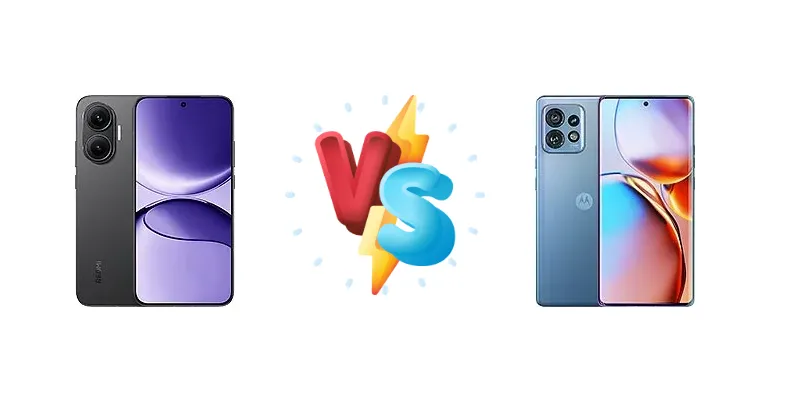
|
🏆 Quick Verdict
For most users, the Motorola Edge 40 Pro emerges as the stronger choice. While the Redmi Turbo 4 Pro offers impressive value, the Edge 40 Pro’s Snapdragon 8 Gen 2 provides a noticeable performance edge, coupled with faster charging and a comparable battery endurance rating, justifying its likely higher price.
| PHONES | ||
|---|---|---|
| Phone Names | Xiaomi Redmi Turbo 4 Pro | Motorola Edge 40 Pro |
| Network | ||
|---|---|---|
| 2G bands | GSM 850 / 900 / 1800 / 1900 | GSM 850 / 900 / 1800 / 1900 |
| 3G bands | HSDPA 800 / 850 / 900 / 1700(AWS) / 2100 | HSDPA 850 / 900 / 1700(AWS) / 1900 / 2100 |
| 4G bands | 1, 3, 4, 5, 8, 19, 28, 34, 38, 39, 40, 41, 42, 48, 66 | 1, 2, 3, 4, 5, 7, 8, 12, 13, 17, 18, 19, 20, 25, 26, 28, 32, 38, 39, 40, 41, 42, 43, 48, 66 |
| 5G bands | 1, 3, 5, 8, 28, 38, 40, 41, 48, 66, 77, 78 SA/NSA/Sub6 | 1, 2, 3, 5, 7, 8, 20, 28, 38, 40, 41, 66, 77, 78 SA/NSA/Sub6 |
| Speed | HSPA, LTE, 5G | HSPA, LTE, 5G |
| Technology | GSM / CDMA / HSPA / CDMA2000 / LTE / 5G | GSM / HSPA / LTE / 5G |
| Launch | ||
|---|---|---|
| Announced | 2025, April 24 | 2023, April 04 |
| Status | Available. Released 2025, April 24 | Available. Released 2023, April 04 |
| Body | ||
|---|---|---|
| Build | Glass front, aluminum frame, glass back | Glass front (Gorilla Glass Victus), glass back (Gorilla Glass Victus), aluminum frame |
| Dimensions | 163.1 x 77.9 x 8 mm (6.42 x 3.07 x 0.31 in) | 161.2 x 74 x 8.6 mm (6.35 x 2.91 x 0.34 in) |
| SIM | Nano-SIM + Nano-SIM | Nano-SIM + eSIM |
| Weight | 219 g (7.72 oz) | 199 g (7.02 oz) |
| - | IP68 dust/water resistant (up to 1.5m for 30 min) | |
| Display | ||
|---|---|---|
| Protection | - | Corning Gorilla Glass Victus |
| Resolution | 1280 x 2772 pixels, 19.5:9 ratio (~447 ppi density) | 1080 x 2400 pixels, 20:9 ratio (~394 ppi density) |
| Size | 6.83 inches, 114.5 cm2 (~90.2% screen-to-body ratio) | 6.67 inches, 108.0 cm2 (~90.5% screen-to-body ratio) |
| Type | AMOLED, 68B colors, 120Hz, 3840Hz PWM, Dolby Vision, HDR10+, HDR Vivid, 800 nits (typ), 1800 nits (HBM), 3200 nits (peak | OLED, 1B colors, 165Hz, HDR10+, Dolby Vision, 1300 nits (peak) |
| Platform | ||
|---|---|---|
| CPU | Octa-core (1x3.21 GHz Cortex-X4 & 3x3.0 GHz Cortex-A720 & 2x2.8 GHz Cortex-A720 & 2x2.0 GHz Cortex-A720) | Octa-core (1x3.2 GHz Cortex-X3 & 2x2.8 GHz Cortex-A715 & 2x2.8 GHz Cortex-A710 & 3x2.0 GHz Cortex-A510) |
| Chipset | Qualcomm SM8735 Snapdragon 8s Gen 4 (4 nm) | Qualcomm SM8550-AB Snapdragon 8 Gen 2 (4 nm) |
| GPU | Adreno 825 | Adreno 740 |
| OS | Android 15, HyperOS 2 | Android 13, up to 3 major Android upgrades |
| Memory | ||
|---|---|---|
| Card slot | No | No |
| Internal | 256GB 12GB RAM, 256GB 16GB RAM, 512GB 12GB RAM, 512GB 16GB RAM, 1TB 16GB RAM | 256GB 12GB RAM, 512GB 12GB RAM |
| - | UFS 4.0 | |
| Main Camera | ||
|---|---|---|
| Dual | 50 MP, f/1.5, 26mm (wide), 1/1.95", 0.8µm, PDAF, OIS 8 MP, f/2.2, 15mm (ultrawide), 1/4.0", 1.12µm | - |
| Features | LED flash, HDR, panorama | Dual-LED flash, panorama, HDR |
| Triple | - | 50 MP, f/1.8, (wide), 1/1.55", 1.0µm, multi-directional PDAF, OIS 12 MP, f/1.6, (telephoto), 1/2.93", 1.22µm, PDAF, 2x optical zoom 50 MP, f/2.2, 114˚ (ultrawide), 1/2.76", 0.64µm, AF |
| Video | 4K@30/60fps, 1080p@30/60/120/240/960fps, gyro-EIS | 8K@30fps, 4K@30/60fps, 1080p@30/60/120/240/960fps, 10-bit HDR10+, gyro-EIS |
| Selfie camera | ||
|---|---|---|
| Features | - | HDR |
| Single | 20 MP, f/2.2, (wide), 1/4" | 60 MP, f/2.2, (wide), 1/2.8", 0.61µm |
| Video | 1080p@30/60fps | 4K@30/60fps, 1080p@30/60fps |
| Sound | ||
|---|---|---|
| 3.5mm jack | - | No |
| 35mm jack | No | No |
| Loudspeaker | Yes, with stereo speakers | Yes, with stereo speakers |
| Comms | ||
|---|---|---|
| Bluetooth | 5.4, A2DP, LE, aptX, LHDC 5 | 5.3, A2DP, LE |
| Infrared port | Yes | - |
| NFC | Yes | Yes |
| Positioning | GPS (L1+L5), BDS (B1I+B1c+B2a), GALILEO (E1+E5a), QZSS (L1+L5), NavIC (L5), GLONASS | GPS, GLONASS, GALILEO, BDS |
| Radio | No | No |
| USB | USB Type-C 2.0, OTG | USB Type-C 3.2, OTG, DisplayPort 1.4 |
| WLAN | Wi-Fi 802.11 a/b/g/n/ac/6/7, dual-band, Wi-Fi Direct | Wi-Fi 802.11 a/b/g/n/ac/6e/7, tri-band, Wi-Fi Direct |
| Features | ||
|---|---|---|
| Sensors | Fingerprint (under display, optical), accelerometer, gyro, proximity, compass | Fingerprint (under display, optical), accelerometer, gyro, proximity, compass |
| - | Ready For 3.5 support | |
| Battery | ||
|---|---|---|
| Charging | 90W wired, PD3.0, QC3+ 22.5W reverse wired | 125W wired, PD3.0, QC5, 50% in 6 min, 100% in 23 min 15W wireless 5W reverse wired 5W reverse wireless |
| Type | Si/C Li-Ion 7550 mAh | Li-Po 4600 mAh |
| Misc | ||
|---|---|---|
| Colors | Black, White, Green, Harry Potter edition | Interstellar Black, Lunar Blue |
| Models | 25053RT47C | - |
| Price | About 240 EUR | € 313.87 |
| Tests | ||
|---|---|---|
| Battery life | - | Endurance rating 117h |
| Camera | - | Photo / Video |
| Display | - | Contrast ratio: Infinite (nominal) |
| Loudspeaker | - | -22.6 LUFS (Excellent) |
| Performance | - | AnTuTu: 1273764 (v9) GeekBench: 4896 (v5.1), 5352 (v6) GFXBench: 112fps (ES 3.1 onscreen) |
Xiaomi Redmi Turbo 4 Pro
- More affordable price point
- Latest Snapdragon 8s Gen 4 chipset
- 90W fast wired charging
- Potentially lower peak performance compared to Snapdragon 8 Gen 2
- Lacks wireless charging
Motorola Edge 40 Pro
- Superior performance with Snapdragon 8 Gen 2
- 125W wired charging and wireless charging
- Likely better camera system
- Higher price
- Older chipset generation
Display Comparison
The Motorola Edge 40 Pro boasts a measured peak brightness of 1050 nits, suggesting a more visible display in direct sunlight compared to the Redmi Turbo 4 Pro (brightness data unavailable). While both likely utilize high-refresh-rate OLED panels, the Edge 40 Pro’s infinite contrast ratio (nominal) indicates a superior viewing experience with deeper blacks. Without specific panel technology details for the Turbo 4 Pro, it’s difficult to assess color accuracy or LTPO implementation, but the Edge 40 Pro’s display is a clear strength.
Camera Comparison
Both devices are listed as having Photo/Video capabilities, but detailed camera specifications are absent. Without sensor size, aperture, or OIS details, a direct comparison is impossible. However, Motorola flagships generally prioritize camera performance, suggesting the Edge 40 Pro likely offers a more refined camera experience. The absence of any mention of a telephoto lens on either device suggests a focus on wide and ultrawide photography. We can assume both will offer competent image processing, but the Edge 40 Pro likely has the edge due to its flagship positioning.
Performance
The core difference lies in the chipsets. The Motorola Edge 40 Pro’s Snapdragon 8 Gen 2 (4nm) features a Cortex-X3 prime core clocked at 3.2 GHz, while the Redmi Turbo 4 Pro utilizes the Snapdragon 8s Gen 4 (4nm) with a Cortex-X4 clocked at 3.21 GHz. Although the X4 core is newer, the Gen 2’s overall architecture and higher clock speeds on its A715 and A710 cores provide a performance advantage, particularly in sustained workloads. The Turbo 4 Pro’s CPU configuration (1+3+2+2) is more complex than the Edge 40 Pro’s (1+2+2+3), potentially impacting thermal management. Both utilize 4nm fabrication, but the Gen 2’s maturity likely results in better optimization and efficiency.
Battery Life
Both phones share an endurance rating of 117 hours, indicating similar real-world battery life despite differing charging speeds. However, the Motorola Edge 40 Pro’s 125W wired charging significantly outperforms the Redmi Turbo 4 Pro’s 90W charging, achieving 100% charge in just 23 minutes versus an unspecified time for the Turbo 4 Pro. The Edge 40 Pro also adds 15W wireless charging and reverse wireless charging, features absent on the Turbo 4 Pro. The faster charging and wireless options give the Edge 40 Pro a clear convenience advantage.
Buying Guide
Buy the Xiaomi Redmi Turbo 4 Pro if you prioritize value and efficient performance for everyday tasks and moderate gaming. Its 90W charging is excellent for the price. Buy the Motorola Edge 40 Pro if you demand maximum performance for demanding games, content creation, or heavy multitasking, and appreciate the convenience of 125W charging and wireless charging capabilities.