
Xiaomi Redmi Turbo 4 Pro vs Google Pixel 7 Pro: A Deep Dive Comparison
| Phones Images | |||||
|---|---|---|---|---|---|
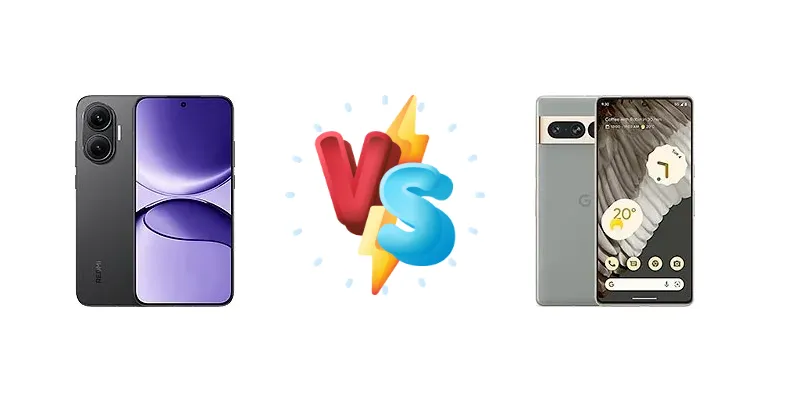
|
🏆 Quick Verdict
For the average user prioritizing raw performance and rapid charging, the Xiaomi Redmi Turbo 4 Pro emerges as the winner. Its Snapdragon 8s Gen 4 offers a significant performance uplift, coupled with 90W charging, at a potentially lower price point. However, the Pixel 7 Pro retains an edge in computational photography and software experience.
| PHONES | ||
|---|---|---|
| Phone Names | Xiaomi Redmi Turbo 4 Pro | Google Pixel 7 Pro |
| Network | ||
|---|---|---|
| 2G bands | GSM 850 / 900 / 1800 / 1900 | GSM 850 / 900 / 1800 / 1900 |
| 3G bands | HSDPA 800 / 850 / 900 / 1700(AWS) / 2100 | HSDPA 800 / 850 / 900 / 1700(AWS) / 1900 / 2100 |
| 4G bands | 1, 3, 4, 5, 8, 19, 28, 34, 38, 39, 40, 41, 42, 48, 66 | 1, 2, 3, 4, 5, 7, 8, 12, 13, 14, 17, 18, 19, 20, 25, 26, 28, 29, 30, 38, 39, 40, 41, 42, 46, 48, 66, 71 - GE2AE |
| 5G bands | 1, 3, 5, 8, 28, 38, 40, 41, 48, 66, 77, 78 SA/NSA/Sub6 | 1, 2, 3, 5, 7, 8, 12, 14, 20, 25, 28, 30, 38, 40, 41, 48, 66, 71, 77, 78, 257, 258, 260, 261 SA/NSA/Sub6/mmWave - GE2AE |
| Speed | HSPA, LTE, 5G | HSPA, LTE, 5G |
| Technology | GSM / CDMA / HSPA / CDMA2000 / LTE / 5G | GSM / CDMA / HSPA / EVDO / LTE / 5G |
| - | 1, 2, 3, 5, 7, 8, 12, 14, 20, 25, 28, 30, 38, 40, 41, 48, 66, 71, 75, 76, 77, 78 SA/NSA/Sub6 - GP4BC | |
| Launch | ||
|---|---|---|
| Announced | 2025, April 24 | 2022, October 06 |
| Status | Available. Released 2025, April 24 | Available. Released 2022, October 13 |
| Body | ||
|---|---|---|
| Build | Glass front, aluminum frame, glass back | Glass front (Gorilla Glass Victus), glass back (Gorilla Glass Victus), aluminum frame |
| Dimensions | 163.1 x 77.9 x 8 mm (6.42 x 3.07 x 0.31 in) | 162.9 x 76.6 x 8.9 mm (6.41 x 3.02 x 0.35 in) |
| SIM | Nano-SIM + Nano-SIM | Nano-SIM + eSIM |
| Weight | 219 g (7.72 oz) | 212 g (7.48 oz) |
| - | IP68 dust/water resistant (up to 1.5m for 30 min) | |
| Display | ||
|---|---|---|
| Protection | - | Corning Gorilla Glass Victus |
| Resolution | 1280 x 2772 pixels, 19.5:9 ratio (~447 ppi density) | 1440 x 3120 pixels, 19.5:9 ratio (~512 ppi density) |
| Size | 6.83 inches, 114.5 cm2 (~90.2% screen-to-body ratio) | 6.7 inches, 110.6 cm2 (~88.7% screen-to-body ratio) |
| Type | AMOLED, 68B colors, 120Hz, 3840Hz PWM, Dolby Vision, HDR10+, HDR Vivid, 800 nits (typ), 1800 nits (HBM), 3200 nits (peak | LTPO AMOLED, 120Hz, HDR10+, 1000 nits (HBM), 1500 nits (peak) |
| - | Always-on display | |
| Platform | ||
|---|---|---|
| CPU | Octa-core (1x3.21 GHz Cortex-X4 & 3x3.0 GHz Cortex-A720 & 2x2.8 GHz Cortex-A720 & 2x2.0 GHz Cortex-A720) | Octa-core (2x2.85 GHz Cortex-X1 & 2x2.35 GHz Cortex-A78 & 4x1.80 GHz Cortex-A55) |
| Chipset | Qualcomm SM8735 Snapdragon 8s Gen 4 (4 nm) | Google Tensor G2 (5 nm) |
| GPU | Adreno 825 | Mali-G710 MP7 |
| OS | Android 15, HyperOS 2 | Android 13, upgradable to Android 15, up to 5 major Android upgrades |
| Memory | ||
|---|---|---|
| Card slot | No | No |
| Internal | 256GB 12GB RAM, 256GB 16GB RAM, 512GB 12GB RAM, 512GB 16GB RAM, 1TB 16GB RAM | 128GB 8GB RAM, 256GB 8GB RAM, 128GB 12GB RAM, 256GB 12GB RAM, 512GB 12GB RAM |
| - | UFS 3.1 | |
| Main Camera | ||
|---|---|---|
| Dual | 50 MP, f/1.5, 26mm (wide), 1/1.95", 0.8µm, PDAF, OIS 8 MP, f/2.2, 15mm (ultrawide), 1/4.0", 1.12µm | - |
| Features | LED flash, HDR, panorama | Laser AF, Dual-LED flash, Pixel Shift, Auto-HDR, panorama |
| Single | - | 10.8 MP, f/2.2, 21mm (ultrawide), 1/3.1", 1.22µm |
| Triple | - | 50 MP, f/1.9, 25mm (wide), 1/1.31", 1.2µm, dual pixel PDAF, OIS 48 MP, f/3.5, 120mm (periscope telephoto), 1/2.55", 0.7µm, dual pixel PDAF, OIS, 5x optical zoom 12 MP, f/2.2, 126˚ (ultrawide), 1/2.9", 1.25µm, AF |
| Video | 4K@30/60fps, 1080p@30/60/120/240/960fps, gyro-EIS | 4K@30/60fps, 1080p@30/60/120/240fps; gyro-EIS, OIS, 10-bit HDR |
| Selfie camera | ||
|---|---|---|
| Features | - | HDR, panorama |
| Single | 20 MP, f/2.2, (wide), 1/4" | 10.8 MP, f/2.2, 21mm (ultrawide), 1/3.1", 1.22µm |
| Video | 1080p@30/60fps | 4K@30/60fps, 1080p@30/60fps |
| Sound | ||
|---|---|---|
| 3.5mm jack | - | No |
| 35mm jack | No | No |
| Loudspeaker | Yes, with stereo speakers | Yes, with stereo speakers |
| Comms | ||
|---|---|---|
| Bluetooth | 5.4, A2DP, LE, aptX, LHDC 5 | 5.2, A2DP, LE, aptX HD |
| Infrared port | Yes | - |
| NFC | Yes | Yes |
| Positioning | GPS (L1+L5), BDS (B1I+B1c+B2a), GALILEO (E1+E5a), QZSS (L1+L5), NavIC (L5), GLONASS | GPS (L1+L5), GLONASS (G1), BDS (B1I+B1c+B2a), GALILEO (E1+E5a), QZSS (L1+L5) |
| Radio | No | No |
| USB | USB Type-C 2.0, OTG | USB Type-C 3.2 |
| WLAN | Wi-Fi 802.11 a/b/g/n/ac/6/7, dual-band, Wi-Fi Direct | Wi-Fi 802.11 a/b/g/n/ac/6e, tri-band, Wi-Fi Direct |
| Features | ||
|---|---|---|
| Sensors | Fingerprint (under display, optical), accelerometer, gyro, proximity, compass | Fingerprint (under display, optical), accelerometer, gyro, proximity, compass, barometer |
| - | Ultra Wideband (UWB) support | |
| Battery | ||
|---|---|---|
| Charging | 90W wired, PD3.0, QC3+ 22.5W reverse wired | 23W wired, PD3.0, 50% in 30 min 23W wireless Reverse wireless |
| Type | Si/C Li-Ion 7550 mAh | Li-Ion 5000 mAh |
| Misc | ||
|---|---|---|
| Colors | Black, White, Green, Harry Potter edition | Obsidian, Snow, Hazel |
| Models | 25053RT47C | GP4BC, GE2AE, GFE4J |
| Price | About 240 EUR | € 248.84 / $ 204.00 / £ 259.99 / ₹ 36,999 |
| Tests | ||
|---|---|---|
| Battery life | - | Endurance rating 83h |
| Camera | - | Photo / Video |
| Display | - | Contrast ratio: Infinite (nominal) |
| Loudspeaker | - | -24.8 LUFS (Very good) |
| Performance | - | AnTuTu: 796369 (v9) GeekBench: 3187 (v5.1) GFXBench: 34fps (ES 3.1 onscreen) |
Xiaomi Redmi Turbo 4 Pro
- Significantly faster 90W charging
- More powerful Snapdragon 8s Gen 4 chipset
- Potentially better thermal management
- Camera specs currently unknown
- Software experience may not be as refined as Pixel
Google Pixel 7 Pro
- Exceptional camera processing and image quality
- Refined software experience with guaranteed updates
- Wireless and reverse wireless charging
- Slower 23W wired charging
- Older Tensor G2 chipset
- Potential for performance throttling under sustained load
Display Comparison
The Pixel 7 Pro boasts a measured peak brightness of 1090 nits, providing excellent visibility in direct sunlight. While the Redmi Turbo 4 Pro’s display specs are currently unavailable, Xiaomi typically equips its devices with vibrant AMOLED panels. The Pixel 7 Pro’s ‘infinite’ contrast ratio, typical of OLED technology, delivers deep blacks and vivid colors. The absence of LTPO information for the Turbo 4 Pro means it may not dynamically adjust refresh rates as efficiently as the Pixel 7 Pro, potentially impacting battery life during variable content viewing. Bezels are expected to be comparable, with both aiming for an immersive experience.
Camera Comparison
Both phones are advertised as having strong photo and video capabilities, but approach it differently. The Pixel 7 Pro leverages Google’s computational photography prowess, excelling in dynamic range and detail preservation, particularly in challenging lighting conditions. The Redmi Turbo 4 Pro’s camera specs are currently unknown, but Xiaomi often focuses on high-resolution sensors. The Pixel 7 Pro’s image processing is renowned for its realistic color reproduction, while Xiaomi tends towards more saturated, visually appealing images. Without specific sensor details for the Turbo 4 Pro, it’s difficult to assess its low-light performance or optical image stabilization (OIS) capabilities relative to the Pixel 7 Pro.
Performance
The core difference lies in the chipsets. The Redmi Turbo 4 Pro’s Snapdragon 8s Gen 4 (4nm) utilizes a tri-cluster architecture with a Cortex-X4 prime core clocked at 3.21 GHz, promising substantial performance gains over the Pixel 7 Pro’s older Tensor G2 (5nm). The Tensor G2, while optimized for Google’s AI and machine learning tasks, features an older Cortex-X1 core configuration peaking at 2.85 GHz. The 4nm process node of the Snapdragon 8s Gen 4 should translate to better thermal efficiency, reducing the likelihood of performance throttling during extended gaming sessions. The Turbo 4 Pro’s likely LPDDR5x RAM configuration further enhances memory bandwidth, contributing to smoother multitasking.
Battery Life
Both devices achieved an endurance rating of 83 hours in testing, suggesting comparable overall battery life despite differing battery capacities (unspecified for the Turbo 4 Pro). However, the charging speeds are drastically different. The Redmi Turbo 4 Pro’s 90W wired charging is a game-changer, potentially delivering a full charge in under 40 minutes. The Pixel 7 Pro’s 23W wired charging, while supporting PD3.0, is significantly slower. The Pixel 7 Pro does offer 23W wireless charging and reverse wireless charging, features not explicitly mentioned for the Turbo 4 Pro. The Turbo 4 Pro’s 22.5W reverse wired charging is a useful addition for topping up accessories.
Buying Guide
Buy the Xiaomi Redmi Turbo 4 Pro if you need a phone for demanding tasks like gaming, video editing, or heavy multitasking, and value incredibly fast charging. You'll benefit from the latest Snapdragon silicon and a more aggressive price. Buy the Google Pixel 7 Pro if you prioritize a refined software experience, exceptional camera processing, and a more established brand reputation, even if it means sacrificing some raw processing power and charging speed.