
Xiaomi Redmi Turbo 3 vs. K70 Ultra: A Deep Dive into Performance and Value
| Phones Images | |||||
|---|---|---|---|---|---|
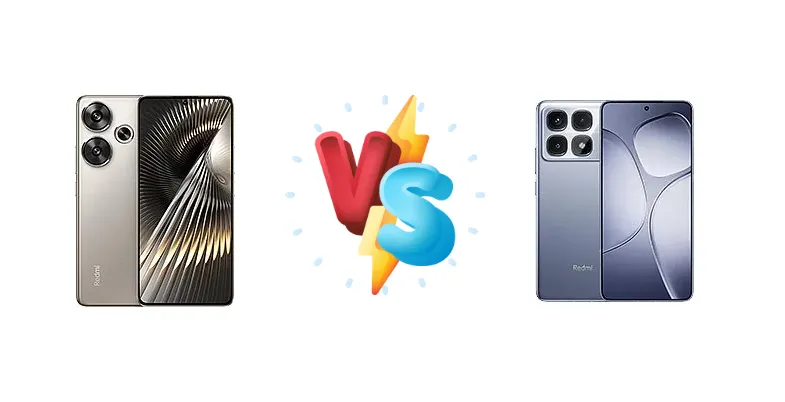
|
🏆 Quick Verdict
For the average user prioritizing raw performance and future-proofing, the Xiaomi Redmi K70 Ultra emerges as the winner. The Dimensity 9300+ offers a noticeable performance edge, especially in demanding tasks, and the 120W charging significantly reduces downtime. However, the Turbo 3 remains a compelling option for those seeking a slightly more efficient and potentially cooler experience.
| PHONES | ||
|---|---|---|
| Phone Names | Xiaomi Redmi Turbo 3 | Xiaomi Redmi K70 Ultra |
| Network | ||
|---|---|---|
| 2G bands | GSM 850 / 900 / 1800 / 1900 | GSM 850 / 900 / 1800 / 1900 |
| 3G bands | HSDPA 800 / 850 / 900 / 1700(AWS) / 1900 / 2100 | HSDPA 800 / 850 / 900 / 1700(AWS) / 2100 |
| 4G bands | 1, 3, 4, 5, 8, 18, 19, 26, 28, 34, 38, 39, 40, 41, 42, 48, 66 | 1, 3, 4, 5, 7, 8, 18, 19, 26, 28, 34, 38, 39, 40, 41, 42, 48, 66 |
| 5G bands | 1, 3, 5, 8, 28, 38, 40, 41, 48, 66, 77, 78 SA/NSA | 1, 3, 5, 7, 8, 28, 66, 38, 40, 41, 48, 77, 78 SA/NSA |
| Speed | HSPA, LTE, 5G | HSPA, LTE, 5G |
| Technology | GSM / CDMA / HSPA / CDMA2000 / LTE / 5G | GSM / CDMA / HSPA / CDMA2000 / LTE / 5G |
| Launch | ||
|---|---|---|
| Announced | 2024, April 10 | 2024, July 19 |
| Status | Available. Released 2024, April 10 | Available. Released 2024, July 19 |
| Body | ||
|---|---|---|
| Build | Glass front (Gorilla Glass Victus), plastic frame, plastic back | Glass front, aluminum frame |
| Dimensions | 160.5 x 74.4 x 7.8 mm (6.32 x 2.93 x 0.31 in) | 160.4 x 75.1 x 8.4 mm (6.31 x 2.96 x 0.33 in) |
| SIM | Nano-SIM + Nano-SIM | Nano-SIM + Nano-SIM |
| Weight | 179 g (6.31 oz) | 211 g (7.44 oz) |
| Display | ||
|---|---|---|
| Protection | Corning Gorilla Glass Victus | Scratch/drop-resistant glass |
| Resolution | 1220 x 2712 pixels, 20:9 ratio (~446 ppi density) | 1220 x 2712 pixels, 20:9 ratio (~446 ppi density) |
| Size | 6.67 inches, 107.4 cm2 (~89.9% screen-to-body ratio) | 6.67 inches, 107.4 cm2 (~89.1% screen-to-body ratio) |
| Type | AMOLED, 68B colors, 120Hz, Dolby Vision, HDR10+, 2400 nits (peak) | OLED, 68B colors, 144Hz, Dolby Vision, HDR10+, 1600 nits (HBM), 4000 nits (peak) |
| Platform | ||
|---|---|---|
| CPU | Octa-core (1x3.0 GHz Cortex-X4 & 4x2.8 GHz Cortex-A720 & 3x2.0 GHz Cortex-A520) | Octa-core (1x3.25 GHz Cortex-X4 & 3x2.85 GHz Cortex-X4 & 4x2.0 GHz Cortex-A720) |
| Chipset | Qualcomm SM8635 Snapdragon 8s Gen 3 (4 nm) | Mediatek Dimensity 9300+ (4 nm) |
| GPU | Adreno 735 | Immortalis-G720 MC12 |
| OS | Android 14, HyperOS | Android 14, HyperOS |
| Memory | ||
|---|---|---|
| Card slot | No | No |
| Internal | 256GB 12GB RAM, 512GB 12GB RAM, 512GB 16GB RAM, 1TB 16GB RAM | 256GB 12GB RAM, 512GB 12GB RAM, 512GB 16GB RAM, 1TB 16GB RAM, 1TB 24GB RAM |
| Main Camera | ||
|---|---|---|
| Dual | 50 MP, f/1.6, (wide), 1/1.95", 0.8µm, PDAF, OIS 8 MP, (ultrawide), 1/4.0", 1.12µm | - |
| Features | LED flash, HDR, panorama | Color spectrum sensor, Dual-LED dual-tone flash, HDR, panorama |
| Triple | - | 50 MP, f/1.7, 23mm (wide), 1/1.56", 1.0µm, PDAF, OIS 8 MP, 119˚ (ultrawide), 1/4.0", 1.12µm 2 MP (macro) |
| Video | 4K@30/60fps, 1080p@30/60/120/240fps, gyro-EIS | 8K@24/30fps, 4K@24/30/60fps, 1080p@30/60/120/240/960fps, gyro-EIS |
| Selfie camera | ||
|---|---|---|
| Features | HDR | HDR |
| Single | 20 MP, f/2.2, (wide), 0.8µm | 20 MP, (wide), 1/2.0", 0.8µm |
| Video | 1080p@30/60fps | 1080p@30fps |
| Sound | ||
|---|---|---|
| 35mm jack | No | No |
| Loudspeaker | Yes, with stereo speakers | Yes, with stereo speakers |
| Comms | ||
|---|---|---|
| Bluetooth | 5.4, A2DP, LE, aptX HD, aptX Adaptive, LHDC | 5.4, A2DP, LE, LHDC 5 |
| Infrared port | Yes | Yes |
| NFC | Yes | Yes |
| Positioning | GPS, GALILEO, GLONASS, QZSS, BDS (B1I+B1c) | GPS (L1+L5), BDS (B1I+B1C+B2a+B2b), GALILEO (E1+E5a+E5b), QZSS (L1+L5), NavIC (L5), GLONASS |
| Radio | No | Unspecified |
| USB | USB Type-C 2.0, OTG | USB Type-C |
| WLAN | Wi-Fi 802.11 a/b/g/n/ac/6e, dual-band, Wi-Fi Direct | Wi-Fi 802.11 a/b/g/n/ac/6/7, dual-band, Wi-Fi Direct |
| Features | ||
|---|---|---|
| Sensors | Fingerprint (under display, optical), accelerometer, gyro, proximity, compass | Fingerprint (under display, optical), accelerometer, gyro, proximity, compass |
| Battery | ||
|---|---|---|
| Charging | 90W wired, PD3.0, QC3+ | 120W wired, PD3.0, 100% in 24 min |
| Type | Li-Po 5000 mAh | Li-Po 5500 mAh |
| Misc | ||
|---|---|---|
| Colors | Black, Green, Titanium, Harry Potter | Black, White, Violet, Green Championship Edition, Orange Championship Edition |
| Models | 24069RA21C | 2407FRK8EC |
| Price | About 260 EUR | About 330 EUR |
Xiaomi Redmi Turbo 3
- Excellent performance with Snapdragon 8s Gen 3
- Potentially better thermal management
- Competitive 90W fast charging
- Slightly less powerful chipset than K70 Ultra
- May have a less advanced camera system
Xiaomi Redmi K70 Ultra
- Superior performance with Dimensity 9300+
- Ultra-fast 120W charging
- Likely more advanced camera features
- May run hotter under sustained load
- Potentially higher price point
Display Comparison
While both devices likely feature high-refresh-rate AMOLED displays (data not provided), the core difference lies in the processing power driving them. The chipset impacts the smoothness of animations and responsiveness. Without specific display specs, we can infer that Xiaomi will aim for similar quality panels across both models, focusing on color accuracy and brightness. The K70 Ultra’s more powerful chipset may allow for more sophisticated display processing, potentially enhancing HDR content.
Camera Comparison
Without detailed camera specifications, it’s difficult to make a definitive comparison. However, given the K70 Ultra’s positioning as a more premium device, it’s reasonable to expect a more advanced camera system. This could include a larger main sensor, optical image stabilization (OIS), and more sophisticated image processing algorithms. The Turbo 3 will likely offer a capable camera experience, but the K70 Ultra is expected to deliver superior image quality, particularly in low-light conditions. We can assume both will offer a range of shooting modes, but the K70 Ultra may have additional features like 8K video recording.
Performance
The heart of the difference is the chipset. The Redmi K70 Ultra’s MediaTek Dimensity 9300+ boasts a unique CPU configuration with 1x3.25 GHz Cortex-X4, 3x2.85 GHz Cortex-X4, and 4x2.0 GHz Cortex-A720 cores. This contrasts with the Redmi Turbo 3’s Qualcomm SM8635 Snapdragon 8s Gen 3, featuring 1x3.0 GHz Cortex-X4, 4x2.8 GHz Cortex-A720, and 3x2.0 GHz Cortex-A520 cores. The K70 Ultra’s increased number of high-performance X4 cores suggests superior multi-core performance. The Snapdragon 8s Gen 3, while still powerful, prioritizes efficiency. Both are built on a 4nm process, but the Dimensity 9300+’s architecture gives it a theoretical edge in sustained performance. The K70 Ultra will likely excel in demanding games and applications.
Battery Life
The Redmi K70 Ultra’s 120W wired charging is a significant advantage, promising a full charge in just 24 minutes. The Turbo 3’s 90W charging is still fast, but noticeably slower. While battery capacity isn’t specified, the faster charging of the K70 Ultra mitigates any potential disadvantage from a slightly smaller battery. The K70 Ultra’s charging also supports PD3.0, offering wider compatibility. The Turbo 3 also supports PD3.0 and QC3+, but the faster peak wattage of the K70 Ultra is the key differentiator.
Buying Guide
Buy the Xiaomi Redmi Turbo 3 if you need a well-rounded device with excellent performance for everyday tasks and gaming, and value thermal efficiency. It’s ideal for users who don’t necessarily need the absolute fastest chipset but want a smooth, reliable experience. Buy the Xiaomi Redmi K70 Ultra if you prioritize maximum performance, especially for gaming and content creation, and demand the fastest possible charging speeds. This phone is for power users who want the best possible specs within a reasonable budget.