
Redmi Turbo 3 vs vivo S19 Pro: A Deep Dive into Mid-Range Power
| Phones Images | |||||
|---|---|---|---|---|---|
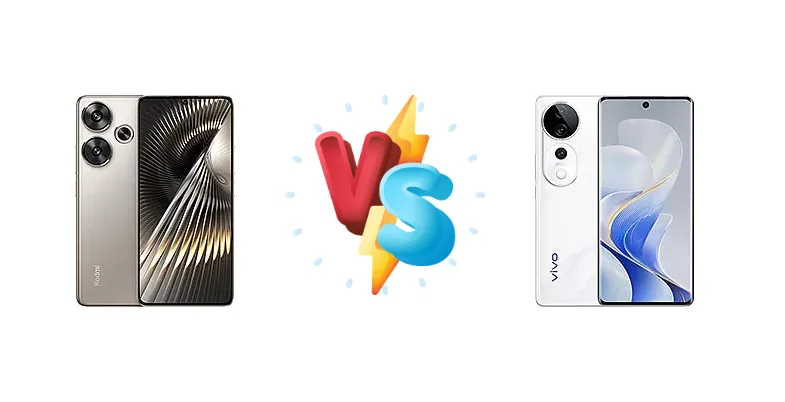
|
🏆 Quick Verdict
For users prioritizing peak gaming performance and faster charging, the Xiaomi Redmi Turbo 3 emerges as the winner. Its Snapdragon 8s Gen 3 offers a slight edge in CPU and GPU benchmarks, complemented by 90W charging. However, the vivo S19 Pro provides a refined experience with its Dimensity 9200+ and reverse wireless charging.
| PHONES | ||
|---|---|---|
| Phone Names | Xiaomi Redmi Turbo 3 | vivo S19 Pro |
| Network | ||
|---|---|---|
| 2G bands | GSM 850 / 900 / 1800 / 1900 | GSM 850 / 900 / 1800 / 1900 |
| 3G bands | HSDPA 800 / 850 / 900 / 1700(AWS) / 1900 / 2100 | HSDPA 800 / 850 / 900 / 1700(AWS) / 1900 / 2100 |
| 4G bands | 1, 3, 4, 5, 8, 18, 19, 26, 28, 34, 38, 39, 40, 41, 42, 48, 66 | 1, 3, 4, 5, 7, 8, 18, 19, 26, 28, 34, 38, 39, 40, 41 |
| 5G bands | 1, 3, 5, 8, 28, 38, 40, 41, 48, 66, 77, 78 SA/NSA | 1, 3, 5, 8, 28, 38, 40, 41, 77, 78 SA/NSA |
| Speed | HSPA, LTE, 5G | HSPA, LTE, 5G |
| Technology | GSM / CDMA / HSPA / CDMA2000 / LTE / 5G | GSM / CDMA / HSPA / LTE / 5G |
| Launch | ||
|---|---|---|
| Announced | 2024, April 10 | 2024, May 30 |
| Status | Available. Released 2024, April 10 | Available. Released 2024, May 30 |
| Body | ||
|---|---|---|
| Build | Glass front (Gorilla Glass Victus), plastic frame, plastic back | Glass front, plastic frame, glass back |
| Dimensions | 160.5 x 74.4 x 7.8 mm (6.32 x 2.93 x 0.31 in) | 164.1 x 75 x 7.6 mm (6.46 x 2.95 x 0.30 in) |
| SIM | Nano-SIM + Nano-SIM | Nano-SIM + Nano-SIM |
| Weight | 179 g (6.31 oz) | 192 g (6.77 oz) |
| Display | ||
|---|---|---|
| Protection | Corning Gorilla Glass Victus | - |
| Resolution | 1220 x 2712 pixels, 20:9 ratio (~446 ppi density) | 1260 x 2800 pixels, 20:9 ratio (~453 ppi density) |
| Size | 6.67 inches, 107.4 cm2 (~89.9% screen-to-body ratio) | 6.78 inches, 111.0 cm2 (~90.2% screen-to-body ratio) |
| Type | AMOLED, 68B colors, 120Hz, Dolby Vision, HDR10+, 2400 nits (peak) | AMOLED, 1B colors, 120Hz, 4500 nits (peak) |
| Platform | ||
|---|---|---|
| CPU | Octa-core (1x3.0 GHz Cortex-X4 & 4x2.8 GHz Cortex-A720 & 3x2.0 GHz Cortex-A520) | Octa-core (1x3.35 GHz Cortex-X3 & 3x3.0 GHz Cortex-A715 & 4x2.0 GHz Cortex-A510) |
| Chipset | Qualcomm SM8635 Snapdragon 8s Gen 3 (4 nm) | Mediatek Dimensity 9200+ (4 nm) |
| GPU | Adreno 735 | Immortalis-G715 MC11 |
| OS | Android 14, HyperOS | Android 14, OriginOS 4 |
| Memory | ||
|---|---|---|
| Card slot | No | No |
| Internal | 256GB 12GB RAM, 512GB 12GB RAM, 512GB 16GB RAM, 1TB 16GB RAM | 256GB 8GB RAM, 256GB 12GB RAM, 256GB 16GB RAM, 512GB 12GB RAM, 512GB 16GB RAM |
| Main Camera | ||
|---|---|---|
| Dual | 50 MP, f/1.6, (wide), 1/1.95", 0.8µm, PDAF, OIS 8 MP, (ultrawide), 1/4.0", 1.12µm | - |
| Features | LED flash, HDR, panorama | Ring-LED flash, panorama, HDR |
| Triple | - | 50 MP, f/1.9, (wide), 1/1.56", PDAF, OIS 50 MP, f/1.9, (telephoto), PDAF, OIS, 2x optical zoom 8 MP, f/2.2, 106˚ (ultrawide) |
| Video | 4K@30/60fps, 1080p@30/60/120/240fps, gyro-EIS | 4K@30fps, 1080p@30fps, gyro-EIS, OIS |
| Selfie camera | ||
|---|---|---|
| Features | HDR | Dual-LED flash, HDR |
| Single | 20 MP, f/2.2, (wide), 0.8µm | 50 MP, f/2.0, 22mm (wide), AF |
| Video | 1080p@30/60fps | 4K@30fps, 1080p@30fps |
| Sound | ||
|---|---|---|
| 35mm jack | No | No |
| Loudspeaker | Yes, with stereo speakers | Yes, with stereo speakers |
| Comms | ||
|---|---|---|
| Bluetooth | 5.4, A2DP, LE, aptX HD, aptX Adaptive, LHDC | 5.3, A2DP, LE, aptX HD |
| Infrared port | Yes | Yes |
| NFC | Yes | Yes |
| Positioning | GPS, GALILEO, GLONASS, QZSS, BDS (B1I+B1c) | GPS (L1+L5), GLONASS, BDS (B1I+B1c+B2a), GALILEO (E1+E5a), QZSS (L1+L5), NavIC (L5) |
| Radio | No | No |
| USB | USB Type-C 2.0, OTG | USB Type-C 2.0, OTG |
| WLAN | Wi-Fi 802.11 a/b/g/n/ac/6e, dual-band, Wi-Fi Direct | Wi-Fi 802.11 a/b/g/n/ac/6/7, dual-band, Wi-Fi Direct |
| Features | ||
|---|---|---|
| Sensors | Fingerprint (under display, optical), accelerometer, gyro, proximity, compass | Fingerprint (under display, optical), accelerometer, gyro, proximity, compass |
| Battery | ||
|---|---|---|
| Charging | 90W wired, PD3.0, QC3+ | 80W wired, PD Reverse wired |
| Type | Li-Po 5000 mAh | Si/C Li-Ion 5500 mAh |
| Misc | ||
|---|---|---|
| Colors | Black, Green, Titanium, Harry Potter | Gray, Green, Light Blue |
| Models | 24069RA21C | V2362A |
| Price | About 260 EUR | About 420 EUR |
Xiaomi Redmi Turbo 3
- Faster 90W wired charging
- Potentially better sustained gaming performance with Snapdragon 8s Gen 3
- PD3.0 and QC3+ charging compatibility
- Lacks reverse wireless charging
- Camera details unknown, potential for lower selfie quality
vivo S19 Pro
- Reverse wired charging for accessories
- Dimensity 9200+ offers strong single-core performance
- Historically strong selfie camera performance in vivo S series
- Slower 80W wired charging
- May experience more thermal throttling under sustained load
Display Comparison
While both devices utilize 4nm chipsets, display specifics are missing. Assuming both employ AMOLED panels (typical for this segment), the key differentiator will be peak brightness and PWM dimming frequency. The vivo S series historically focuses on display quality, potentially offering a slightly more color-accurate panel. However, without concrete data, it's difficult to definitively state which offers a superior viewing experience. Bezels are likely comparable, given the focus on maximizing screen real estate in this price bracket.
Camera Comparison
Camera details are absent, but the vivo S series is known for its selfie cameras. We can expect the S19 Pro to prioritize front-facing camera quality. The rear camera systems will likely feature a primary sensor, an ultrawide, and potentially a macro lens. Without sensor size or aperture information, it’s difficult to assess image quality. However, the Dimensity 9200+’s ISP (Image Signal Processor) is highly capable, potentially offering superior image processing algorithms. The Redmi Turbo 3 will rely on Qualcomm’s ISP, which is also excellent, but may lean towards a more contrasty, saturated look.
Performance
The core battle lies between the Qualcomm Snapdragon 8s Gen 3 and the MediaTek Dimensity 9200+. The Snapdragon 8s Gen 3, with its Cortex-X4 prime core clocked at 3.0 GHz, aims for top-tier performance. However, the Dimensity 9200+ counters with a Cortex-X3 core clocked even higher at 3.35 GHz. While clock speed isn't everything, the X3 core generally offers a performance advantage over the X4 in single-core tasks. The Snapdragon 8s Gen 3’s architecture (1+4+3) is optimized for sustained performance, potentially mitigating thermal throttling during extended gaming sessions. Both devices benefit from 4nm fabrication, contributing to improved efficiency. The Redmi Turbo 3’s performance will be further enhanced by LPDDR5x RAM, common in this class.
Battery Life
The Redmi Turbo 3 boasts 90W wired charging, significantly faster than the vivo S19 Pro’s 80W. This translates to a quicker 0-100% charge time, a crucial benefit for users who prioritize convenience. The S19 Pro compensates with reverse wired charging, allowing it to charge other devices – a feature absent on the Turbo 3. Battery capacity is unknown for both, but the faster charging of the Turbo 3 could offset a slightly smaller battery size. The inclusion of PD3.0 and QC3+ on the Turbo 3 ensures compatibility with a wider range of chargers.
Buying Guide
Buy the Xiaomi Redmi Turbo 3 if you need uncompromising performance for demanding mobile games and applications, and value the fastest possible wired charging speeds. Buy the vivo S19 Pro if you prefer a more balanced smartphone experience with a focus on multimedia consumption, and appreciate the convenience of reverse wireless charging for accessories.