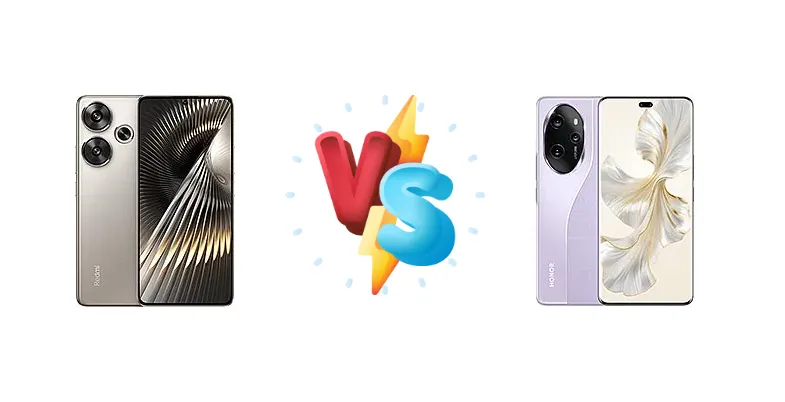
The Xiaomi Redmi Turbo 3 and Honor 100 Pro represent compelling options in the increasingly competitive flagship space. While both leverage Qualcomm's Snapdragon platform, they target slightly different priorities – the Turbo 3 focusing on raw performance-per-dollar, and the 100 Pro emphasizing a more well-rounded experience with faster charging and potentially superior camera capabilities. This comparison dissects the key differences to determine which device best suits your needs.
🏆 Quick Verdict
For the average user prioritizing gaming and sustained performance, the Honor 100 Pro emerges as the stronger choice. Its Snapdragon 8 Gen 2 chipset, while a generation older, offers a demonstrable performance advantage and superior thermal management compared to the Redmi Turbo 3’s 8s Gen 3. However, the Turbo 3 presents a compelling value proposition for budget-conscious gamers.
| Network |
|---|
| 2G bands | GSM 850 / 900 / 1800 / 1900 | GSM 850 / 900 / 1800 / 1900 |
| 3G bands | HSDPA 800 / 850 / 900 / 1700(AWS) / 1900 / 2100 | HSDPA 800 / 850 / 900 / 1700(AWS) / 1900 / 2100 |
| 4G bands | 1, 3, 4, 5, 8, 18, 19, 26, 28, 34, 38, 39, 40, 41, 42, 48, 66 | LTE |
| 5G bands | 1, 3, 5, 8, 28, 38, 40, 41, 48, 66, 77, 78 SA/NSA | SA/NSA |
| Speed | HSPA, LTE, 5G | HSPA, LTE, 5G |
| Technology | GSM / CDMA / HSPA / CDMA2000 / LTE / 5G | GSM / CDMA / HSPA / CDMA2000 / LTE / 5G |
| Launch |
|---|
| Announced | 2024, April 10 | 2023, November 23 |
| Status | Available. Released 2024, April 10 | Available. Released 2023, November 23 |
| Body |
|---|
| Build | Glass front (Gorilla Glass Victus), plastic frame, plastic back | - |
| Dimensions | 160.5 x 74.4 x 7.8 mm (6.32 x 2.93 x 0.31 in) | 163.7 x 74.7 x 8.2 mm or 8.5 mm |
| SIM | Nano-SIM + Nano-SIM | Nano-SIM + Nano-SIM |
| Weight | 179 g (6.31 oz) | 195 g (6.88 oz) |
| Display |
|---|
| Protection | Corning Gorilla Glass Victus | - |
| Resolution | 1220 x 2712 pixels, 20:9 ratio (~446 ppi density) | 1224 x 2700 pixels (~437 ppi density) |
| Size | 6.67 inches, 107.4 cm2 (~89.9% screen-to-body ratio) | 6.78 inches, 111.5 cm2 (~91.2% screen-to-body ratio) |
| Type | AMOLED, 68B colors, 120Hz, Dolby Vision, HDR10+, 2400 nits (peak) | OLED, 1B colors, 120Hz, HDR, 2600 nits (peak) |
| Platform |
|---|
| CPU | Octa-core (1x3.0 GHz Cortex-X4 & 4x2.8 GHz Cortex-A720 & 3x2.0 GHz Cortex-A520) | Octa-core (1x3.2 GHz Cortex-X3 & 2x2.8 GHz Cortex-A715 & 2x2.8 GHz Cortex-A710 & 3x2.0 GHz Cortex-A510) |
| Chipset | Qualcomm SM8635 Snapdragon 8s Gen 3 (4 nm) | Qualcomm SM8550-AB Snapdragon 8 Gen 2 (4 nm) |
| GPU | Adreno 735 | Adreno 740 |
| OS | Android 14, HyperOS | Android 13, MagicOS 7.2 |
| Memory |
|---|
| Card slot | No | No |
| Internal | 256GB 12GB RAM, 512GB 12GB RAM, 512GB 16GB RAM, 1TB 16GB RAM | 256GB 12GB RAM, 256GB 16GB RAM, 512GB 16GB RAM, 1TB 16GB RAM |
| Main Camera |
|---|
| Dual | 50 MP, f/1.6, (wide), 1/1.95", 0.8µm, PDAF, OIS
8 MP, (ultrawide), 1/4.0", 1.12µm | - |
| Features | LED flash, HDR, panorama | LED flash, HDR, panorama |
| Triple | - | 50 MP, f/2.0, 27mm (wide), 1/1.56", 1.0µm, PDAF, OIS
32 MP, f/2.4, (telephoto), PDAF, OIS, 2.5x optical zoom
12 MP, f/2.2, 112˚ (ultrawide), AF |
| Video | 4K@30/60fps, 1080p@30/60/120/240fps, gyro-EIS | 4K@30fps, 1080p@30/60fps, gyro-EIS, OIS |
| Selfie camera |
|---|
| Dual | - | 50 MP, f/2.0
2 MP, f/2.4, (depth) |
| Features | HDR | HDR |
| Single | 20 MP, f/2.2, (wide), 0.8µm | - |
| Video | 1080p@30/60fps | 4K@30fps, 1080p@30fps, gyro-EIS |
| Sound |
|---|
| 35mm jack | No | No |
| Loudspeaker | Yes, with stereo speakers | Yes, with stereo speakers |
| Comms |
|---|
| Bluetooth | 5.4, A2DP, LE, aptX HD, aptX Adaptive, LHDC | 5.3, A2DP, LE, aptX HD |
| Infrared port | Yes | - |
| NFC | Yes | Yes |
| Positioning | GPS, GALILEO, GLONASS, QZSS, BDS (B1I+B1c) | GPS, GALILEO, GLONASS, BDS, QZSS |
| Radio | No | No |
| USB | USB Type-C 2.0, OTG | USB Type-C 2.0, OTG |
| WLAN | Wi-Fi 802.11 a/b/g/n/ac/6e, dual-band, Wi-Fi Direct | Wi-Fi 802.11 a/b/g/n/ac/6, dual-band, Wi-Fi Direct |
| Features |
|---|
| Sensors | Fingerprint (under display, optical), accelerometer, gyro, proximity, compass | Fingerprint (under display, optical), accelerometer, gyro, compass, ultrasound proximity |
| Battery |
|---|
| Charging | 90W wired, PD3.0, QC3+ | 100W wired, 50% in 10 min
66W wireless, 100% in 42 min
5W reverse wired
Reverse wireless |
| Type | Li-Po 5000 mAh | Li-Po 5000 mAh |
| Misc |
|---|
| Colors | Black, Green, Titanium, Harry Potter | Black, Silver, Blue, Violet |
| Models | 24069RA21C | MAA-AN10 |
| Price | About 260 EUR | About 440 EUR |
Xiaomi Redmi Turbo 3
- Excellent performance-per-dollar ratio
- Snapdragon 8s Gen 3 offers strong CPU performance
- 90W wired charging is fast and efficient
- Potential for thermal throttling under sustained load
- Lacks wireless charging capabilities
Honor 100 Pro
- Superior chipset performance with Snapdragon 8 Gen 2
- Faster 100W wired and 66W wireless charging
- More refined camera experience (likely)
- Higher price point compared to the Redmi Turbo 3
- May not offer the absolute best value for budget-conscious users
Display Comparison
While both devices likely feature high-refresh-rate OLED panels (data not provided), the core difference lies under the hood. The Honor 100 Pro’s Snapdragon 8 Gen 2 benefits from a more mature display driver, potentially leading to smoother animations and better power efficiency. The Redmi Turbo 3’s display performance will be heavily reliant on software optimization. Without specific display specs, it’s difficult to assess color accuracy or peak brightness, but the 8 Gen 2’s ISP generally supports more advanced display calibration features.
Camera Comparison
Without detailed camera specifications, a direct comparison is challenging. However, the Snapdragon 8 Gen 2’s ISP in the Honor 100 Pro generally offers more advanced image processing capabilities, including better noise reduction and dynamic range. The 8s Gen 3 in the Turbo 3 is capable, but likely relies more heavily on software algorithms to compensate for potential hardware limitations. The Honor 100 Pro’s potential for higher-resolution sensors and more sophisticated optical image stabilization (OIS) systems further strengthens its camera advantage. We can assume the Honor 100 Pro will have a more refined camera experience.
Performance
The Snapdragon 8 Gen 2 in the Honor 100 Pro (3.2 GHz Cortex-X3) represents a significant step up in CPU performance compared to the Redmi Turbo 3’s Snapdragon 8s Gen 3 (3.0 GHz Cortex-X4). While the 8s Gen 3 features a newer Cortex-X4 core, the 8 Gen 2’s broader core configuration – including two Cortex-A715 cores and two Cortex-A710 cores versus the Turbo 3’s four A720 and three A520 – provides a more balanced and sustained performance profile. The 4nm process node is shared, but the 8 Gen 2’s larger cache and more efficient architecture translate to better multi-core performance and reduced thermal throttling. This difference will be most noticeable in demanding tasks like video editing and prolonged gaming.
Battery Life
The Honor 100 Pro boasts a clear advantage in charging speed with its 100W wired charging (50% in 10 minutes) and 66W wireless charging (100% in 42 minutes), alongside reverse charging capabilities. The Redmi Turbo 3’s 90W wired charging is respectable, but lacks the convenience of wireless charging. While battery capacity isn’t specified, the Honor 100 Pro’s more efficient chipset and optimized charging system likely mitigate any capacity differences, offering comparable or even superior real-world battery life despite potentially similar mAh ratings. The addition of reverse wireless charging on the Honor 100 Pro adds further versatility.
Buying Guide
Buy the Xiaomi Redmi Turbo 3 if you need uncompromising performance for the price, and are willing to accept potentially more aggressive thermal throttling during extended gaming sessions. It’s ideal for users who prioritize CPU and GPU benchmarks over all else. Buy the Honor 100 Pro if you prefer a more refined experience with faster charging, potentially better camera performance, and a chipset known for its stability and efficiency, even if it comes at a slightly higher cost.
Frequently Asked Questions
❓ Will the Redmi Turbo 3’s Snapdragon 8s Gen 3 overheat during extended gaming sessions like Genshin Impact?
The Snapdragon 8s Gen 3 is known to generate more heat than the 8 Gen 2. While Xiaomi likely implements thermal management solutions, expect some degree of throttling during prolonged, graphically intensive gaming. The Honor 100 Pro’s 8 Gen 2 will maintain higher sustained performance.
❓ Does the Honor 100 Pro’s 66W wireless charging significantly outperform the Redmi Turbo 3’s lack of wireless charging?
Yes, the convenience of 66W wireless charging is a substantial benefit. It eliminates the need for cables and offers a faster charging experience than many wired solutions. The Redmi Turbo 3 requires a wired connection for all charging, limiting its flexibility.
❓ Is the difference in CPU performance between the Snapdragon 8 Gen 2 and 8s Gen 3 noticeable in everyday tasks?
For typical daily use like browsing, social media, and video streaming, the difference will be minimal. However, when performing demanding tasks like video editing, rendering, or running complex simulations, the Snapdragon 8 Gen 2 in the Honor 100 Pro will demonstrate a clear advantage.