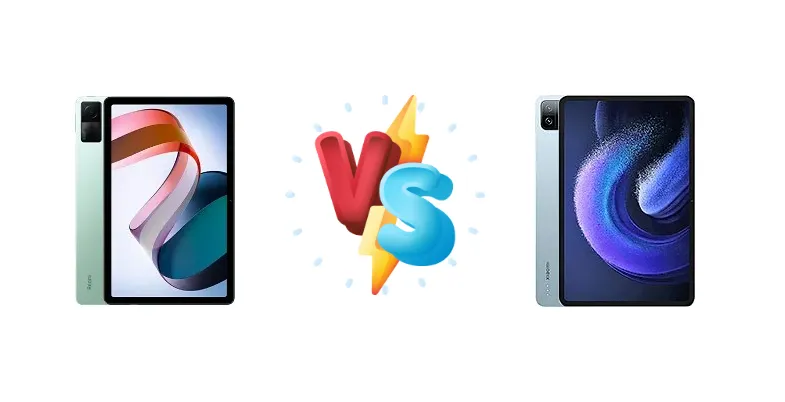
The Xiaomi Pad series offers excellent value in the tablet market, but choosing between models can be tricky. We're pitting the budget-friendly Redmi Pad against the more premium Pad 6 to determine which one reigns supreme. This detailed comparison will cover everything from display quality to performance and battery life.
🏆 Quick Verdict
The Xiaomi Pad 6 is the clear winner, offering significantly better performance thanks to the Snapdragon 870 and faster charging. However, the Redmi Pad remains a compelling option for budget-conscious users prioritizing affordability and a large display.
| Network |
|---|
| 2G bands | N/A | N/A |
| 3G bands | N/A | N/A |
| 4G bands | N/A | - |
| EDGE | N/A | N/A |
| GPRS | N/A | N/A |
| Technology | No cellular connectivity | No cellular connectivity |
| Launch |
|---|
| Announced | 2022, October 04 | 2023, April 18 |
| Status | Available. Released 2022, October 05 | Available. Released 2023, April 18 |
| Body |
|---|
| Build | Glass front, aluminum frame | Glass front (Gorilla Glass 3), aluminum frame, aluminum back |
| Dimensions | 250.5 x 158.1 x 7.1 mm (9.86 x 6.22 x 0.28 in) | 254 x 165.2 x 6.5 mm (10.0 x 6.50 x 0.26 in) |
| SIM | No | No |
| Weight | 465 g (1.03 lb) | 490 g (1.08 lb) |
| | - | Stylus support (magnetic) |
| Display |
|---|
| Protection | - | Corning Gorilla Glass 3 |
| Resolution | 1200 x 2000 pixels, 5:3 ratio (~220 ppi density) | 1800 x 2880 pixels, 16:10 ratio (~309 ppi density) |
| Size | 10.61 inches, 320.4 cm2 (~80.9% screen-to-body ratio) | 11.0 inches, 350.9 cm2 (~83.6% screen-to-body ratio) |
| Type | IPS LCD, 1B colors, 90Hz, 400 nits (typ) | IPS LCD, 1B colors, 144Hz, HDR10, Dolby Vision, 550 nits |
| Platform |
|---|
| CPU | Octa-core (2x2.2 GHz Cortex-A76 & 6x2.0 GHz Cortex-A55) | Octa-core (1x3.2 GHz Kryo 585 & 3x2.42 GHz Kryo 585 & 4x1.80 GHz Kryo 585) |
| Chipset | Mediatek Helio G99 (6 nm) | Qualcomm SM8250-AC Snapdragon 870 5G (7 nm) |
| GPU | Mali-G57 MC2 | Adreno 650 |
| OS | Android 12, upgradable to Android 13, MIUI 14 | Android 13, MIUI Pad 14 |
| Memory |
|---|
| Card slot | microSDXC | No |
| Internal | 64GB 3GB RAM, 128GB 4GB RAM, 128GB 6GB RAM | 128GB 6GB RAM, 128GB 8GB RAM, 256GB 8GB RAM |
| | UFS 2.2 | UFS 3.1 |
| Main Camera |
|---|
| Features | - | Dual-LED flash, HDR, panorama |
| Single | 8 MP, f/2.0, (wide), AF | 13 MP, f/2.2, PDAF |
| Video | 1080p@30fps | 4K@30fps, 1080p@30/60fps |
| Selfie camera |
|---|
| Single | 8 MP, f/2.3, 105° (ultrawide) | 8 MP, f/2.2, 1/4.0", 1.12µm |
| Video | 1080p@30fps | 1080p@30fps |
| Sound |
|---|
| 3.5mm jack | No | No |
| 35mm jack | No | No |
| Loudspeaker | Yes, with stereo speakers (4 speakers) | Yes, with stereo speakers (4 speakers) |
| | 24-bit/192kHz audio | 24-bit/192kHz audio |
| Comms |
|---|
| Bluetooth | 5.2, A2DP, LE | 5.2, A2DP, LE |
| NFC | No | No |
| Positioning | No | Unspecified |
| Radio | No | No |
| USB | USB Type-C, OTG | USB Type-C 3.2, accessory connector |
| WLAN | Wi-Fi 802.11 a/b/g/n/ac, dual-band, Wi-Fi Direct | Wi-Fi 802.11 a/b/g/n/a/6, dual-band, Wi-Fi Direct |
| Features |
|---|
| Sensors | Accelerometer | Accelerometer, gyro, proximity (accessories only) |
| Battery |
|---|
| Charging | 18W wired | 33W wired, PD3.0, QC4 |
| Type | Li-Po 8000 mAh | Li-Po 8840 mAh |
| Misc |
|---|
| Colors | Graphite Gray, Moonlight Silver, Mint Green | Black, Blue, Gold |
| Models | 22081283G | 23043RP34C, 23043RP34G, 23043RP34I |
| Price | About 250 EUR | About 400 EUR |
| SAR EU | 0.36 W/kg (body) | - |
| Tests |
|---|
| Display |
Contrast ratio: 1529:1 (nominal) | - |
| Loudspeaker |
-23.9 LUFS (Very good)
| - |
| Performance |
AnTuTu: 319077 (v9)
GeekBench: 1852 (v5.1)
GFXBench: 13fps (ES 3.1 onscreen) | - |
Xiaomi Redmi Pad
- Affordable
- Large Display
- Good Contrast Ratio
- Decent for Media Consumption
- Lower Performance
- Less Bright Display
- Slower Charging
- Basic Camera
Xiaomi Pad 6
- Powerful Snapdragon 870
- Brighter Display
- Faster Charging (33W)
- Better Battery Life
- Improved Camera
- More Expensive
- Slightly Lower Contrast Ratio (Nominal)
Display Comparison
The Xiaomi Pad 6 boasts a brighter display at 500 nits compared to the Redmi Pad's 402 nits. While both offer excellent contrast ratios (1529:1 for Redmi, 1060:1 for Pad 6), the Pad 6's higher brightness makes it more comfortable to use outdoors. The Pad 6 also generally has better color accuracy.
Camera Comparison
While neither tablet excels in camera quality, the Pad 6 generally offers slightly better image processing and detail. Both cameras are primarily for video calls and casual snapshots, not serious photography. The Redmi Pad's camera is adequate, but the Pad 6's is a bit more refined.
Performance
Here's where the Pad 6 truly shines. The Snapdragon 870 chipset is a significant upgrade over the Helio G99 in the Redmi Pad. Expect noticeably faster app loading times, smoother multitasking, and a much better gaming experience on the Pad 6. The Redmi Pad is adequate for everyday tasks but struggles with demanding applications.
Battery Life
The Xiaomi Pad 6 demonstrates superior battery life, achieving 9 hours and 39 minutes in active use tests. The Redmi Pad's battery life is respectable, but falls short of the Pad 6's endurance. The Pad 6's faster 33W charging also provides a quicker top-up.
Buying Guide
The Xiaomi Redmi Pad is ideal for casual users, students, or anyone needing a large screen for media consumption and light tasks. The Xiaomi Pad 6 is better suited for gamers, power users, and those who demand a smoother, faster experience with more features.
Frequently Asked Questions
❓ Is the Xiaomi Pad 6 worth the extra money?
If you prioritize performance, battery life, and a brighter display, the Pad 6 is definitely worth the investment. However, if you're on a tight budget and primarily need a tablet for basic tasks, the Redmi Pad offers excellent value.
❓ Can the Redmi Pad handle gaming?
The Redmi Pad can handle some casual games, but it will struggle with more demanding titles. The Pad 6's Snapdragon 870 provides a significantly better gaming experience.