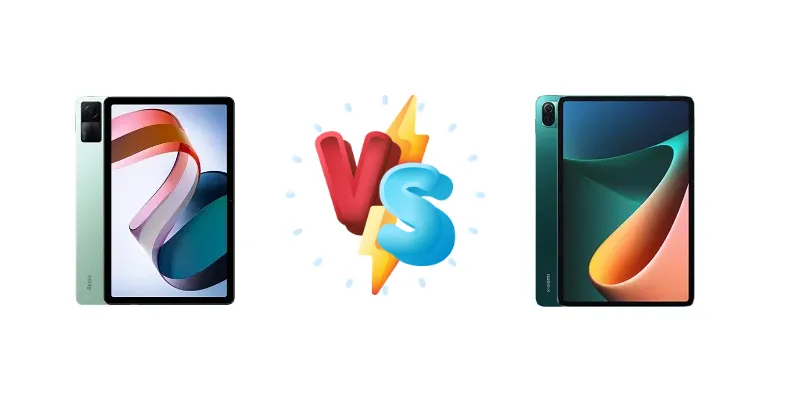
Choosing the right tablet can be tough, especially with so many options available. The Xiaomi Redmi Pad and Pad 5 are both excellent contenders, but cater to different needs and budgets. This comprehensive comparison will break down their strengths and weaknesses to help you make the best decision.
🏆 Quick Verdict
The Xiaomi Pad 5 offers significantly better performance thanks to its Snapdragon 860 chipset and faster charging. However, the Redmi Pad is a more budget-friendly option that still delivers a solid experience for everyday tasks and media consumption. The Pad 5 is the clear winner for power users.
| Network |
|---|
| 2G bands | N/A | N/A |
| 3G bands | N/A | N/A |
| 4G bands | N/A | - |
| EDGE | N/A | N/A |
| GPRS | N/A | N/A |
| Technology | No cellular connectivity | No cellular connectivity |
| Launch |
|---|
| Announced | 2022, October 04 | 2021, August 10 |
| Status | Available. Released 2022, October 05 | Available. Released 2021, August 10 |
| Body |
|---|
| Build | Glass front, aluminum frame | Glass front, aluminum frame, plastic back |
| Dimensions | 250.5 x 158.1 x 7.1 mm (9.86 x 6.22 x 0.28 in) | 254.7 x 166.3 x 6.9 mm (10.03 x 6.55 x 0.27 in) |
| SIM | No | No |
| Weight | 465 g (1.03 lb) | 511 g (1.13 lb) |
| | - | Stylus support (magnetic) |
| Display |
|---|
| Resolution | 1200 x 2000 pixels, 5:3 ratio (~220 ppi density) | 1600 x 2560 pixels, 16:10 ratio (~274 ppi density) |
| Size | 10.61 inches, 320.4 cm2 (~80.9% screen-to-body ratio) | 11.0 inches, 350.9 cm2 (~82.8% screen-to-body ratio) |
| Type | IPS LCD, 1B colors, 90Hz, 400 nits (typ) | IPS LCD, 1B colors, 120Hz, HDR10, Dolby Vision |
| Platform |
|---|
| CPU | Octa-core (2x2.2 GHz Cortex-A76 & 6x2.0 GHz Cortex-A55) | Octa-core (1x2.96 GHz Kryo 485 Gold & 3x2.42 GHz Kryo 485 Gold & 4x1.78 GHz Kryo 485 Silver) |
| Chipset | Mediatek Helio G99 (6 nm) | Qualcomm Snapdragon 860 (7 nm) |
| GPU | Mali-G57 MC2 | Adreno 640 |
| OS | Android 12, upgradable to Android 13, MIUI 14 | Android 11, upgradable to Android 13, MIUI 14 |
| Memory |
|---|
| Card slot | microSDXC | No |
| Internal | 64GB 3GB RAM, 128GB 4GB RAM, 128GB 6GB RAM | 128GB 6GB RAM, 256GB 6GB RAM |
| | UFS 2.2 | UFS 3.1 |
| Main Camera |
|---|
| Features | - | Dual-LED flash, HDR, panorama |
| Single | 8 MP, f/2.0, (wide), AF | 13 MP, f/2.0 |
| Video | 1080p@30fps | 4K@30fps, 1080p@30fps |
| Selfie camera |
|---|
| Single | 8 MP, f/2.3, 105° (ultrawide) | 8 MP, f/2.0 |
| Video | 1080p@30fps | 1080p@30fps |
| Sound |
|---|
| 3.5mm jack | No | No |
| 35mm jack | No | No |
| Loudspeaker | Yes, with stereo speakers (4 speakers) | Yes, with stereo speakers (4 speakers) |
| | 24-bit/192kHz audio | 24-bit/192kHz audio |
| Comms |
|---|
| Bluetooth | 5.2, A2DP, LE | 5.0, A2DP, LE |
| NFC | No | No |
| Positioning | No | No |
| Radio | No | No |
| USB | USB Type-C, OTG | USB Type-C |
| WLAN | Wi-Fi 802.11 a/b/g/n/ac, dual-band, Wi-Fi Direct | Wi-Fi 802.11 a/b/g/n/ac, dual-band, Wi-Fi Direct |
| Features |
|---|
| Sensors | Accelerometer | Accelerometer, gyro, proximity, compass |
| Battery |
|---|
| Charging | 18W wired | 33W wired, PD3.0 |
| Type | Li-Po 8000 mAh | Li-Po 8720 mAh |
| Misc |
|---|
| Colors | Graphite Gray, Moonlight Silver, Mint Green | Cosmic Gray, Pearl White, Green |
| Models | 22081283G | 21051182G, 21051182C |
| Price | About 250 EUR | About 350 EUR |
| SAR EU | 0.36 W/kg (body) | - |
| Tests |
|---|
| Display |
Contrast ratio: 1529:1 (nominal) |
Contrast ratio: 1271:1 (nominal) |
| Loudspeaker |
-23.9 LUFS (Very good)
|
-24.4 LUFS (Very good)
|
| Performance |
AnTuTu: 319077 (v9)
GeekBench: 1852 (v5.1)
GFXBench: 13fps (ES 3.1 onscreen) |
AnTuTu: 473819 (v8), 555079 (v9)
GeekBench: 2583 (v5.1)
GFXBench: 24fps (ES 3.1 onscreen) |
Xiaomi Redmi Pad
- Excellent value for money
- Good display quality
- Decent battery life
- Lightweight and portable
- Less powerful chipset
- Slower charging
- Average camera quality
Xiaomi Pad 5
- Powerful Snapdragon 860 chipset
- Faster 33W charging
- Brighter display
- Better performance for gaming
- More expensive
- Slightly heavier than the Redmi Pad
Display Comparison
The Xiaomi Pad 5 boasts a slightly brighter display at 478 nits compared to the Redmi Pad's 402 nits. While both offer excellent contrast ratios (1529:1 and 1271:1 respectively), the Pad 5's higher brightness provides a more vibrant viewing experience, especially in well-lit environments. Both tablets feature LCD panels, but the Pad 5's slightly superior brightness gives it an edge.
Camera Comparison
While neither tablet excels in camera quality, the Pad 5 generally offers slightly better image quality due to its superior processing power. Both cameras are primarily intended for video calls and casual snapshots. Expect average results in low-light conditions.
Performance
This is where the Xiaomi Pad 5 truly shines. The Snapdragon 860 chipset is considerably more powerful than the Mediatek Helio G99. Expect smoother multitasking, faster app loading times, and significantly better gaming performance on the Pad 5. The Redmi Pad is perfectly adequate for everyday tasks, but struggles with more demanding applications.
Battery Life
Both tablets offer decent battery life, but the Xiaomi Pad 5's 33W fast charging provides a significant advantage. It can be charged much faster than the Redmi Pad's 18W charging. Battery capacity is similar, so real-world usage should be comparable, but charging time is a key differentiator.
Buying Guide
The Xiaomi Redmi Pad is ideal for students, casual users, and those on a tight budget who primarily need a tablet for browsing, streaming, and light gaming. The Xiaomi Pad 5 is better suited for users who demand more processing power for gaming, multitasking, and creative tasks, and appreciate faster charging.
Frequently Asked Questions
❓ Is the Xiaomi Pad 5 worth the extra money?
If you prioritize performance and fast charging, the Pad 5 is definitely worth the investment. However, if you're on a budget and primarily need a tablet for basic tasks, the Redmi Pad offers excellent value.
❓ Can the Redmi Pad handle gaming?
The Redmi Pad can handle casual games, but it will struggle with more demanding titles. The Pad 5 is a much better choice for serious mobile gaming.