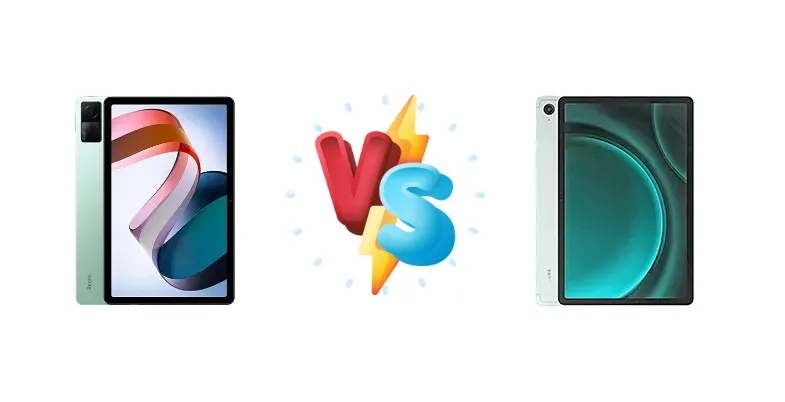
The tablet market has seen a resurgence, offering compelling alternatives to laptops for media consumption and light productivity. The Samsung Galaxy Tab S9 FE aims to deliver a premium experience at a more accessible price point, while the Xiaomi Redmi Pad focuses on delivering maximum value. This comparison dissects their key differences to determine which tablet best suits your needs.
🏆 Quick Verdict
For most users, the Samsung Galaxy Tab S9 FE emerges as the superior choice. Its more powerful Exynos 1380 chipset and faster 45W charging provide a smoother, more responsive experience and reduced downtime. However, the Redmi Pad remains a strong contender for budget-conscious users prioritizing affordability.
| Network |
|---|
| 2G bands | N/A | GSM 850 / 900 / 1800 / 1900 |
| 3G bands | N/A | HSDPA 850 / 900 / 1700(AWS) / 1900 / 2100 |
| 4G bands | N/A | 1, 2, 3, 4, 5, 7, 8, 12, 13, 17, 20, 26, 28, 32, 38, 40, 41, 66 |
| 5G bands | - | 1, 3, 5, 7, 8, 20, 28, 38, 40, 41, 66, 77, 78 SA/NSA/Sub6 |
| EDGE | N/A | - |
| GPRS | N/A | - |
| Speed | - | HSPA, LTE, 5G - cellular model only |
| Technology | No cellular connectivity | GSM / HSPA / LTE / 5G |
| Launch |
|---|
| Announced | 2022, October 04 | 2023, October 04 |
| Status | Available. Released 2022, October 05 | Available. Released 2023, October 16 |
| Body |
|---|
| Build | Glass front, aluminum frame | Glass front, aluminum back, aluminum frame |
| Dimensions | 250.5 x 158.1 x 7.1 mm (9.86 x 6.22 x 0.28 in) | 254.3 x 165.8 x 6.5 mm (10.01 x 6.53 x 0.26 in) |
| SIM | No | Nano-SIM + eSIM (cellular model only) |
| Weight | 465 g (1.03 lb) | 523 g or 524 g (1.15 lb) |
| Display |
|---|
| Resolution | 1200 x 2000 pixels, 5:3 ratio (~220 ppi density) | 1440 x 2304 pixels, 16:10 ratio (~249 ppi density) |
| Size | 10.61 inches, 320.4 cm2 (~80.9% screen-to-body ratio) | 10.9 inches, 344.5 cm2 (~81.7% screen-to-body ratio) |
| Type | IPS LCD, 1B colors, 90Hz, 400 nits (typ) | IPS LCD, 90Hz |
| Platform |
|---|
| CPU | Octa-core (2x2.2 GHz Cortex-A76 & 6x2.0 GHz Cortex-A55) | Octa-core (4x2.4 GHz Cortex-A78 & 4x2.0 GHz Cortex-A55) |
| Chipset | Mediatek Helio G99 (6 nm) | Exynos 1380 (5 nm) |
| GPU | Mali-G57 MC2 | Mali-G68 MP5 |
| OS | Android 12, upgradable to Android 13, MIUI 14 | Android 13, up to 4 major Android upgrades, One UI 6 |
| Memory |
|---|
| Card slot | microSDXC | microSDXC (dedicated slot) |
| Internal | 64GB 3GB RAM, 128GB 4GB RAM, 128GB 6GB RAM | 128GB 6GB RAM, 128GB 8GB RAM, 256GB 8GB RAM |
| | UFS 2.2 | - |
| Main Camera |
|---|
| Single | 8 MP, f/2.0, (wide), AF | 8 MP, (wide) |
| Video | 1080p@30fps | 4K@30fps, 1080p@30fps |
| Selfie camera |
|---|
| Single | 8 MP, f/2.3, 105° (ultrawide) | 12 MP, (ultrawide) |
| Video | 1080p@30fps | Yes |
| Sound |
|---|
| 3.5mm jack | No | - |
| 35mm jack | No | No |
| Loudspeaker | Yes, with stereo speakers (4 speakers) | Yes, with stereo speakers |
| | 24-bit/192kHz audio | - |
| Comms |
|---|
| Bluetooth | 5.2, A2DP, LE | 5.3, A2DP, LE |
| NFC | No | No |
| Positioning | No | GPS, GALILEO, GLONASS, BDS, QZSS - cellular model only |
| Radio | No | No |
| USB | USB Type-C, OTG | USB Type-C 2.0, magnetic connector |
| WLAN | Wi-Fi 802.11 a/b/g/n/ac, dual-band, Wi-Fi Direct | Wi-Fi 802.11 a/b/g/n/ac/6, dual-band, Wi-Fi Direct |
| Features |
|---|
| Sensors | Accelerometer | Fingerprint (side-mounted), accelerometer, gyro, compass, proximity (accessories only) |
| Battery |
|---|
| Charging | 18W wired | 45W wired, QC2.0 |
| Type | Li-Po 8000 mAh | Li-Po 8000 mAh |
| Misc |
|---|
| Colors | Graphite Gray, Moonlight Silver, Mint Green | Mint, Silver, Gray, Lavender |
| Models | 22081283G | SM-X510, SM-X516B |
| Price | About 250 EUR | About 300 EUR |
| SAR | - | 1.55 W/kg (body) |
| SAR EU | 0.36 W/kg (body) | 0.59 W/kg (body) |
| Tests |
|---|
| Display |
Contrast ratio: 1529:1 (nominal) | - |
| Loudspeaker |
-23.9 LUFS (Very good)
| - |
| Performance |
AnTuTu: 319077 (v9)
GeekBench: 1852 (v5.1)
GFXBench: 13fps (ES 3.1 onscreen) | - |
Xiaomi Redmi Pad
- More Affordable Price
- Large Display (assumed)
- Decent Contrast Ratio (1529:1)
- Less Powerful Chipset (Helio G99)
- Slower Charging (18W)
- Potentially Lower Display Quality
Samsung Galaxy Tab S9 FE
- More Powerful Chipset (Exynos 1380)
- Faster Charging (45W, QC2.0)
- Likely Superior Display Quality
- Higher Price
- Potentially Shorter Battery Life (depending on capacity)
- May not include S Pen in base model
Display Comparison
The Redmi Pad boasts a contrast ratio of 1529:1 and a measured peak brightness of 402 nits. While respectable, the Tab S9 FE, though lacking specific brightness data, benefits from Samsung’s display expertise, likely offering superior color accuracy and viewing angles. The Redmi Pad’s larger screen size (assumed, based on market positioning) is advantageous for media, but the S9 FE’s potential for a higher refresh rate (not specified, but common in the FE line) would contribute to smoother scrolling and animations. The contrast ratio on the Redmi Pad is good, but the S9 FE likely has better color reproduction.
Camera Comparison
Neither tablet is positioned as a photography powerhouse, but the S9 FE likely has a more refined camera system. While specific details are missing, Samsung typically prioritizes camera quality even in its FE series. The Redmi Pad’s camera specs are unknown, but it’s reasonable to assume a basic configuration. The Exynos 1380’s image signal processor (ISP) will likely deliver better image processing and noise reduction compared to the Helio G99’s ISP. Focusing on the primary sensor quality is key, as secondary sensors (like macro lenses) are often of limited utility.
Performance
The core difference lies in the chipsets. The Samsung Galaxy Tab S9 FE utilizes the Exynos 1380 (5nm), featuring four Cortex-A78 cores clocked at 2.4 GHz, alongside four Cortex-A55 cores. This architecture, built on a smaller 5nm process, offers a significant advantage in both performance and power efficiency compared to the Redmi Pad’s MediaTek Helio G99 (6nm). The G99, with its two Cortex-A76 cores at 2.2 GHz and six Cortex-A55 cores, is a capable chip, but the Exynos 1380’s more modern core design and process node translate to faster app loading times, smoother multitasking, and improved gaming performance. The S9 FE is likely to exhibit less thermal throttling under sustained load.
Battery Life
The Redmi Pad features 18W wired charging, while the Tab S9 FE supports 45W wired charging with Quick Charge 2.0. This charging speed difference is substantial. While battery capacity isn’t specified for either device, the faster charging of the S9 FE significantly reduces downtime. A full charge on the Redmi Pad will take considerably longer. The 5nm process of the Exynos 1380 also contributes to better power efficiency, potentially offsetting any capacity difference.
Buying Guide
Buy the Xiaomi Redmi Pad if you need a large-screen tablet primarily for casual media consumption, web browsing, and light tasks, and your budget is a primary concern. Buy the Samsung Galaxy Tab S9 FE if you prioritize performance for multitasking, gaming, and creative applications, and value faster charging and a more refined user experience, even at a higher price.
Frequently Asked Questions
❓ Does the Exynos 1380 in the Tab S9 FE tend to overheat during extended gaming sessions?
The Exynos 1380, built on a 5nm process, is relatively efficient. While it will generate heat during demanding tasks like gaming, the thermal design of the Tab S9 FE should prevent significant throttling. It's unlikely to overheat to the point of causing performance issues in most scenarios.
❓ Is the 18W charging on the Redmi Pad slow enough to be a major inconvenience?
Yes, 18W charging is considerably slower than the 45W charging on the Tab S9 FE. Expect a significantly longer time to reach a full charge, potentially taking over 3 hours depending on battery capacity. This is a key trade-off for the Redmi Pad's lower price.
❓ How does the Helio G99 handle graphically intensive games like Genshin Impact or Call of Duty Mobile?
The Helio G99 can run these games, but you'll likely need to lower the graphics settings to medium or low to achieve a smooth frame rate. The Exynos 1380 in the Tab S9 FE will provide a noticeably better gaming experience with higher settings and more consistent performance.
❓ Does the Samsung Tab S9 FE support the S Pen, and is it included in the box?
The Samsung Tab S9 FE is compatible with the S Pen, but it is often sold separately. Check the specific model you are purchasing to confirm whether the S Pen is included. The S Pen adds significant value for note-taking, drawing, and precise navigation.