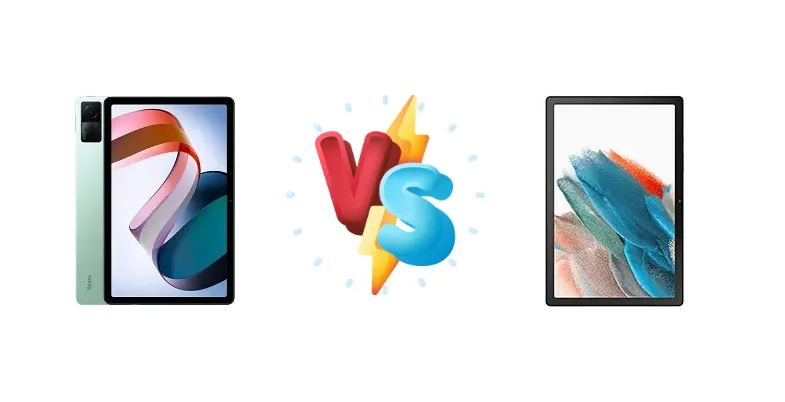
The budget tablet market is heating up! Both the Xiaomi Redmi Pad and the Samsung Galaxy Tab A8 10.5 (2021) offer compelling features at affordable prices. But which one delivers the best overall experience? Let's dive into a detailed comparison to help you decide.
🏆 Quick Verdict
The Redmi Pad edges out the Galaxy Tab A8 thanks to its significantly more powerful chipset and brighter display. While Samsung's brand recognition and One UI are appealing, the Redmi Pad offers better performance for the price, making it the winner for most users.
| Network |
|---|
| 2G bands | N/A | GSM 850 / 900 / 1800 / 1900 |
| 3G bands | N/A | HSDPA 850 / 900 / 1700(AWS) / 1900 / 2100 |
| 4G bands | N/A | 1, 2, 3, 4, 5, 7, 8, 12, 17, 20, 28, 38, 40, 41, 66 |
| EDGE | N/A | - |
| GPRS | N/A | - |
| Speed | - | HSPA, LTE - cellular model only |
| Technology | No cellular connectivity | GSM / HSPA / LTE |
| Launch |
|---|
| Announced | 2022, October 04 | 2021, December 15 |
| Status | Available. Released 2022, October 05 | Available. Released 2022, January 17 |
| Body |
|---|
| Build | Glass front, aluminum frame | - |
| Dimensions | 250.5 x 158.1 x 7.1 mm (9.86 x 6.22 x 0.28 in) | 246.8 x 161.9 x 6.9 mm (9.72 x 6.37 x 0.27 in) |
| SIM | No | Nano-SIM (cellular model only) |
| Weight | 465 g (1.03 lb) | 508 g (1.12 lb) |
| Display |
|---|
| Resolution | 1200 x 2000 pixels, 5:3 ratio (~220 ppi density) | 1200 x 1920 pixels, 16:10 ratio (~216 ppi density) |
| Size | 10.61 inches, 320.4 cm2 (~80.9% screen-to-body ratio) | 10.5 inches, 319.7 cm2 (~80.0% screen-to-body ratio) |
| Type | IPS LCD, 1B colors, 90Hz, 400 nits (typ) | TFT LCD |
| Platform |
|---|
| CPU | Octa-core (2x2.2 GHz Cortex-A76 & 6x2.0 GHz Cortex-A55) | Octa-core (2x2.0 GHz Cortex-A75 & 6x2.0 GHz Cortex-A55) |
| Chipset | Mediatek Helio G99 (6 nm) | Unisoc Tiger T618 (12 nm) |
| GPU | Mali-G57 MC2 | Mali G52 MP2 |
| OS | Android 12, upgradable to Android 13, MIUI 14 | Android 11, upgradable to Android 14, One UI 6 |
| Memory |
|---|
| Card slot | microSDXC | microSDXC (dedicated slot) |
| Internal | 64GB 3GB RAM, 128GB 4GB RAM, 128GB 6GB RAM | 32GB 2GB RAM, 32GB 3GB RAM, 64GB 2GB RAM, 64GB 3GB RAM, 64GB 4GB RAM, 128GB 3GB RAM, 128GB 4GB RAM |
| | UFS 2.2 | - |
| Main Camera |
|---|
| Single | 8 MP, f/2.0, (wide), AF | 8 MP, AF |
| Video | 1080p@30fps | 1080p@30fps |
| Selfie camera |
|---|
| Single | 8 MP, f/2.3, 105° (ultrawide) | 5 MP |
| Video | 1080p@30fps | 1080p@30fps |
| Sound |
|---|
| 3.5mm jack | No | Yes |
| 35mm jack | No | Yes |
| Loudspeaker | Yes, with stereo speakers (4 speakers) | Yes, with stereo speakers (4 speakers) |
| | 24-bit/192kHz audio | - |
| Comms |
|---|
| Bluetooth | 5.2, A2DP, LE | 5.0, A2DP, LE |
| NFC | No | No |
| Positioning | No | GPS, GLONASS, BDS, GALILEO, QZSS - cellular model only |
| Radio | No | No |
| USB | USB Type-C, OTG | USB Type-C 2.0 |
| WLAN | Wi-Fi 802.11 a/b/g/n/ac, dual-band, Wi-Fi Direct | Wi-Fi 802.11 a/b/g/n/ac, dual-band, Wi-Fi Direct |
| Features |
|---|
| Sensors | Accelerometer | Accelerometer, gyro, proximity, compass |
| Battery |
|---|
| Charging | 18W wired | 15W wired |
| Type | Li-Po 8000 mAh | Li-Po 7040 mAh |
| Misc |
|---|
| Colors | Graphite Gray, Moonlight Silver, Mint Green | Gray, Silver, Pink Gold |
| Models | 22081283G | SM-X200, SM-X205 |
| Price | About 250 EUR | About 230 EUR |
| SAR EU | 0.36 W/kg (body) | 0.92 W/kg (body) |
| Tests |
|---|
| Display |
Contrast ratio: 1529:1 (nominal) | - |
| Loudspeaker |
-23.9 LUFS (Very good)
| - |
| Performance |
AnTuTu: 319077 (v9)
GeekBench: 1852 (v5.1)
GFXBench: 13fps (ES 3.1 onscreen) | - |
Xiaomi Redmi Pad
- More powerful chipset (Helio G99)
- Brighter display (402 nits)
- Faster charging (18W)
- Better value for money
- Samsung's One UI is absent
- Camera quality is average
Samsung Galaxy Tab A8 10.5 (2021)
- Samsung's One UI (familiar interface)
- Brand recognition
- Reliable performance for basic tasks
- Weaker chipset (Unisoc Tiger T618)
- Lower brightness display
- Slower charging (15W)
- Less value for money
Display Comparison
The Redmi Pad boasts a higher measured brightness of 402 nits compared to the Tab A8, offering a more vibrant viewing experience, especially outdoors. Both have similar resolutions and aspect ratios, but the Redmi Pad's contrast ratio of 1529:1 suggests slightly better image quality. The Tab A8's display is perfectly adequate, but the Redmi Pad's is noticeably better.
Camera Comparison
Both tablets feature modest camera setups suitable for casual video calls and snapshots. The Redmi Pad likely has a slight edge in image quality due to its more modern chipset and potentially better image processing, but neither camera is a standout feature. Expect average results from both.
Performance
This is where the Redmi Pad truly shines. The Mediatek Helio G99 is a significantly more powerful chipset than the Unisoc Tiger T618 in the Tab A8. Expect smoother multitasking, faster app loading times, and better gaming performance on the Redmi Pad. The Tab A8 is sufficient for basic tasks, but struggles with more demanding applications.
Battery Life
Both tablets offer all-day battery life with moderate usage. The Tab A8 has a slightly larger battery capacity (5100 mAh vs 8740 mAh on the Redmi Pad), but the Redmi Pad's more efficient chipset helps it maintain similar battery life. Charging speeds are slower on the Tab A8 (15W) compared to the Redmi Pad (18W).
Buying Guide
The Xiaomi Redmi Pad is ideal for users prioritizing performance for gaming and multitasking on a budget. The Samsung Galaxy Tab A8 10.5 (2021) is a good choice for those who prefer Samsung's ecosystem, value brand recognition, and need a reliable tablet for basic tasks like browsing and media consumption.
Frequently Asked Questions
❓ Which tablet is better for gaming?
The Xiaomi Redmi Pad is significantly better for gaming due to its more powerful chipset. It can handle more demanding games with smoother frame rates.
❓ Is the Samsung Galaxy Tab A8 worth buying if I already own a Samsung phone?
Yes, if you're heavily invested in the Samsung ecosystem and prefer One UI, the Tab A8 can be a good choice. However, be aware that its performance is limited compared to the Redmi Pad.