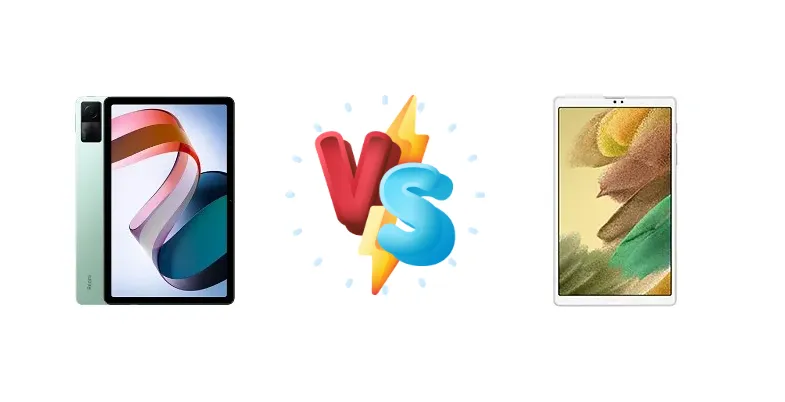
Looking for an affordable tablet for entertainment, browsing, or light productivity? The Xiaomi Redmi Pad and Samsung Galaxy Tab A7 Lite are popular contenders. But which one offers the best bang for your buck? Let's dive into a detailed comparison to help you decide.
🏆 Quick Verdict
The Redmi Pad takes the lead with its significantly more powerful chipset, brighter display, and better contrast. While the Tab A7 Lite boasts Samsung's brand recognition and a slightly more compact design, the Redmi Pad offers a superior overall experience for the price.
| Network |
|---|
| 2G bands | N/A | GSM 850 / 900 / 1800 / 1900 |
| 3G bands | N/A | HSDPA 850 / 900 / 1700(AWS) / 1900 / 2100 |
| 4G bands | N/A | 1, 2, 3, 4, 5, 7, 8, 12, 17, 20, 28, 38, 40, 66 |
| EDGE | N/A | - |
| GPRS | N/A | - |
| Speed | - | HSPA, LTE - cellular model only |
| Technology | No cellular connectivity | GSM / HSPA / LTE |
| Launch |
|---|
| Announced | 2022, October 04 | 2021, May 27 |
| Status | Available. Released 2022, October 05 | Available. Released 2021, June 18 |
| Body |
|---|
| Build | Glass front, aluminum frame | Glass front, aluminum back, aluminum frame, plastic ends |
| Dimensions | 250.5 x 158.1 x 7.1 mm (9.86 x 6.22 x 0.28 in) | 212.5 x 124.7 x 8 mm (8.37 x 4.91 x 0.31 in) |
| SIM | No | Nano-SIM (cellular model only) |
| Weight | 465 g (1.03 lb) | 366 g (Wi-Fi), 371 g (LTE) (12.91 oz) |
| Display |
|---|
| Resolution | 1200 x 2000 pixels, 5:3 ratio (~220 ppi density) | 800 x 1340 pixels, 5:3 ratio (~179 ppi density) |
| Size | 10.61 inches, 320.4 cm2 (~80.9% screen-to-body ratio) | 8.7 inches, 214.9 cm2 (~81.1% screen-to-body ratio) |
| Type | IPS LCD, 1B colors, 90Hz, 400 nits (typ) | TFT LCD |
| Platform |
|---|
| CPU | Octa-core (2x2.2 GHz Cortex-A76 & 6x2.0 GHz Cortex-A55) | Octa-core (4x2.3 GHz Cortex-A53 & 4x1.8 GHz Cortex-A53) |
| Chipset | Mediatek Helio G99 (6 nm) | Mediatek MT8768T Helio P22T (12 nm) |
| GPU | Mali-G57 MC2 | PowerVR GE8320 |
| OS | Android 12, upgradable to Android 13, MIUI 14 | Android 11, upgradable to Android 14, One UI 6.1 |
| Memory |
|---|
| Card slot | microSDXC | microSDXC (dedicated slot) |
| Internal | 64GB 3GB RAM, 128GB 4GB RAM, 128GB 6GB RAM | 32GB 2GB RAM, 32GB 3GB RAM, 64GB 4GB RAM |
| | UFS 2.2 | eMMC 5.1 |
| Main Camera |
|---|
| Single | 8 MP, f/2.0, (wide), AF | 8 MP, AF |
| Video | 1080p@30fps | 1080p@30fps |
| Selfie camera |
|---|
| Single | 8 MP, f/2.3, 105° (ultrawide) | 2 MP |
| Video | 1080p@30fps | - |
| Sound |
|---|
| 3.5mm jack | No | Yes |
| 35mm jack | No | Yes |
| Loudspeaker | Yes, with stereo speakers (4 speakers) | Yes, with stereo speakers |
| | 24-bit/192kHz audio | - |
| Comms |
|---|
| Bluetooth | 5.2, A2DP, LE | 5.0, A2DP, LE |
| NFC | No | No |
| Positioning | No | GPS, GLONASS, BDS, GALILEO - cellular model only |
| Radio | No | No |
| USB | USB Type-C, OTG | USB Type-C 2.0 |
| WLAN | Wi-Fi 802.11 a/b/g/n/ac, dual-band, Wi-Fi Direct | Wi-Fi 802.11 a/b/g/n/ac, dual-band, Wi-Fi Direct |
| Features |
|---|
| Sensors | Accelerometer | Accelerometer, compass |
| Battery |
|---|
| Charging | 18W wired | 15W wired |
| Type | Li-Po 8000 mAh | Li-Po 5100 mAh |
| Misc |
|---|
| Colors | Graphite Gray, Moonlight Silver, Mint Green | Gray, Silver |
| Models | 22081283G | SM-T225, SM-T220, SM-T225N, SM-T227U |
| Price | About 250 EUR | About 140 EUR |
| SAR | - | 0.68 W/kg (body) |
| SAR EU | 0.36 W/kg (body) | 0.64 W/kg (head) 0.99 W/kg (body) |
| Tests |
|---|
| Display |
Contrast ratio: 1529:1 (nominal) | - |
| Loudspeaker |
-23.9 LUFS (Very good)
| - |
| Performance |
AnTuTu: 319077 (v9)
GeekBench: 1852 (v5.1)
GFXBench: 13fps (ES 3.1 onscreen) | - |
Xiaomi Redmi Pad
- Superior Performance (Helio G99)
- Brighter & Higher Contrast Display
- Larger Screen
- Faster Charging (18W)
- Better Value for Money
- Build Quality could be improved
- Software updates may be less frequent than Samsung
Samsung Galaxy Tab A7 Lite
- Compact and Portable
- Samsung Brand Recognition
- Reliable Performance for Basic Tasks
- Good Software Support
- Weaker Performance (Helio P22T)
- Dimmer Display
- Slower Charging (15W)
- Less Value for Money
Display Comparison
The Redmi Pad boasts a significantly better display. Its 1529:1 contrast ratio and 402 nits brightness offer a more immersive and visually appealing experience compared to the Tab A7 Lite. While both have similar resolutions, the Redmi Pad's superior brightness makes it easier to view outdoors. The Tab A7 Lite's smaller size might be preferable for some, but the Redmi Pad's larger screen is better for media.
Camera Comparison
Neither tablet excels in the camera department. Both offer basic 8MP main cameras, suitable for casual snapshots. Image quality is generally acceptable in good lighting conditions, but expect noise and limited detail in low light. The Redmi Pad might offer slightly better image processing due to its more powerful chipset.
Performance
Here, the Redmi Pad truly shines. The Mediatek Helio G99 is a substantial upgrade over the Tab A7 Lite's Helio P22T. Expect smoother multitasking, faster app loading times, and better gaming performance on the Redmi Pad. The Tab A7 Lite is adequate for basic tasks, but struggles with more demanding applications.
Battery Life
Both tablets offer decent battery life, typically lasting a full day with moderate usage. The Tab A7 Lite has a slightly smaller battery capacity, but efficiency can vary. The Redmi Pad's more powerful chipset might consume slightly more power, but the larger battery generally compensates.
Buying Guide
The Xiaomi Redmi Pad is ideal for users prioritizing performance, a vibrant display, and a larger screen for media consumption. The Samsung Galaxy Tab A7 Lite is a good choice for those who prefer a more portable device, value Samsung's ecosystem, and need a reliable, basic tablet for everyday tasks.
Frequently Asked Questions
❓ Which tablet is better for gaming?
The Xiaomi Redmi Pad is significantly better for gaming due to its more powerful chipset and smoother performance.
❓ Is the Samsung Galaxy Tab A7 Lite more durable?
While both tablets are reasonably durable, the Tab A7 Lite's smaller size might make it slightly less prone to accidental drops. However, neither is particularly rugged.
❓ Which tablet has better software support?
Samsung generally offers better and more consistent software updates and security patches compared to Xiaomi.
❓ Can I expand the storage on either tablet?
Yes, both tablets support microSD card expansion, allowing you to increase storage capacity.