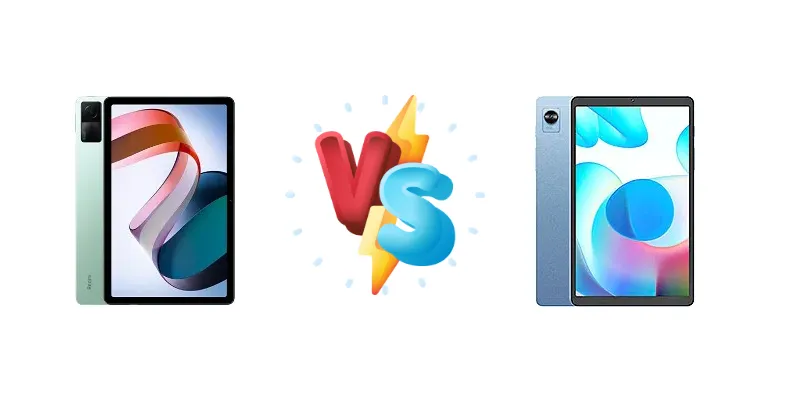
The budget tablet market is heating up! Both the Xiaomi Redmi Pad and the Realme Pad Mini offer compelling features at affordable prices. But which one is the better choice for your needs? We're diving deep into a detailed comparison to help you decide.
🏆 Quick Verdict
The Xiaomi Redmi Pad edges out the Realme Pad Mini thanks to its significantly more powerful chipset and brighter display. While the Realme Pad Mini boasts reverse charging, the Redmi Pad's overall performance and screen quality make it the stronger contender for most users.
| Network |
|---|
| 2G bands | N/A | GSM 850 / 900 / 1800 / 1900 |
| 3G bands | N/A | HSDPA 850 / 900 / 2100 |
| 4G bands | N/A | 1, 3, 5, 7, 8, 20, 28, 38, 40, 41 |
| EDGE | N/A | - |
| GPRS | N/A | - |
| Speed | - | HSPA, LTE - cellular model only |
| Technology | No cellular connectivity | GSM / HSPA / LTE |
| Launch |
|---|
| Announced | 2022, October 04 | 2022, April 04 |
| Status | Available. Released 2022, October 05 | Available. Released 2022, April 08 |
| Body |
|---|
| Build | Glass front, aluminum frame | - |
| Dimensions | 250.5 x 158.1 x 7.1 mm (9.86 x 6.22 x 0.28 in) | 211.8 x 124.5 x 7.6 mm (8.34 x 4.90 x 0.30 in) |
| SIM | No | Nano-SIM (cellular model only) |
| Weight | 465 g (1.03 lb) | 372 g (13.12 oz) |
| Display |
|---|
| Resolution | 1200 x 2000 pixels, 5:3 ratio (~220 ppi density) | 800 x 1340 pixels, 5:3 ratio (~179 ppi density) |
| Size | 10.61 inches, 320.4 cm2 (~80.9% screen-to-body ratio) | 8.7 inches, 214.9 cm2 (~81.5% screen-to-body ratio) |
| Type | IPS LCD, 1B colors, 90Hz, 400 nits (typ) | IPS LCD |
| Platform |
|---|
| CPU | Octa-core (2x2.2 GHz Cortex-A76 & 6x2.0 GHz Cortex-A55) | Octa-core (2x2.0 GHz Cortex-A75 & 6x1.8 GHz Cortex-A55) |
| Chipset | Mediatek Helio G99 (6 nm) | Unisoc Tiger T616 (12 nm) |
| GPU | Mali-G57 MC2 | Mali-G57 MP1 |
| OS | Android 12, upgradable to Android 13, MIUI 14 | Android 11 |
| Memory |
|---|
| Card slot | microSDXC | microSDXC (uses shared SIM slot) |
| Internal | 64GB 3GB RAM, 128GB 4GB RAM, 128GB 6GB RAM | 32GB 3GB RAM, 64GB 4GB RAM, 128GB 6GB RAM |
| | UFS 2.2 | UFS 2.1 |
| Main Camera |
|---|
| Single | 8 MP, f/2.0, (wide), AF | 8 MP, f/2.0 |
| Video | 1080p@30fps | 1080p@30fps |
| Selfie camera |
|---|
| Single | 8 MP, f/2.3, 105° (ultrawide) | 5 MP, f/2.2 |
| Video | 1080p@30fps | - |
| Sound |
|---|
| 3.5mm jack | No | Yes |
| 35mm jack | No | Yes |
| Loudspeaker | Yes, with stereo speakers (4 speakers) | Yes, with stereo speakers |
| | 24-bit/192kHz audio | - |
| Comms |
|---|
| Bluetooth | 5.2, A2DP, LE | 5.0, A2DP, LE |
| NFC | No | No |
| Positioning | No | GPS, GLONASS, BDS - cellular model only |
| Radio | No | No |
| USB | USB Type-C, OTG | USB Type-C 2.0, OTG |
| WLAN | Wi-Fi 802.11 a/b/g/n/ac, dual-band, Wi-Fi Direct | Wi-Fi 802.11 a/b/g/n/ac, dual-band, Wi-Fi Direct |
| Features |
|---|
| Sensors | Accelerometer | Accelerometer, proximity |
| Battery |
|---|
| Charging | 18W wired | 18W wired
5W reverse wired |
| Type | Li-Po 8000 mAh | 6400 mAh |
| Misc |
|---|
| Colors | Graphite Gray, Moonlight Silver, Mint Green | Gray, Blue |
| Models | 22081283G | RMP2105, RMP2106 |
| Price | About 250 EUR | About 180 EUR |
| SAR EU | 0.36 W/kg (body) | - |
| Tests |
|---|
| Display |
Contrast ratio: 1529:1 (nominal) | - |
| Loudspeaker |
-23.9 LUFS (Very good)
| - |
| Performance |
AnTuTu: 319077 (v9)
GeekBench: 1852 (v5.1)
GFXBench: 13fps (ES 3.1 onscreen) | - |
Xiaomi Redmi Pad
- More powerful chipset
- Brighter and better display
- Better multitasking performance
- Generally better build quality
- No reverse charging
- Slightly higher price
Realme Pad Mini
- Reverse wired charging
- More affordable
- Compact and lightweight
- Weaker chipset
- Dimmer display
- Slower performance
Display Comparison
The Redmi Pad features a 1529:1 contrast ratio and a measured 402 nits brightness, offering a noticeably better viewing experience than the Realme Pad Mini. While both have similar resolutions, the Redmi Pad's brightness advantage makes it more usable outdoors. The Redmi Pad also generally has better color accuracy.
Camera Comparison
Both tablets feature modest camera setups suitable for basic video calls and occasional snapshots. The Redmi Pad likely has a slight edge in image quality due to its more capable chipset, but neither camera is a standout feature. Expect around 8MP for both front and rear cameras.
Performance
Here's where the Redmi Pad truly shines. The Mediatek Helio G99 chipset is considerably more powerful than the Unisoc Tiger T616 in the Realme Pad Mini. Expect smoother multitasking, faster app loading times, and better gaming performance on the Redmi Pad. The G99's 6nm process also contributes to better power efficiency.
Battery Life
Both tablets offer similar battery capacity (around 8000mAh) and 18W wired charging. The Realme Pad Mini's inclusion of 5W reverse wired charging is a unique selling point, allowing it to act as a power bank for other devices. However, the Redmi Pad's more efficient chipset may result in slightly longer real-world battery life.
Buying Guide
The Xiaomi Redmi Pad is ideal for users who prioritize performance, a better display for media consumption, and a more versatile experience. The Realme Pad Mini is a good option for those on a tighter budget who primarily need a tablet for basic tasks like browsing and light entertainment, and appreciate the added convenience of reverse charging.
Frequently Asked Questions
❓ Which tablet is better for gaming?
The Xiaomi Redmi Pad is significantly better for gaming due to its more powerful chipset and better thermal management.
❓ Can the Realme Pad Mini charge my phone?
Yes, the Realme Pad Mini supports 5W reverse wired charging, allowing you to charge other devices with a USB-C cable.
❓ Is the Redmi Pad worth the extra money?
If performance and display quality are important to you, then yes, the Redmi Pad is worth the extra investment.