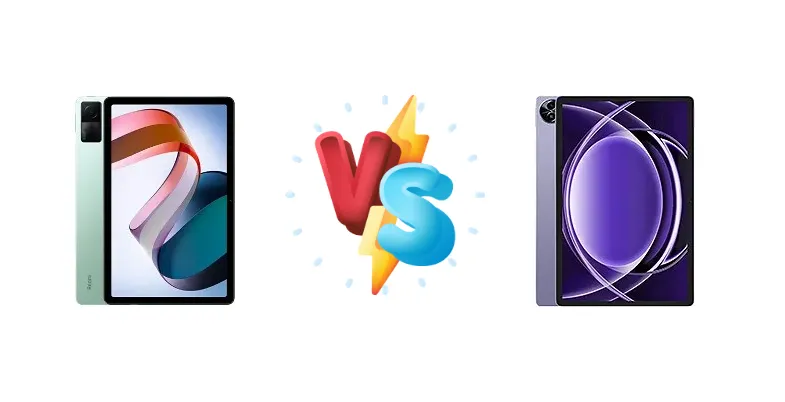
The budget tablet market is heating up, with Xiaomi and Realme offering compelling options under $200. Both the Redmi Pad and the Realme Pad 2 Lite leverage the Mediatek Helio G99 chipset, but subtle differences in display quality and charging speeds could make one a better fit for your needs. This deep dive analyzes these tablets to determine which delivers the best overall experience.
🏆 Quick Verdict
For most users, the Xiaomi Redmi Pad emerges as the slightly better choice. Its measured 402 nits of brightness and 1529:1 contrast ratio provide a noticeably more vibrant viewing experience, making it ideal for media consumption. While both share the same chipset, the Redmi Pad's display advantage justifies the minimal price difference.
| Network |
|---|
| 2G bands | N/A | GSM 850 / 900 / 1800 / 1900 |
| 3G bands | N/A | HSDPA 850 / 900 / 2100 |
| 4G bands | N/A | 1, 3, 5, 7, 8, 20, 28, 38, 40, 41 |
| EDGE | N/A | - |
| GPRS | N/A | - |
| Speed | - | HSPA, LTE |
| Technology | No cellular connectivity | GSM / HSPA / LTE |
| Launch |
|---|
| Announced | 2022, October 04 | 2024, September 13 |
| Status | Available. Released 2022, October 05 | Available. Released 2024, September 26 |
| Body |
|---|
| Build | Glass front, aluminum frame | - |
| Dimensions | 250.5 x 158.1 x 7.1 mm (9.86 x 6.22 x 0.28 in) | 258 x 169.5 x 8.3 mm (10.16 x 6.67 x 0.33 in) |
| SIM | No | No |
| Weight | 465 g (1.03 lb) | 525 g (1.16 lb) |
| Display |
|---|
| Resolution | 1200 x 2000 pixels, 5:3 ratio (~220 ppi density) | 1200 x 1920 pixels, 16:10 ratio (~207 ppi density) |
| Size | 10.61 inches, 320.4 cm2 (~80.9% screen-to-body ratio) | 10.95 inches, 347.7 cm2 (~79.5% screen-to-body ratio) |
| Type | IPS LCD, 1B colors, 90Hz, 400 nits (typ) | IPS LCD, 1B colors, 90Hz, 450 nits (peak) |
| Platform |
|---|
| CPU | Octa-core (2x2.2 GHz Cortex-A76 & 6x2.0 GHz Cortex-A55) | Octa-core (2x2.2 GHz Cortex-A76 & 6x2.0 GHz Cortex-A55) |
| Chipset | Mediatek Helio G99 (6 nm) | Mediatek Helio G99 (6 nm) |
| GPU | Mali-G57 MC2 | Mali-G57 MC2 |
| OS | Android 12, upgradable to Android 13, MIUI 14 | Android 14, Realme UI 5.0 for Pad |
| Memory |
|---|
| Card slot | microSDXC | Unspecified |
| Internal | 64GB 3GB RAM, 128GB 4GB RAM, 128GB 6GB RAM | 128GB 4GB RAM, 128GB 8GB RAM |
| | UFS 2.2 | - |
| Main Camera |
|---|
| Features | - | Panorama |
| Single | 8 MP, f/2.0, (wide), AF | 8 MP, f/2.0 |
| Video | 1080p@30fps | 1080p@30fps |
| Selfie camera |
|---|
| Features | - | Panorama |
| Single | 8 MP, f/2.3, 105° (ultrawide) | 5 MP, f/2.2 |
| Video | 1080p@30fps | 1080p@30fps |
| Sound |
|---|
| 3.5mm jack | No | - |
| 35mm jack | No | No |
| Loudspeaker | Yes, with stereo speakers (4 speakers) | Yes, with stereo speakers (4 speakers) |
| | 24-bit/192kHz audio | - |
| Comms |
|---|
| Bluetooth | 5.2, A2DP, LE | 5.2, A2DP, LE |
| NFC | No | No |
| Positioning | No | GPS, GALILEO, GLONASS, BDS |
| Radio | No | No |
| USB | USB Type-C, OTG | USB Type-C |
| WLAN | Wi-Fi 802.11 a/b/g/n/ac, dual-band, Wi-Fi Direct | Wi-Fi 802.11 a/b/g/n/ac, dual-band |
| Features |
|---|
| Sensors | Accelerometer | Accelerometer |
| Battery |
|---|
| Charging | 18W wired | 15W wired |
| Type | Li-Po 8000 mAh | 8300 mAh |
| Misc |
|---|
| Colors | Graphite Gray, Moonlight Silver, Mint Green | Nebula Purple, Space Grey |
| Models | 22081283G | RMP2402 |
| Price | About 250 EUR | About 160 EUR |
| SAR EU | 0.36 W/kg (body) | - |
| Tests |
|---|
| Display |
Contrast ratio: 1529:1 (nominal) | - |
| Loudspeaker |
-23.9 LUFS (Very good)
| - |
| Performance |
AnTuTu: 319077 (v9)
GeekBench: 1852 (v5.1)
GFXBench: 13fps (ES 3.1 onscreen) | - |
Xiaomi Redmi Pad
- Brighter and higher contrast display (402 nits, 1529:1)
- Slightly faster 18W charging
- Potentially better viewing experience for media
- May be slightly more expensive than the Realme Pad 2 Lite
- Camera specs are not detailed
Realme Pad 2 Lite
- More affordable price point
- Same Helio G99 chipset for comparable performance
- Lightweight and portable design
- Likely lower display brightness and contrast
- Slower 15W charging
Display Comparison
Both tablets feature a 10.61-inch display, but the Redmi Pad distinguishes itself with a measured peak brightness of 402 nits and a contrast ratio of 1529:1. While Realme doesn't publish these figures, the Redmi Pad's numbers suggest a more vivid and punchy image. This difference is particularly noticeable when viewing HDR content or using the tablet outdoors. The lack of detailed display specs for the Realme Pad 2 Lite suggests a more standard LCD panel, likely with lower peak brightness and contrast.
Camera Comparison
Neither tablet excels in the camera department, and detailed camera specs are sparse. Focusing on the primary use case of tablets, camera quality is less critical. However, it's safe to assume both feature basic camera setups suitable for casual snapshots and video calls. Given the market segment, expecting flagship-level camera performance would be unrealistic. The absence of detailed camera specs reinforces this point; these are not photography-focused devices.
Performance
Both the Redmi Pad and Realme Pad 2 Lite are powered by the Mediatek Helio G99 (6 nm) chipset, featuring an octa-core CPU configuration with 2x2.2 GHz Cortex-A76 and 6x2.0 GHz Cortex-A55 cores. This means performance will be virtually identical for everyday tasks like web browsing, social media, and light gaming. The 6nm process node ensures reasonable thermal efficiency, preventing significant throttling during extended use. However, neither tablet is designed for demanding AAA gaming; expect to adjust graphics settings for a smooth experience.
Battery Life
The Realme Pad 2 Lite has a 15W wired charging capability, while the Redmi Pad supports 18W wired charging. While the difference of 3W may seem small, it translates to a slightly faster 0-100% charge time for the Redmi Pad. Battery capacity is not specified for either device, but given the similar form factors and chipsets, they likely offer comparable battery life – around 8-10 hours of mixed usage. The 18W charging on the Redmi Pad provides a small convenience advantage for users who frequently need to top up their battery.
Buying Guide
Buy the Xiaomi Redmi Pad if you prioritize display quality for streaming videos and browsing, and value a slightly brighter, more contrast-rich screen. Buy the Realme Pad 2 Lite if you're looking for the absolute lowest price point and are willing to compromise slightly on display performance. Both are excellent choices for casual use, but the Redmi Pad offers a more immersive visual experience.
Frequently Asked Questions
❓ Will the Helio G99 in either tablet struggle with graphically intensive games like Genshin Impact?
Yes, while the Helio G99 is capable, Genshin Impact will likely require significant graphics settings reductions to achieve playable frame rates on both the Redmi Pad and Realme Pad 2 Lite. These tablets are better suited for less demanding mobile games.
❓ Is the lack of detailed camera specs a major concern for casual users?
No, for typical tablet use cases like video calls and occasional snapshots, the basic camera setups on both devices should be sufficient. These tablets aren't designed for serious photography.
❓ Does either tablet support stylus input or a keyboard cover?
While not explicitly stated, both Xiaomi and Realme often offer optional accessories like stylus pens and keyboard covers for their tablets. Check the official websites or retailers for compatibility and availability.
❓ How does the 15W vs 18W charging impact real-world usage?
The 3W difference translates to roughly 15-20 minutes faster charging from 0-100% on the Redmi Pad. This is a minor convenience, but can be noticeable for users who frequently need to quickly recharge their tablet.