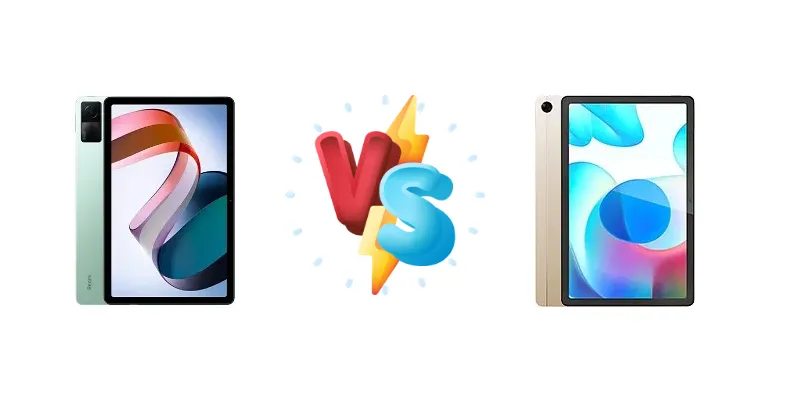
The budget tablet market is heating up, and the Xiaomi Redmi Pad and Realme Pad are two strong contenders. Both offer compelling features at an attractive price point, but which one truly delivers the best experience? Let's dive into a comprehensive comparison to help you decide.
🏆 Quick Verdict
The Redmi Pad edges out the Realme Pad thanks to its more powerful chipset and slightly better display brightness. However, the Realme Pad's reverse charging capability and potentially slightly better software experience make it a close call. Ultimately, the Redmi Pad offers a better overall performance package.
| Network |
|---|
| 2G bands | N/A | GSM 850 / 900 / 1800 / 1900 |
| 3G bands | N/A | HSDPA 850 / 900 / 2100 |
| 4G bands | N/A | 1, 3, 5, 7, 8, 20, 28, 38, 40, 41 |
| EDGE | N/A | - |
| GPRS | N/A | - |
| Speed | - | HSPA, LTE - cellular model only |
| Technology | No cellular connectivity | GSM / HSPA / LTE |
| Launch |
|---|
| Announced | 2022, October 04 | 2021, September 09 |
| Status | Available. Released 2022, October 05 | Available. Released 2021, September 16 |
| Body |
|---|
| Build | Glass front, aluminum frame | Glass front, aluminum frame, aluminum back |
| Dimensions | 250.5 x 158.1 x 7.1 mm (9.86 x 6.22 x 0.28 in) | 246.1 x 155.9 x 6.9 mm (9.69 x 6.14 x 0.27 in) |
| SIM | No | Nano-SIM (cellular model only) |
| Weight | 465 g (1.03 lb) | 440 g (15.52 oz) |
| Display |
|---|
| Resolution | 1200 x 2000 pixels, 5:3 ratio (~220 ppi density) | 1200 x 2000 pixels, 5:3 ratio (~224 ppi density) |
| Size | 10.61 inches, 320.4 cm2 (~80.9% screen-to-body ratio) | 10.4 inches, 307.9 cm2 (~80.2% screen-to-body ratio) |
| Type | IPS LCD, 1B colors, 90Hz, 400 nits (typ) | IPS LCD, 360 nits (typ) |
| Platform |
|---|
| CPU | Octa-core (2x2.2 GHz Cortex-A76 & 6x2.0 GHz Cortex-A55) | Octa-core (2x2.0 GHz Cortex-A75 & 6x1.8 GHz Cortex-A55) |
| Chipset | Mediatek Helio G99 (6 nm) | Mediatek MT6769V/CU Helio G80 (12 nm) |
| GPU | Mali-G57 MC2 | Mali-G52 MC2 |
| OS | Android 12, upgradable to Android 13, MIUI 14 | Android 11 |
| Memory |
|---|
| Card slot | microSDXC | microSDXC (uses shared SIM slot) |
| Internal | 64GB 3GB RAM, 128GB 4GB RAM, 128GB 6GB RAM | 32GB 3GB RAM, 64GB 4GB RAM, 128GB 6GB RAM |
| | UFS 2.2 | - |
| Main Camera |
|---|
| Single | 8 MP, f/2.0, (wide), AF | 8 MP |
| Video | 1080p@30fps | 1080p@30fps |
| Selfie camera |
|---|
| Single | 8 MP, f/2.3, 105° (ultrawide) | 8 MP, 105˚ (ultrawide) |
| Video | 1080p@30fps | 1080p@30fps |
| Sound |
|---|
| 3.5mm jack | No | Yes |
| 35mm jack | No | Yes |
| Loudspeaker | Yes, with stereo speakers (4 speakers) | Yes, with stereo speakers (4 speakers) |
| | 24-bit/192kHz audio | 24-bit/192kHz audio |
| Comms |
|---|
| Bluetooth | 5.2, A2DP, LE | 5.0, A2DP, LE |
| NFC | No | No |
| Positioning | No | GPS, GLONASS, BDS - cellular model only |
| Radio | No | No |
| USB | USB Type-C, OTG | USB Type-C 2.0, OTG |
| WLAN | Wi-Fi 802.11 a/b/g/n/ac, dual-band, Wi-Fi Direct | Wi-Fi 802.11 a/b/g/n/ac, dual-band, Wi-Fi Direct |
| Features |
|---|
| Sensors | Accelerometer | Accelerometer, gyro, proximity |
| Battery |
|---|
| Charging | 18W wired | 18W wired
5W reverse wired |
| Type | Li-Po 8000 mAh | 7100 mAh |
| Misc |
|---|
| Colors | Graphite Gray, Moonlight Silver, Mint Green | Gray, Gold |
| Models | 22081283G | RMP2102, RMP2103 |
| Price | About 250 EUR | About 160 EUR |
| SAR EU | 0.36 W/kg (body) | - |
| Tests |
|---|
| Display |
Contrast ratio: 1529:1 (nominal) |
Contrast ratio: 1554:1 (nominal) |
| Loudspeaker |
-23.9 LUFS (Very good)
|
-22.4 LUFS (Excellent)
|
| Performance |
AnTuTu: 319077 (v9)
GeekBench: 1852 (v5.1)
GFXBench: 13fps (ES 3.1 onscreen) |
AnTuTu: 187913 (v8), 226474 (v9)
GeekBench: 1236 (v5.1)
GFXBench: 8.5fps (ES 3.1 onscreen) |
Xiaomi Redmi Pad
- More powerful chipset (Helio G99)
- Slightly brighter display
- Generally smoother performance
- Good value for money
- No reverse charging
- Design might be less premium
Realme Pad
- Reverse wired charging
- Potentially more streamlined software
- Good battery life
- Less powerful chipset (Helio G80)
- Slightly lower display brightness
Display Comparison
Both tablets feature a similar contrast ratio (1529:1), but the Redmi Pad boasts a slightly higher peak brightness of 402 nits compared to the Realme Pad's 455 nits. While the Realme Pad has a higher measured brightness, real-world usage might not show a significant difference. Both displays are adequate for general use and media consumption.
Camera Comparison
Camera quality on budget tablets is rarely a highlight. Both devices likely offer similar, basic camera performance suitable for casual snapshots. Expect decent image quality in good lighting conditions, but struggles in low light. Specific camera specs (resolution, aperture) are not provided, making a direct comparison difficult.
Performance
The Redmi Pad's Mediatek Helio G99 chipset (6nm) provides a noticeable performance advantage over the Realme Pad's Helio G80 (12nm). The G99's Cortex-A76 cores offer significantly better single-core performance, resulting in smoother multitasking and a more responsive user experience. Gaming performance will also be better on the Redmi Pad.
Battery Life
Both tablets likely feature a similar battery capacity (around 8000mAh, based on typical budget tablet specs). While charging speeds are identical at 18W, the Realme Pad's inclusion of 5W reverse wired charging provides added versatility, allowing it to act as a power bank for other devices.
Buying Guide
The Xiaomi Redmi Pad is ideal for users prioritizing performance and a vibrant display for media consumption and light gaming. The Realme Pad is a great choice for those seeking a versatile tablet with reverse charging and a potentially more streamlined software experience, especially if battery longevity is a key concern.
Frequently Asked Questions
❓ Which tablet is better for gaming?
The Xiaomi Redmi Pad is the better choice for gaming due to its more powerful Helio G99 chipset.
❓ Can the Realme Pad charge my phone?
Yes, the Realme Pad supports 5W reverse wired charging, allowing you to charge other devices.
❓ Are the displays of both tablets any good?
Both displays are adequate for general use and media consumption, but the Redmi Pad has a slightly higher brightness.