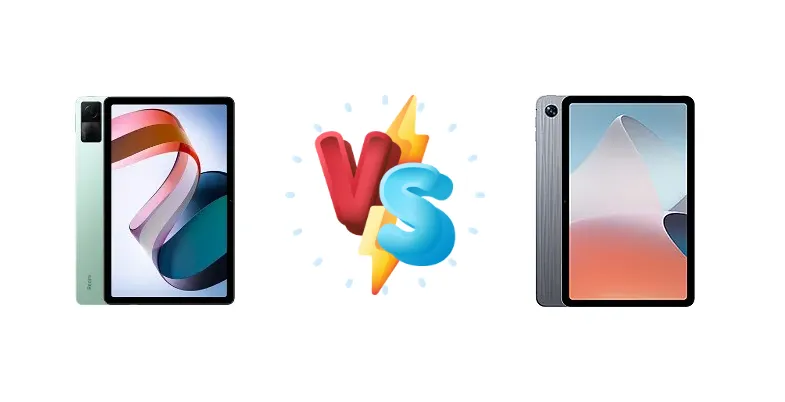
The budget tablet market is heating up! Both the Xiaomi Redmi Pad and the Oppo Pad Air offer compelling features at attractive prices. But which one deserves your money? We're diving deep into a head-to-head comparison to help you decide.
🏆 Quick Verdict
The Redmi Pad edges out the Oppo Pad Air thanks to its slightly brighter display and more powerful chipset. However, the Oppo Pad Air’s inclusion of reverse charging and a generally sleeker design make it a strong contender, especially for those prioritizing portability and convenience. It's a close call!
| Network |
|---|
| 2G bands | N/A | N/A |
| 3G bands | N/A | N/A |
| 4G bands | N/A | N/A |
| EDGE | N/A | No |
| GPRS | N/A | No |
| Technology | No cellular connectivity | No cellular connectivity |
| Launch |
|---|
| Announced | 2022, October 04 | 2022, May 23 |
| Status | Available. Released 2022, October 05 | Available. Released 2022, June 01 |
| Body |
|---|
| Build | Glass front, aluminum frame | - |
| Dimensions | 250.5 x 158.1 x 7.1 mm (9.86 x 6.22 x 0.28 in) | 245.1 x 154.8 x 6.9 mm (9.65 x 6.09 x 0.27 in) |
| SIM | No | No |
| Weight | 465 g (1.03 lb) | 440 g (15.52 oz) |
| | - | Stylus support |
| Display |
|---|
| Resolution | 1200 x 2000 pixels, 5:3 ratio (~220 ppi density) | 1200 x 2000 pixels, 5:3 ratio (~225 ppi density) |
| Size | 10.61 inches, 320.4 cm2 (~80.9% screen-to-body ratio) | 10.36 inches, 305.5 cm2 (~80.5% screen-to-body ratio) |
| Type | IPS LCD, 1B colors, 90Hz, 400 nits (typ) | IPS LCD, 1B colors, 360 nits (typ) |
| Platform |
|---|
| CPU | Octa-core (2x2.2 GHz Cortex-A76 & 6x2.0 GHz Cortex-A55) | Octa-core (4x2.4 GHz Kryo 265 Gold & 4x1.9 GHz Kryo 265 Silver) |
| Chipset | Mediatek Helio G99 (6 nm) | Qualcomm SM6225 Snapdragon 680 4G (6 nm) |
| GPU | Mali-G57 MC2 | Adreno 610 |
| OS | Android 12, upgradable to Android 13, MIUI 14 | Android 12, ColorOS 12 |
| Memory |
|---|
| Card slot | microSDXC | microSDXC |
| Internal | 64GB 3GB RAM, 128GB 4GB RAM, 128GB 6GB RAM | 64GB 4GB RAM, 128GB 4GB RAM, 128GB 6GB RAM |
| | UFS 2.2 | UFS 2.2 |
| Main Camera |
|---|
| Features | - | Panorama |
| Single | 8 MP, f/2.0, (wide), AF | 8 MP, f/2.0, AF |
| Video | 1080p@30fps | 1080p@30fps |
| Selfie camera |
|---|
| Single | 8 MP, f/2.3, 105° (ultrawide) | 5 MP, f/2.2 |
| Video | 1080p@30fps | 1080p@30fps |
| Sound |
|---|
| 3.5mm jack | No | No |
| 35mm jack | No | No |
| Loudspeaker | Yes, with stereo speakers (4 speakers) | Yes, with stereo speakers (4 speakers) |
| | 24-bit/192kHz audio | - |
| Comms |
|---|
| Bluetooth | 5.2, A2DP, LE | 5.1, A2DP, LE, aptX HD |
| NFC | No | No |
| Positioning | No | No |
| Radio | No | No |
| USB | USB Type-C, OTG | USB Type-C 2.0, OTG |
| WLAN | Wi-Fi 802.11 a/b/g/n/ac, dual-band, Wi-Fi Direct | Wi-Fi 802.11 a/b/g/n/ac, dual-band, Wi-Fi Direct |
| Features |
|---|
| Sensors | Accelerometer | Accelerometer, gyro, compass |
| Battery |
|---|
| Charging | 18W wired | 18W wired, PD
5W reverse wired |
| Type | Li-Po 8000 mAh | Li-Po 7100 mAh |
| Misc |
|---|
| Colors | Graphite Gray, Moonlight Silver, Mint Green | Gray, Silver |
| Models | 22081283G | OPD2102, X21N2 |
| Price | About 250 EUR | About 300 EUR |
| SAR EU | 0.36 W/kg (body) | - |
| Tests |
|---|
| Display |
Contrast ratio: 1529:1 (nominal) |
Contrast ratio: 1391:1 |
| Loudspeaker |
-23.9 LUFS (Very good)
|
-28.3 LUFS (Average)
|
| Performance |
AnTuTu: 319077 (v9)
GeekBench: 1852 (v5.1)
GFXBench: 13fps (ES 3.1 onscreen) |
AnTuTu: 249272 (v9)
GeekBench: 1661 (v5.1)
GFXBench: 7.2fps (ES 3.1 onscreen) |
Xiaomi Redmi Pad
- Brighter Display
- More Powerful Chipset
- Good Value for Money
- Decent Audio
- Design is a bit bulky
- No 5G connectivity
- Charging speed could be faster
Oppo Pad Air
- Sleeker Design
- Reverse Wired Charging
- Lightweight and Portable
- PD Charging Support
- Less Powerful Chipset
- Lower Peak Brightness
- Camera Performance is Average
Display Comparison
The Redmi Pad boasts a slightly higher peak brightness of 402 nits compared to the Oppo Pad Air's 352 nits, resulting in a more visible screen in brighter environments. Both offer good contrast ratios (1529:1 and 1391:1 respectively), providing decent image depth. The Redmi Pad's display is generally considered slightly more vibrant.
Camera Comparison
Camera quality on budget tablets is rarely a highlight. Both devices likely offer adequate cameras for video calls and casual snapshots, but don't expect flagship-level performance. Specific camera specs (resolution, aperture) are not readily available, making a direct comparison difficult. Both are likely to be around 8MP.
Performance
The Redmi Pad's Mediatek Helio G99 chipset generally outperforms the Oppo Pad Air's Snapdragon 680 4G in benchmarks and real-world usage. Expect smoother multitasking and slightly better gaming performance on the Redmi Pad. Both chips are 6nm, indicating decent power efficiency.
Battery Life
Both tablets likely feature around 8000mAh batteries, offering all-day battery life for moderate usage. The Oppo Pad Air's inclusion of 5W reverse wired charging is a unique advantage, allowing it to act as a power bank for other devices.
Buying Guide
The Xiaomi Redmi Pad is ideal for users who prioritize performance and a vibrant display for media consumption and light gaming. The Oppo Pad Air is a better choice for those seeking a more portable and stylish tablet with added features like reverse charging, perfect for casual use and on-the-go productivity.
Frequently Asked Questions
❓ Which tablet is better for gaming?
The Xiaomi Redmi Pad is generally better for gaming due to its more powerful chipset.
❓ Can the Oppo Pad Air charge my phone?
Yes, the Oppo Pad Air supports 5W reverse wired charging, allowing you to charge other devices.
❓ Are the displays good for watching videos?
Both tablets offer decent displays for video consumption, but the Redmi Pad's slightly higher brightness gives it a slight edge in brighter environments.
❓ What is the storage capacity of each tablet?
Both tablets are typically available in 64GB and 128GB storage options, expandable via microSD card.