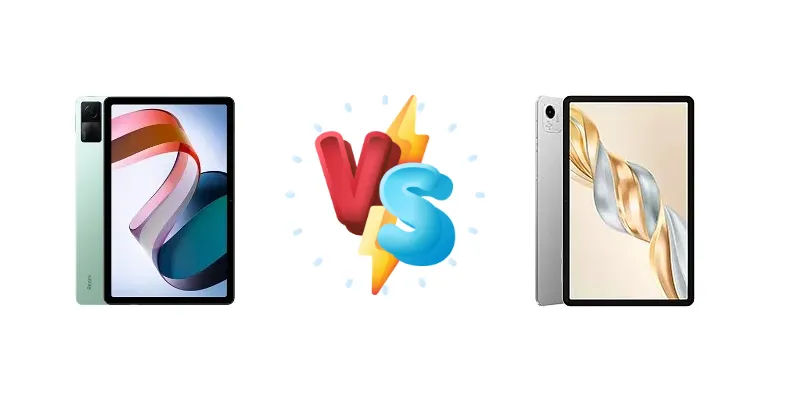
The budget tablet market is heating up, with the Xiaomi Redmi Pad and Honor Pad X9a vying for dominance. Both offer compelling features at attractive price points, but cater to slightly different priorities. The Redmi Pad focuses on delivering solid performance with its Helio G99 chipset, while the Honor Pad X9a emphasizes long-lasting battery life and rapid charging. This comparison dives deep into the specifics to determine which tablet best suits your needs.
🏆 Quick Verdict
For the average user prioritizing consistent performance for everyday tasks and light gaming, the Xiaomi Redmi Pad emerges as the better choice. Its Helio G99 chipset offers a noticeable performance edge over the Snapdragon 685 in the Honor Pad X9a. However, if battery life is paramount, the Honor Pad X9a’s exceptional endurance is a significant advantage.
| Network |
|---|
| 2G bands | N/A | N/A |
| 3G bands | N/A | N/A |
| 4G bands | N/A | N/A |
| EDGE | N/A | No |
| GPRS | N/A | No |
| Technology | No cellular connectivity | No cellular connectivity |
| Launch |
|---|
| Announced | 2022, October 04 | 2025, March 21 |
| Status | Available. Released 2022, October 05 | Available. Released 2025, March 26 |
| Body |
|---|
| Build | Glass front, aluminum frame | Glass front, aluminum frame, aluminum back |
| Dimensions | 250.5 x 158.1 x 7.1 mm (9.86 x 6.22 x 0.28 in) | 267.3 x 167.4 x 6.8 mm (10.52 x 6.59 x 0.27 in) |
| SIM | No | No |
| Weight | 465 g (1.03 lb) | 475 g (1.05 lb) |
| Display |
|---|
| Protection | - | Mohs level 4 |
| Resolution | 1200 x 2000 pixels, 5:3 ratio (~220 ppi density) | 1504 x 2508 pixels, 5:3 ratio (~254 ppi density) |
| Size | 10.61 inches, 320.4 cm2 (~80.9% screen-to-body ratio) | 11.5 inches, 376.3 cm2 (~84.1% screen-to-body ratio) |
| Type | IPS LCD, 1B colors, 90Hz, 400 nits (typ) | TFT LCD, 120Hz, 400 nits (peak) |
| Platform |
|---|
| CPU | Octa-core (2x2.2 GHz Cortex-A76 & 6x2.0 GHz Cortex-A55) | Octa-core (4x2.8 GHz Cortex-A73 & 4x1.9 GHz Cortex-A53) |
| Chipset | Mediatek Helio G99 (6 nm) | Qualcomm SM6225 Snapdragon 685 (6 nm) |
| GPU | Mali-G57 MC2 | Adreno 610 |
| OS | Android 12, upgradable to Android 13, MIUI 14 | Android 15, MagicOS 9 |
| Memory |
|---|
| Card slot | microSDXC | No |
| Internal | 64GB 3GB RAM, 128GB 4GB RAM, 128GB 6GB RAM | 128GB 6GB RAM, 128GB 8GB RAM |
| | UFS 2.2 | - |
| Main Camera |
|---|
| Single | 8 MP, f/2.0, (wide), AF | 8 MP, f/2.0, (wide), 1/5.0" |
| Video | 1080p@30fps | 1080p@30fps |
| Selfie camera |
|---|
| Single | 8 MP, f/2.3, 105° (ultrawide) | 5 MP, f/2.2 |
| Video | 1080p@30fps | 1080p@30fps |
| Sound |
|---|
| 3.5mm jack | No | - |
| 35mm jack | No | No |
| Loudspeaker | Yes, with stereo speakers (4 speakers) | Yes, with stereo speakers (4 speakers) |
| | 24-bit/192kHz audio | - |
| Comms |
|---|
| Bluetooth | 5.2, A2DP, LE | 5.1, A2DP, LE |
| NFC | No | No |
| Positioning | No | No |
| Radio | No | No |
| USB | USB Type-C, OTG | USB Type-C |
| WLAN | Wi-Fi 802.11 a/b/g/n/ac, dual-band, Wi-Fi Direct | Wi-Fi 802.11 a/b/g/n/ac, dual-band |
| Features |
|---|
| Sensors | Accelerometer | Accelerometer |
| Battery |
|---|
| Charging | 18W wired | 35W wired |
| Type | Li-Po 8000 mAh | Li-Ion 8300 mAh |
| Misc |
|---|
| Colors | Graphite Gray, Moonlight Silver, Mint Green | Gray |
| Models | 22081283G | ELN2-W29 |
| Price | About 250 EUR | About 210 EUR |
| SAR EU | 0.36 W/kg (body) | - |
| Tests |
|---|
| Display |
Contrast ratio: 1529:1 (nominal) | - |
| Loudspeaker |
-23.9 LUFS (Very good)
| - |
| Performance |
AnTuTu: 319077 (v9)
GeekBench: 1852 (v5.1)
GFXBench: 13fps (ES 3.1 onscreen) | - |
| EU LABEL |
|---|
| Battery | - | 92:29h endurance, 1200 cycles |
| Energy | - | Class F |
| Free fall | - | Class E (10 falls) |
| Repairability | - | Class C |
Xiaomi Redmi Pad
- Stronger CPU performance with Helio G99
- More modern CPU architecture (Cortex-A76)
- Higher contrast ratio for a more vibrant display
- Slower charging speed (18W)
- Likely shorter battery life compared to Honor Pad X9a
- No published battery endurance rating
Honor Pad X9a
- Exceptional battery endurance (92-29h)
- Fast 35W wired charging
- High battery cycle count (1200 cycles)
- Older CPU architecture (Cortex-A73)
- Potentially lower sustained performance
- Display specs are less detailed
Display Comparison
The Redmi Pad boasts a measured peak brightness of 402 nits and a 1529:1 contrast ratio, providing a reasonably vibrant viewing experience. While the Honor Pad X9a’s display specifications aren’t provided, it’s likely to offer a similar level of brightness given its market positioning. The Redmi Pad’s contrast ratio suggests deeper blacks and more vivid colors. Neither tablet is expected to feature high-end panel technology like LTPO, meaning refresh rates are likely fixed, impacting smoothness during scrolling and animations. Bezels are expected to be comparable on both devices, typical for this price segment.
Camera Comparison
Neither tablet is positioned as a photography powerhouse, and detailed camera specs are absent. Given the price point, expect modest camera performance suitable for casual snapshots. Focusing on the chipsets, the image signal processors (ISPs) within the Helio G99 and Snapdragon 685 are likely comparable in capability. Without specific sensor details, it’s difficult to definitively declare a winner, but the Redmi Pad’s slightly more powerful CPU could contribute to faster image processing.
Performance
The core difference lies in the chipsets. The Redmi Pad utilizes the Mediatek Helio G99 (6nm), featuring a CPU with 2x2.2 GHz Cortex-A76 cores and 6x2.0 GHz Cortex-A55 cores. This configuration prioritizes single-core performance, beneficial for app responsiveness. The Honor Pad X9a, on the other hand, employs the Qualcomm Snapdragon 685 (6nm) with 4x2.8 GHz Cortex-A73 cores and 4x1.9 GHz Cortex-A53 cores. While the Snapdragon 685 has higher clocked cores, the older Cortex-A73 architecture is less efficient than the A76 found in the Helio G99. This translates to a likely advantage for the Redmi Pad in sustained performance and potentially better thermal management. The G99’s architecture is more modern, offering better instructions per clock (IPC).
Battery Life
The Honor Pad X9a shines in battery endurance, boasting a remarkable 92-29h endurance rating and a claimed 1200 charge cycles. This suggests significantly longer battery life compared to the Redmi Pad, which lacks a published endurance rating. The Honor Pad X9a also supports 35W wired charging, enabling faster replenishment. The Redmi Pad is limited to 18W charging, meaning a full charge will take considerably longer. The combination of high capacity and fast charging makes the Honor Pad X9a the clear winner for users prioritizing battery life and convenience.
Buying Guide
Buy the Xiaomi Redmi Pad if you need a tablet for streaming video, browsing, and casual gaming, and value a responsive user experience. It’s ideal for students or anyone who needs a versatile tablet for productivity on the go. Buy the Honor Pad X9a if you prioritize extended battery life above all else, frequently travel, or need a tablet that can last through long workdays or entertainment sessions without needing a recharge.
Frequently Asked Questions
❓ Will the Snapdragon 685 in the Honor Pad X9a struggle with demanding games like Genshin Impact?
The Snapdragon 685 is a capable chipset for casual gaming, but it will likely struggle with graphically intensive titles like Genshin Impact, even on low settings. Expect frame rate drops and potential stuttering. The Redmi Pad’s Helio G99 offers a slight advantage in gaming performance, but neither tablet is designed for hardcore mobile gaming.
❓ How long will the Honor Pad X9a’s battery last during video playback?
The Honor Pad X9a’s 92-29h endurance rating suggests exceptional video playback time. Based on this, you can realistically expect over 15 hours of continuous 1080p video playback on a single charge, potentially even longer with optimized settings and lower brightness.
❓ Is the 18W charging on the Redmi Pad slow compared to the 35W on the Honor Pad X9a?
Yes, 18W charging is noticeably slower than 35W. While 18W will still charge the Redmi Pad overnight, the Honor Pad X9a will significantly reduce charging times, allowing you to quickly top up the battery when needed. Expect a full charge on the Redmi Pad to take around 3-4 hours, while the Honor Pad X9a should charge fully in approximately 1.5-2 hours.