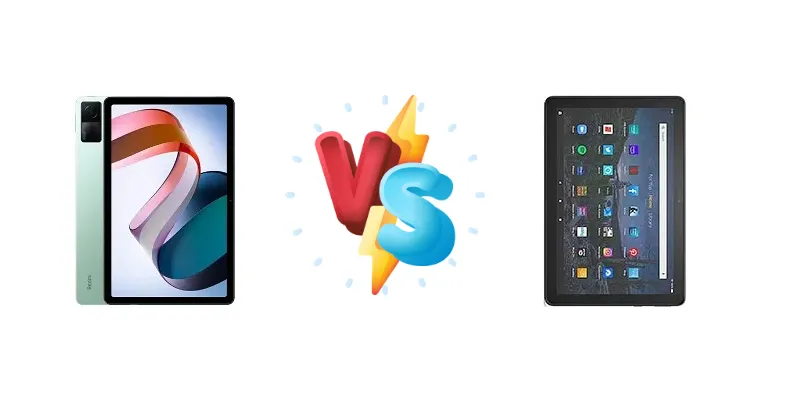
The tablet market offers a wide range of options, but finding the right balance between price and performance can be challenging. The Xiaomi Redmi Pad and the Amazon Fire HD 10 Plus (2021) both aim to deliver an affordable tablet experience, but they take very different approaches. This comparison dives deep into their specifications and features to determine which tablet is the better choice for your needs.
🏆 Quick Verdict
For most users, the Xiaomi Redmi Pad emerges as the superior choice. Its significantly more modern Mediatek Helio G99 chipset provides a noticeable performance boost over the Fire HD 10 Plus’s Helio P60T, making it better suited for multitasking and gaming. While the Fire HD 10 Plus offers wireless charging, the Redmi Pad’s overall performance advantage justifies the trade-off.
| Network |
|---|
| 2G bands | N/A | N/A |
| 3G bands | N/A | - |
| 4G bands | N/A | - |
| EDGE | N/A | No |
| GPRS | N/A | No |
| Technology | No cellular connectivity | No cellular connectivity |
| Launch |
|---|
| Announced | 2022, October 04 | 2021, April 27. Released 2021, May 26 |
| Status | Available. Released 2022, October 05 | Discontinued |
| Body |
|---|
| Build | Glass front, aluminum frame | - |
| Dimensions | 250.5 x 158.1 x 7.1 mm (9.86 x 6.22 x 0.28 in) | 247 x 166 x 9.2 mm (9.72 x 6.54 x 0.36 in) |
| SIM | No | No |
| Weight | 465 g (1.03 lb) | 468 g (1.03 lb) |
| Display |
|---|
| Protection | - | Aluminosilicate glass |
| Resolution | 1200 x 2000 pixels, 5:3 ratio (~220 ppi density) | 1920 x 1200 pixels, 16:10 ratio (~224 ppi density) |
| Size | 10.61 inches, 320.4 cm2 (~80.9% screen-to-body ratio) | 10.1 inches, 295.8 cm2 (~72.1% screen-to-body ratio) |
| Type | IPS LCD, 1B colors, 90Hz, 400 nits (typ) | IPS LCD |
| Platform |
|---|
| CPU | Octa-core (2x2.2 GHz Cortex-A76 & 6x2.0 GHz Cortex-A55) | Octa-core (4x2.0 GHz Cortex-A73 & 4x2.0 GHz Cortex-A53) |
| Chipset | Mediatek Helio G99 (6 nm) | Mediatek MT8183 Helio P60T (12 nm) |
| GPU | Mali-G57 MC2 | Mali-G72 MP3 |
| OS | Android 12, upgradable to Android 13, MIUI 14 | Android 9.0 (Pie), Fire OS 7 |
| Memory |
|---|
| Card slot | microSDXC | microSDXC (dedicated slot) |
| Internal | 64GB 3GB RAM, 128GB 4GB RAM, 128GB 6GB RAM | 32GB 4GB RAM, 64GB 4GB RAM |
| | UFS 2.2 | eMMC 5.1 |
| Main Camera |
|---|
| Single | 8 MP, f/2.0, (wide), AF | 5 MP |
| Video | 1080p@30fps | 720p |
| Selfie camera |
|---|
| Single | 8 MP, f/2.3, 105° (ultrawide) | 2 MP |
| Video | 1080p@30fps | 720p |
| Sound |
|---|
| 3.5mm jack | No | Yes |
| 35mm jack | No | Yes |
| Loudspeaker | Yes, with stereo speakers (4 speakers) | Yes, with stereo speakers |
| | 24-bit/192kHz audio | - |
| Comms |
|---|
| Bluetooth | 5.2, A2DP, LE | 5.0, A2DP, LE |
| NFC | No | No |
| Positioning | No | No |
| Radio | No | No |
| USB | USB Type-C, OTG | USB Type-C 2.0, OTG |
| WLAN | Wi-Fi 802.11 a/b/g/n/ac, dual-band, Wi-Fi Direct | Wi-Fi 802.11 a/b/g/n/ac, dual-band |
| Features |
|---|
| Sensors | Accelerometer | Accelerometer |
| | - | Text-to-Speech English-language content reader |
| Battery |
|---|
| Charging | 18W wired | Wireless |
| Type | Li-Po 8000 mAh | Li-Ion |
| Misc |
|---|
| Colors | Graphite Gray, Moonlight Silver, Mint Green | Slate |
| Models | 22081283G | T76N2P |
| Price | About 250 EUR | About 150 EUR |
| SAR EU | 0.36 W/kg (body) | - |
| Tests |
|---|
| Display |
Contrast ratio: 1529:1 (nominal) | - |
| Loudspeaker |
-23.9 LUFS (Very good)
| - |
| Performance |
AnTuTu: 319077 (v9)
GeekBench: 1852 (v5.1)
GFXBench: 13fps (ES 3.1 onscreen) | - |
Xiaomi Redmi Pad
- Significantly faster processor (Helio G99)
- More efficient 6nm chipset
- Brighter and higher contrast display
- More versatile Android OS
- No wireless charging
- Limited camera capabilities (details unknown)
Amazon Fire HD 10 Plus (2021)
- Wireless charging support
- Deep integration with Amazon services
- Affordable price point
- Fire OS is optimized for media consumption
- Outdated and less powerful processor (Helio P60T)
- Less efficient 12nm chipset
- Limited app ecosystem (Fire OS)
- Potentially lower display quality
Display Comparison
The Redmi Pad boasts a measured peak brightness of 402 nits and a 1529:1 contrast ratio, offering a vibrant and clear viewing experience. While the Fire HD 10 Plus’s display specifications aren’t publicly available with the same precision, it’s generally understood to have lower brightness and contrast. The Redmi Pad’s higher brightness is particularly beneficial for outdoor use or in brightly lit environments. Both tablets likely utilize IPS LCD panels, but the Redmi Pad’s superior contrast ratio suggests better black levels and a more immersive image. Bezels appear comparable on both devices, but the Redmi Pad’s display quality gives it an edge.
Camera Comparison
Neither tablet is designed for serious photography. However, the Redmi Pad likely has a more capable camera system due to its newer chipset and potentially better image signal processing. The Fire HD 10 Plus’s camera performance is generally considered to be basic at best. Without specific sensor details for either device, it’s difficult to make a precise comparison, but the Redmi Pad’s overall hardware advantage suggests a better imaging experience.
Performance
The core difference between these tablets lies in their chipsets. The Redmi Pad’s Mediatek Helio G99, built on a 6nm process, is a substantial upgrade over the Fire HD 10 Plus’s 12nm Mediatek MT8183 Helio P60T. The G99 features a more modern CPU architecture – Cortex-A76 cores versus the P60T’s Cortex-A73 – resulting in faster single-core and multi-core performance. The 6nm fabrication process also translates to improved power efficiency and reduced thermal throttling. This means the Redmi Pad will handle demanding apps and games more smoothly and for longer periods. The Fire HD 10 Plus’s P60T is adequate for basic tasks, but will struggle with more intensive workloads.
Battery Life
Battery capacity figures are not provided for either device. However, the Fire HD 10 Plus offers the convenience of wireless charging, a feature absent on the Redmi Pad. The Redmi Pad’s more efficient Helio G99 chipset could potentially offset the lack of wireless charging, offering comparable or even better battery life in real-world usage. The Redmi Pad’s 18W wired charging is standard, while the Fire HD 10 Plus’s wireless charging speed is likely slower, meaning a full charge will take longer.
Buying Guide
Buy the Xiaomi Redmi Pad if you prioritize performance for everyday tasks, streaming, and light gaming, and prefer a more open Android experience. It’s ideal for students, casual gamers, and users who want a versatile tablet. Buy the Amazon Fire HD 10 Plus (2021) if you are deeply embedded in the Amazon ecosystem, heavily utilize Amazon services, and value wireless charging convenience over raw processing power. It’s a good option for dedicated media consumers who primarily use Amazon Prime Video and Kindle.
Frequently Asked Questions
❓ Will the Redmi Pad handle demanding games like Genshin Impact or Call of Duty Mobile?
While the Helio G99 isn't a flagship gaming chip, it's capable of running many popular games at medium settings. Expect playable frame rates in Genshin Impact and Call of Duty Mobile, but you may need to lower graphics settings for a smoother experience. The Fire HD 10 Plus’s Helio P60T will struggle with these titles.
❓ How much does the Amazon Fire OS restrict app availability compared to standard Android?
Fire OS is based on Android, but lacks full Google Play Store support. You primarily access apps through the Amazon Appstore, which has a smaller selection. Sideloading apps is possible, but requires technical knowledge and isn't officially supported. The Redmi Pad, running a standard Android build, provides access to the full Google Play Store ecosystem.
❓ Is the wireless charging on the Fire HD 10 Plus significantly slower than wired charging?
Yes, wireless charging on the Fire HD 10 Plus is considerably slower than wired charging. Expect a full charge to take several hours longer via wireless charging. The Redmi Pad’s 18W wired charging offers a faster and more efficient charging experience.
❓ Can I use Google apps like YouTube and Gmail on the Amazon Fire HD 10 Plus?
Yes, you can install YouTube and Gmail on the Fire HD 10 Plus, but you'll need to sideload them as they aren't available through the Amazon Appstore. This process requires enabling apps from unknown sources in the settings and downloading the APK files.