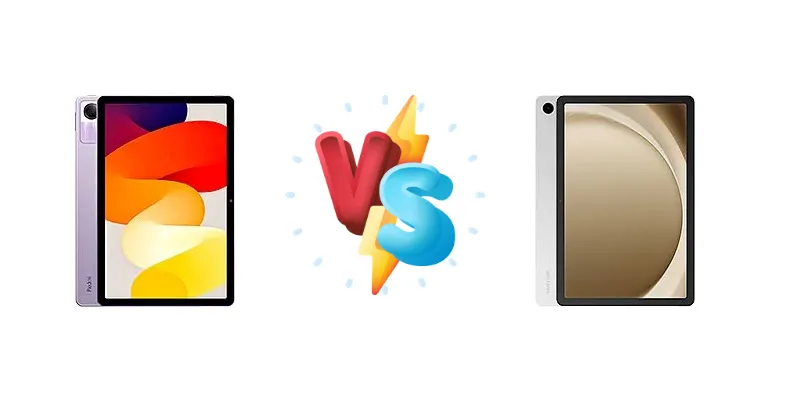
The sub-$200 Android tablet market is heating up, with the Xiaomi Redmi Pad SE and Samsung Galaxy Tab A9+ vying for dominance. Both offer compelling features for the price, but significant differences in chipset and charging strategy dictate which tablet is best suited for different users. This comparison dives deep into the specs to reveal the true winner.
🏆 Quick Verdict
For most users, the Samsung Galaxy Tab A9+ emerges as the better choice. While the Redmi Pad SE boasts impressive battery life, the A9+'s Snapdragon 695 provides a noticeable performance uplift, making it more capable for multitasking and demanding applications. The 5G connectivity, though not universally utilized, adds future-proofing.
| Network |
|---|
| 2G bands | N/A | GSM 850 / 900 / 1800 / 1900 |
| 3G bands | N/A | HSDPA 850 / 900 / 1700(AWS) / 1900 / 2100 |
| 4G bands | N/A | 1, 2, 3, 4, 5, 7, 8, 12, 13, 17, 20, 26, 28, 38, 40, 41, 66 |
| 5G bands | - | 1, 3, 5, 7, 8, 20, 28, 38, 40, 41, 66, 77, 78 SA/NSA/Sub6 |
| EDGE | N/A | - |
| GPRS | N/A | - |
| Speed | - | HSPA, LTE, 5G - cellular model only |
| Technology | No cellular connectivity | GSM / HSPA / LTE / 5G |
| Launch |
|---|
| Announced | 2023, August 15 | 2023, October 05 |
| Status | Available. Released 2023, September | Available. Released 2023, October 17 |
| Body |
|---|
| Build | Glass front, aluminum back, aluminum frame | - |
| Dimensions | 255.5 x 167.1 x 7.4 mm (10.06 x 6.58 x 0.29 in) | 257.1 x 168.7 x 6.9 mm (10.12 x 6.64 x 0.27 in) |
| SIM | No | Nano-SIM + eSIM (cellular model only) |
| Weight | 478 g (1.05 lb) | 480 g or 492 g (1.06 lb) |
| Display |
|---|
| Resolution | 1200 x 1920 pixels, 16:10 ratio (~207 ppi density) | 1200 x 1920 pixels, 16:10 ratio (~206 ppi density) |
| Size | 11.0 inches, 347.5 cm2 (~81.4% screen-to-body ratio) | 11.0 inches, 350.9 cm2 (~80.9% screen-to-body ratio) |
| Type | IPS LCD, 90Hz, 400 nits (typ) | TFT LCD, 90Hz |
| Platform |
|---|
| CPU | Octa-core (4x2.4 GHz Kryo 265 Gold & 4x1.9 GHz Kryo 265 Silver) | Octa-core (2x2.2 GHz Kryo 660 Gold & 6x1.8 GHz Kryo 660 Silver) |
| Chipset | Qualcomm SM6225 Snapdragon 680 4G (6 nm) | Qualcomm SM6375 Snapdragon 695 5G (6 nm) |
| GPU | Adreno 610 | Adreno 619 |
| OS | Android 13, upgradable to Android 15, HyperOS 2 | Android 13, upgradable to Android 15, One UI 7 |
| Memory |
|---|
| Card slot | microSDXC | microSDXC (dedicated slot) |
| Internal | 128GB 4GB RAM, 128GB 6GB RAM, 128GB 8GB RAM, 256GB 8GB RAM | 64GB 4GB RAM, 128GB 4GB RAM, 128GB 8GB RAM, 256GB 8GB RAM |
| Main Camera |
|---|
| Single | 8 MP, f/2.0, (wide), 1/4.0", 1.12µm, AF | 8 MP, AF |
| Video | 1080p@30fps | 1080p@30fps |
| Selfie camera |
|---|
| Single | 5 MP, f/2.2, (ultrawide), 1/5.0", 1.12µm | 5 MP |
| Video | 1080p@30fps | 1080p@30fps |
| Sound |
|---|
| 35mm jack | Yes | Yes |
| Loudspeaker | Yes, with stereo speakers (4 speakers) | Yes, with stereo speakers (4 speakers) |
| Comms |
|---|
| Bluetooth | 5.0, A2DP, LE | 5.1, A2DP, LE |
| NFC | No | No |
| Positioning | No | GPS, GLONASS, GALILEO, BDS, QZSS - cellular model only |
| Radio | Yes | No |
| USB | USB Type-C, OTG | USB Type-C 2.0 |
| WLAN | Wi-Fi 802.11 a/b/g/n/ac, dual-band | Wi-Fi 802.11 a/b/g/n/ac, dual-band, Wi-Fi Direct |
| Features |
|---|
| Sensors | Accelerometer, proximity (accessories only) | Accelerometer, gyro, proximity (accessories only), compass |
| Battery |
|---|
| Charging | 18W Quick Charge 3.0 | 15W wired |
| Type | Li-Po 8000 mAh | Li-Po 7040 mAh |
| Misc |
|---|
| Colors | Lavender Purple, Graphite Gray, Mint Green | Graphite, Silver, Navy |
| Models | 23073RPBFG | SM-X210, SM-X215, SM-X216B |
| Price | About 200 EUR | $ 199.99 |
| SAR | - | 0.42 W/kg (body) |
| SAR EU | 0.37 W/kg (body) | 1.19 W/kg (body) |
Xiaomi Redmi Pad SE
- Exceptional battery life (13:56h active use)
- Higher contrast ratio for a more vibrant display
- Faster charging (18W Quick Charge 3.0)
- Less powerful Snapdragon 680 processor
- Lacks 5G connectivity
Samsung Galaxy Tab A9+
- More powerful Snapdragon 695 5G processor
- 5G connectivity for future-proofing
- Smoother multitasking and app performance
- Likely shorter battery life
- Slower charging (15W)
Display Comparison
Both tablets feature LCD panels, but the Redmi Pad SE edges out the A9+ in measured display quality. The Redmi Pad SE achieves a 1595:1 contrast ratio and 402 nits of peak brightness, offering a more vibrant and visible image, especially in brighter environments. While Samsung doesn't publish contrast ratios, their displays typically prioritize color accuracy over peak brightness. The lack of high refresh rate panels on either device is expected at this price point, but the Redmi Pad SE’s superior contrast provides a more immersive viewing experience.
Camera Comparison
Neither tablet is intended as a photography powerhouse, and detailed camera specs are not provided. However, given the market segment, it’s safe to assume both feature basic camera setups. Focusing on the core processors, the A9+'s ISP (Image Signal Processor) within the Snapdragon 695 will likely offer slightly better image processing capabilities than the 680 in the Redmi Pad SE, but the difference will be minimal in real-world usage. The absence of OIS or high-resolution sensors suggests these cameras are best suited for casual snapshots and video calls.
Performance
The core difference lies in the chipsets. The Samsung Galaxy Tab A9+ utilizes the Qualcomm Snapdragon 695 5G (6nm), featuring a 2x2.2 GHz Kryo 660 Gold and 6x1.8 GHz Kryo 660 Silver configuration. This represents a clear upgrade over the Xiaomi Redmi Pad SE’s Snapdragon 680 4G (6nm) with its 4x2.4 GHz Kryo 265 Gold and 4x1.9 GHz Kryo 265 Silver cores. The 695’s newer architecture and higher clock speeds translate to faster app loading times, smoother multitasking, and improved gaming performance. While both are 6nm chips, the architectural improvements in the 695 provide a tangible benefit. The A9+ also benefits from 5G connectivity, a feature absent in the Redmi Pad SE.
Battery Life
The Redmi Pad SE shines in battery endurance, achieving an impressive 13:56 hours of active use. While the Galaxy Tab A9+’s battery capacity isn’t specified, its more powerful processor and 5G modem will likely result in shorter battery life. The Redmi Pad SE’s 18W Quick Charge 3.0 support is also faster than the A9+'s 15W wired charging, meaning quicker top-ups when needed. However, the A9+'s performance advantage may justify the trade-off for users who prioritize responsiveness over extended runtime.
Buying Guide
Buy the Xiaomi Redmi Pad SE if you prioritize all-day battery life and primarily use your tablet for media consumption and light tasks. It’s ideal for students or travelers who need a reliable device for reading, streaming, and basic productivity. Buy the Samsung Galaxy Tab A9+ if you value smoother performance for multitasking, occasional gaming, and appreciate the added benefit of 5G connectivity for potential future use. It’s a better fit for users who want a more versatile tablet experience.
Frequently Asked Questions
❓ Will the Snapdragon 695 in the Galaxy Tab A9+ struggle with graphically intensive games?
While the Snapdragon 695 isn't a gaming powerhouse, it's capable of running many popular Android games at medium settings. Expect playable frame rates in titles like PUBG Mobile and Call of Duty Mobile, but don't anticipate maxing out graphics settings. The Redmi Pad SE's Snapdragon 680 will offer a less smooth gaming experience.
❓ How much faster is the charging on the Redmi Pad SE compared to the Galaxy Tab A9+ in real-world use?
The Redmi Pad SE's 18W Quick Charge 3.0 support will noticeably reduce charging times. While exact 0-100% times aren't available, expect the Redmi Pad SE to charge significantly faster than the Galaxy Tab A9+'s 15W charging, potentially shaving off 30-60 minutes for a full charge.
❓ Is the 5G connectivity on the Galaxy Tab A9+ useful if I don't have a 5G plan?
Even without an active 5G plan, the 5G modem in the Galaxy Tab A9+ offers future-proofing. When you eventually upgrade to a 5G plan, the tablet will be ready to take advantage of faster data speeds. It also supports older cellular standards like 4G LTE.