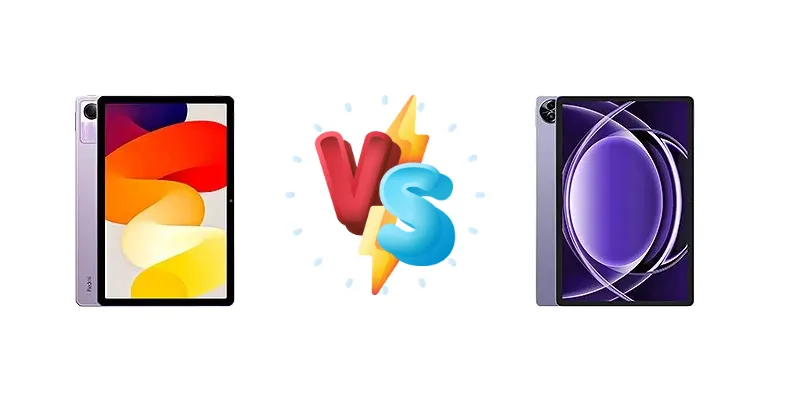
The sub-$200 tablet market is heating up, with the Xiaomi Redmi Pad SE and Realme Pad 2 Lite vying for dominance. Both aim to deliver a compelling experience without breaking the bank, but they take different approaches. The Redmi Pad SE leverages Qualcomm’s Snapdragon 680, while the Realme Pad 2 Lite opts for MediaTek’s Helio G99. This comparison dissects their strengths and weaknesses to determine which tablet offers the best value.
🏆 Quick Verdict
For the average user prioritizing sustained performance and a slightly brighter display, the Realme Pad 2 Lite emerges as the winner. Its Helio G99 chipset provides a noticeable edge in responsiveness and gaming, despite the slower 15W charging. However, the Redmi Pad SE’s longer active use battery life is a strong contender for media consumers.
| Network |
|---|
| 2G bands | N/A | GSM 850 / 900 / 1800 / 1900 |
| 3G bands | N/A | HSDPA 850 / 900 / 2100 |
| 4G bands | N/A | 1, 3, 5, 7, 8, 20, 28, 38, 40, 41 |
| EDGE | N/A | - |
| GPRS | N/A | - |
| Speed | - | HSPA, LTE |
| Technology | No cellular connectivity | GSM / HSPA / LTE |
| Launch |
|---|
| Announced | 2023, August 15 | 2024, September 13 |
| Status | Available. Released 2023, September | Available. Released 2024, September 26 |
| Body |
|---|
| Build | Glass front, aluminum back, aluminum frame | - |
| Dimensions | 255.5 x 167.1 x 7.4 mm (10.06 x 6.58 x 0.29 in) | 258 x 169.5 x 8.3 mm (10.16 x 6.67 x 0.33 in) |
| SIM | No | No |
| Weight | 478 g (1.05 lb) | 525 g (1.16 lb) |
| Display |
|---|
| Resolution | 1200 x 1920 pixels, 16:10 ratio (~207 ppi density) | 1200 x 1920 pixels, 16:10 ratio (~207 ppi density) |
| Size | 11.0 inches, 347.5 cm2 (~81.4% screen-to-body ratio) | 10.95 inches, 347.7 cm2 (~79.5% screen-to-body ratio) |
| Type | IPS LCD, 90Hz, 400 nits (typ) | IPS LCD, 1B colors, 90Hz, 450 nits (peak) |
| Platform |
|---|
| CPU | Octa-core (4x2.4 GHz Kryo 265 Gold & 4x1.9 GHz Kryo 265 Silver) | Octa-core (2x2.2 GHz Cortex-A76 & 6x2.0 GHz Cortex-A55) |
| Chipset | Qualcomm SM6225 Snapdragon 680 4G (6 nm) | Mediatek Helio G99 (6 nm) |
| GPU | Adreno 610 | Mali-G57 MC2 |
| OS | Android 13, upgradable to Android 15, HyperOS 2 | Android 14, Realme UI 5.0 for Pad |
| Memory |
|---|
| Card slot | microSDXC | Unspecified |
| Internal | 128GB 4GB RAM, 128GB 6GB RAM, 128GB 8GB RAM, 256GB 8GB RAM | 128GB 4GB RAM, 128GB 8GB RAM |
| Main Camera |
|---|
| Features | - | Panorama |
| Single | 8 MP, f/2.0, (wide), 1/4.0", 1.12µm, AF | 8 MP, f/2.0 |
| Video | 1080p@30fps | 1080p@30fps |
| Selfie camera |
|---|
| Features | - | Panorama |
| Single | 5 MP, f/2.2, (ultrawide), 1/5.0", 1.12µm | 5 MP, f/2.2 |
| Video | 1080p@30fps | 1080p@30fps |
| Sound |
|---|
| 35mm jack | Yes | No |
| Loudspeaker | Yes, with stereo speakers (4 speakers) | Yes, with stereo speakers (4 speakers) |
| Comms |
|---|
| Bluetooth | 5.0, A2DP, LE | 5.2, A2DP, LE |
| NFC | No | No |
| Positioning | No | GPS, GALILEO, GLONASS, BDS |
| Radio | Yes | No |
| USB | USB Type-C, OTG | USB Type-C |
| WLAN | Wi-Fi 802.11 a/b/g/n/ac, dual-band | Wi-Fi 802.11 a/b/g/n/ac, dual-band |
| Features |
|---|
| Sensors | Accelerometer, proximity (accessories only) | Accelerometer |
| Battery |
|---|
| Charging | 18W Quick Charge 3.0 | 15W wired |
| Type | Li-Po 8000 mAh | 8300 mAh |
| Misc |
|---|
| Colors | Lavender Purple, Graphite Gray, Mint Green | Nebula Purple, Space Grey |
| Models | 23073RPBFG | RMP2402 |
| Price | About 200 EUR | About 160 EUR |
| SAR EU | 0.37 W/kg (body) | - |
Xiaomi Redmi Pad SE
- Longer battery life (13:56h active use)
- Faster 18W Quick Charge 3.0 charging
- Slightly brighter display (402 nits)
- Less powerful chipset (Snapdragon 680)
- Potentially slower app loading times
Realme Pad 2 Lite
- More powerful chipset (Helio G99)
- Smoother multitasking and gaming
- Potentially more responsive user experience
- Slower 15W charging
- Likely shorter battery life
Display Comparison
The Realme Pad 2 Lite and Redmi Pad SE both feature displays suitable for media consumption, but key differences exist. The Redmi Pad SE achieves a measured peak brightness of 402 nits and a 1595:1 contrast ratio. While respectable, the Realme Pad 2 Lite’s display specifications are not provided, suggesting a potentially lower peak brightness. This difference could be noticeable in brightly lit environments. Without further data on the Realme Pad 2 Lite’s panel type and color accuracy, the Redmi Pad SE holds a slight edge based on measured brightness and contrast.
Camera Comparison
Neither tablet is positioned as a photography powerhouse, and detailed camera specs are limited. Given the target price point, image quality will likely be similar. Focusing on the chipsets, the image signal processors (ISPs) within the Snapdragon 680 and Helio G99 are capable of basic image processing, but don't expect flagship-level results. Without specific sensor details, it’s difficult to declare a clear winner; however, the Realme Pad 2 Lite’s more powerful chipset *could* translate to slightly faster image processing.
Performance
This is where the tablets diverge significantly. The Realme Pad 2 Lite’s MediaTek Helio G99, built on a 6nm process, features a dual-core Cortex-A76 setup clocked at 2.2 GHz, paired with six Cortex-A55 cores at 2.0 GHz. This configuration prioritizes peak performance. Conversely, the Redmi Pad SE utilizes the Qualcomm Snapdragon 680 (also 6nm) with an octa-core arrangement of 4x2.4 GHz Kryo 265 Gold and 4x1.9 GHz Kryo 265 Silver cores. While the Snapdragon 680 has more cores, the Helio G99’s higher-clocked Cortex-A76 cores provide a more substantial performance uplift in demanding applications and gaming. The G99’s architecture is better suited for sustained workloads.
Battery Life
The Redmi Pad SE boasts impressive battery life, achieving 13:56 hours of active use. The Realme Pad 2 Lite’s battery capacity is not specified, but its 15W wired charging is slower than the Redmi Pad SE’s 18W Quick Charge 3.0 support. While the Realme Pad 2 Lite’s chipset is more power-efficient under load, the Redmi Pad SE’s larger battery (implied by the longer runtime) provides a significant advantage for users who prioritize longevity. The faster charging on the Redmi Pad SE also offers a quicker top-up when needed.
Buying Guide
Buy the Xiaomi Redmi Pad SE if you prioritize all-day battery life for extended media consumption and light tasks. Its 13:56h active use score makes it ideal for travel or situations where frequent charging isn't possible. Buy the Realme Pad 2 Lite if you value a more responsive user experience, smoother multitasking, and a bit more gaming horsepower. The Helio G99 chipset delivers a noticeable performance boost for everyday tasks and casual gaming.
Frequently Asked Questions
❓ Will the Helio G99 in the Realme Pad 2 Lite overheat during extended gaming sessions?
The MediaTek Helio G99 is designed with thermal efficiency in mind, utilizing a 6nm process. While it will generate heat during gaming, it's unlikely to experience significant throttling in the relatively spacious tablet form factor. However, sustained peak performance may lead to some temperature increase.
❓ Is the 15W charging on the Realme Pad 2 Lite noticeably slower than the Redmi Pad SE’s 18W charging?
Yes, the 15W charging on the Realme Pad 2 Lite will take longer to fully charge the device compared to the Redmi Pad SE’s 18W Quick Charge 3.0. While not a drastic difference, expect a longer wait time to go from 0% to 100%.
❓ Can the Redmi Pad SE handle demanding multitasking with several apps open simultaneously?
The Snapdragon 680 in the Redmi Pad SE is capable of handling moderate multitasking. However, with numerous apps running concurrently, you may experience some slowdowns. The Realme Pad 2 Lite, with its Helio G99, will offer a smoother experience in these scenarios.
❓ What type of storage does each tablet use, and is it expandable?
Storage type and expandability are not specified in the provided data. However, given the price point, both tablets likely utilize UFS 2.2 storage. Expandability via microSD card is common in this segment, but confirmation is needed for each model.