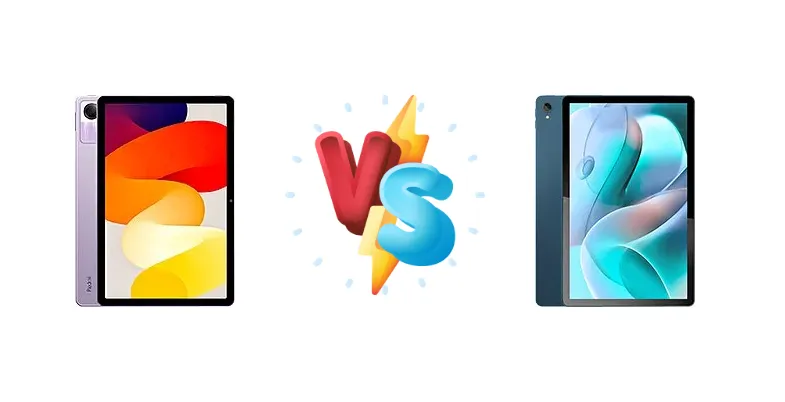
The tablet market is heating up with compelling options under $200. The Xiaomi Redmi Pad SE and Motorola Moto Tab G70 both aim to deliver a solid Android tablet experience without breaking the bank. However, they take different approaches to achieving this, with Xiaomi prioritizing efficiency and Motorola leaning towards raw processing power. This comparison dives deep into the specs and real-world performance to determine which tablet is the better buy.
🏆 Quick Verdict
For the average user prioritizing all-day battery life and a smooth, efficient experience, the Xiaomi Redmi Pad SE emerges as the winner. Its Snapdragon 680 chipset, coupled with a measured 13:56h active use battery score, provides a more consistent and reliable experience than the Motorola Moto Tab G70's Helio G90T.
| Network |
|---|
| 2G bands | N/A | GSM 850 / 900 / 1800 / 1900 |
| 3G bands | N/A | HSDPA 850 / 900 / 1900 / 2100 |
| 4G bands | N/A | 1, 2, 4, 7, 8, 20, 28, 38, 40, 41 |
| EDGE | N/A | - |
| GPRS | N/A | - |
| Speed | - | HSPA 42.2/5.76 Mbps, LTE Cat4 150/50 Mbps - cellular model only |
| Technology | No cellular connectivity | GSM / HSPA / LTE |
| Launch |
|---|
| Announced | 2023, August 15 | 2022, January 12 |
| Status | Available. Released 2023, September | Available. Released 2022, January 13 |
| Body |
|---|
| Build | Glass front, aluminum back, aluminum frame | Glass front, aluminum back, aluminum frame |
| Dimensions | 255.5 x 167.1 x 7.4 mm (10.06 x 6.58 x 0.29 in) | 258.4 x 163 x 7.5 mm (10.17 x 6.42 x 0.30 in) |
| SIM | No | Nano-SIM (cellular model only) |
| Weight | 478 g (1.05 lb) | 500 g (1.10 lb) |
| | - | Water repellent design |
| Display |
|---|
| Resolution | 1200 x 1920 pixels, 16:10 ratio (~207 ppi density) | 1200 x 2000 pixels, 5:3 ratio (~212 ppi density) |
| Size | 11.0 inches, 347.5 cm2 (~81.4% screen-to-body ratio) | 11.0 inches, 344.4 cm2 (~81.8% screen-to-body ratio) |
| Type | IPS LCD, 90Hz, 400 nits (typ) | IPS LCD, 400 nits (typ) |
| Platform |
|---|
| CPU | Octa-core (4x2.4 GHz Kryo 265 Gold & 4x1.9 GHz Kryo 265 Silver) | Octa-core (2x2.05 GHz Cortex-A76 & 6x2.0 GHz Cortex-A55) |
| Chipset | Qualcomm SM6225 Snapdragon 680 4G (6 nm) | Mediatek MT6785 Helio G90T (12 nm) |
| GPU | Adreno 610 | Mali-G76 MC4 |
| OS | Android 13, upgradable to Android 15, HyperOS 2 | Android 11 |
| Memory |
|---|
| Card slot | microSDXC | microSDXC (dedicated slot) |
| Internal | 128GB 4GB RAM, 128GB 6GB RAM, 128GB 8GB RAM, 256GB 8GB RAM | 64GB 4GB RAM, 128GB 6GB RAM |
| | - | eMMC 5.1 |
| Main Camera |
|---|
| Features | - | LED flash |
| Single | 8 MP, f/2.0, (wide), 1/4.0", 1.12µm, AF | 13 MP, f/2.2, 26mm (wide), AF |
| Video | 1080p@30fps | 1080p@30fps |
| Selfie camera |
|---|
| Single | 5 MP, f/2.2, (ultrawide), 1/5.0", 1.12µm | 8 MP, f/2.0, 26mm (wide) |
| Video | 1080p@30fps | 1080p@30fps |
| Sound |
|---|
| 3.5mm jack | - | Yes |
| 35mm jack | Yes | Yes |
| Loudspeaker | Yes, with stereo speakers (4 speakers) | Yes, with stereo speakers (4 speakers) |
| Comms |
|---|
| Bluetooth | 5.0, A2DP, LE | 5.2, A2DP, LE |
| NFC | No | No |
| Positioning | No | GPS, GLONASS - cellular model only |
| Radio | Yes | No |
| USB | USB Type-C, OTG | USB Type-C 2.0, OTG |
| WLAN | Wi-Fi 802.11 a/b/g/n/ac, dual-band | Wi-Fi 802.11 a/b/g/n/ac, dual-band, Wi-Fi Direct |
| Features |
|---|
| Sensors | Accelerometer, proximity (accessories only) | Accelerometer, gyro, proximity |
| Battery |
|---|
| Charging | 18W Quick Charge 3.0 | 20W wired |
| Type | Li-Po 8000 mAh | Li-Po 7700 mAh |
| Misc |
|---|
| Colors | Lavender Purple, Graphite Gray, Mint Green | Modernist Teal, Blue |
| Models | 23073RPBFG | - |
| Price | About 200 EUR | About 380 EUR |
| SAR EU | 0.37 W/kg (body) | - |
Xiaomi Redmi Pad SE
- Exceptional battery life (13:56h active use)
- Efficient Snapdragon 680 chipset
- Good display brightness (402 nits)
- Potentially less powerful for demanding games
- 18W charging is relatively slow
Motorola Moto Tab G70
- Faster 20W charging
- Potentially higher peak performance with Helio G90T
- May handle graphically intensive games slightly better
- Likely shorter battery life
- Helio G90T can run hotter and throttle
- 12nm process is less efficient
Display Comparison
The Redmi Pad SE boasts a display capable of reaching 402 nits of peak brightness, offering good visibility in most indoor environments. Its 1595:1 contrast ratio ensures decent black levels and vibrant colors. While the Moto Tab G70’s display specifications aren’t provided, Motorola typically uses IPS LCDs in this price range, likely resulting in similar brightness and contrast performance. However, the Redmi Pad SE’s measured brightness gives it a slight edge for outdoor use. Both tablets likely feature standard 60Hz refresh rates, prioritizing battery life over ultra-smooth scrolling.
Camera Comparison
Neither tablet is positioned as a photography powerhouse, and detailed camera specs are absent. Given the price point, expect basic camera performance suitable for casual snapshots and video calls. Focusing on the chipsets, the image signal processors (ISPs) within the Snapdragon 680 and Helio G90T are capable of handling basic image processing tasks. However, without knowing sensor sizes or lens apertures, it’s difficult to definitively declare a winner. It's safe to assume both will struggle in low-light conditions.
Performance
The core difference lies in the chipsets. The Redmi Pad SE utilizes the Qualcomm Snapdragon 680 (6nm), an octa-core processor designed for efficiency. Its CPU configuration – 4x2.4 GHz Kryo 265 Gold & 4x1.9 GHz Kryo 265 Silver – balances performance and power consumption. The Moto Tab G70, on the other hand, features the MediaTek Helio G90T (12nm). While the G90T’s CPU – 2x2.05 GHz Cortex-A76 & 6x2.0 GHz Cortex-A55 – offers potentially higher peak performance, the larger 12nm manufacturing process means it will likely generate more heat and consume more power. This translates to potential throttling under sustained loads and shorter battery life. The Snapdragon 680’s 6nm process provides a clear advantage in thermal efficiency.
Battery Life
The Redmi Pad SE shines in battery life, achieving an impressive 13:56h of active use. This is a direct result of the efficient Snapdragon 680 chipset and its 6nm manufacturing process. The Moto Tab G70, while equipped with 20W wired charging (compared to the Redmi Pad SE’s 18W Quick Charge 3.0), is likely to require more frequent charging due to the power-hungry Helio G90T. Faster charging doesn’t necessarily equate to a better experience if the battery drains quickly. The Redmi Pad SE’s longer runtime provides greater peace of mind for users on the go.
Buying Guide
Buy the Xiaomi Redmi Pad SE if you need a tablet primarily for media consumption, light productivity, and extended battery life. It’s ideal for students, travelers, or anyone who wants a dependable tablet for everyday tasks. Buy the Motorola Moto Tab G70 if you prioritize occasional gaming or more demanding applications and are willing to trade some battery life for a potential performance boost in those specific scenarios.
Frequently Asked Questions
❓ Will the Helio G90T in the Moto Tab G70 overheat during extended gaming sessions?
The MediaTek Helio G90T is known to generate more heat than the Snapdragon 680, especially under sustained load. While the Moto Tab G70 likely has thermal management solutions, it's probable that you'll experience some performance throttling during prolonged gaming, leading to dropped frames and a less smooth experience.
❓ How long does it take to fully charge the Redmi Pad SE with the 18W charger?
While the exact 0-100% charging time isn't specified, with an 18W charger and Quick Charge 3.0 support, expect a full charge to take approximately 3-4 hours. The focus with the Redmi Pad SE is on maximizing battery life, not necessarily the fastest charging speeds.
❓ Is the Redmi Pad SE suitable for multitasking with several apps open simultaneously?
The Snapdragon 680, coupled with sufficient RAM (spec not provided, but likely 4GB or 6GB), is capable of handling moderate multitasking. While it won't match the performance of flagship tablets, it should comfortably manage several apps like web browsers, email clients, and document editors without significant slowdowns.
❓ Does the Moto Tab G70 support external storage via microSD card?
While not explicitly stated in the provided data, Motorola tablets typically include a microSD card slot for expandable storage. This is a valuable feature for users who need to store large files like movies, music, or photos.