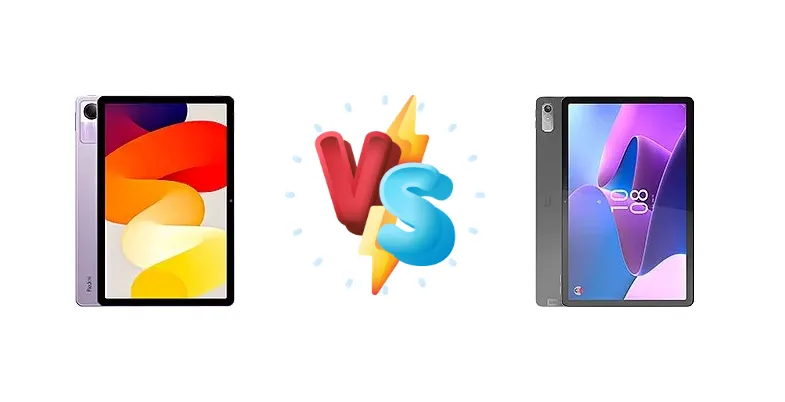
The sub-$200 tablet market is heating up, with the Xiaomi Redmi Pad SE and Lenovo Tab P11 Gen 2 vying for dominance. Both offer a large-screen Android experience at an accessible price, but they take different approaches to achieving it. This comparison dives deep into their specifications and performance to determine which tablet best suits your needs.
🏆 Quick Verdict
For most users, the Lenovo Tab P11 Gen 2 emerges as the better choice. Its Mediatek Helio G99 chipset provides a noticeable performance edge over the Redmi Pad SE’s Snapdragon 680, making it more responsive for multitasking and demanding apps. While the Redmi Pad SE boasts excellent battery life, the P11 Gen 2’s overall experience is more polished.
| Network |
|---|
| 2G bands | N/A | GSM 850 / 900 / 1800 / 1900 |
| 3G bands | N/A | HSDPA 800 / 850 / 900 / 1700(AWS) / 1900 / 2100 |
| 4G bands | N/A | 1, 2, 3, 4, 5, 7, 8, 12, 13, 18, 19, 20, 25, 26, 28, 38, 40, 41, 66 |
| EDGE | N/A | - |
| GPRS | N/A | - |
| Speed | - | HSPA, LTE - cellular model only |
| Technology | No cellular connectivity | GSM / HSPA / LTE |
| Launch |
|---|
| Announced | 2023, August 15 | 2022, September 01 |
| Status | Available. Released 2023, September | Available. Released 2023, January |
| Body |
|---|
| Build | Glass front, aluminum back, aluminum frame | - |
| Dimensions | 255.5 x 167.1 x 7.4 mm (10.06 x 6.58 x 0.29 in) | 269.1 x 169.4 x 7.4 mm (10.59 x 6.67 x 0.29 in) |
| SIM | No | Nano-SIM (cellular model only) |
| Weight | 478 g (1.05 lb) | 520 g (1.15 lb) |
| | - | Stylus support |
| Display |
|---|
| Resolution | 1200 x 1920 pixels, 16:10 ratio (~207 ppi density) | 1200 x 2000 pixels, 5:3 ratio (~203 ppi density) |
| Size | 11.0 inches, 347.5 cm2 (~81.4% screen-to-body ratio) | 11.5 inches, 376.4 cm2 (~82.6% screen-to-body ratio) |
| Type | IPS LCD, 90Hz, 400 nits (typ) | IPS LCD, 120Hz, 400 nits (typ) |
| Platform |
|---|
| CPU | Octa-core (4x2.4 GHz Kryo 265 Gold & 4x1.9 GHz Kryo 265 Silver) | Octa-core (2x2.2 GHz Cortex-A76 & 6x2.0 GHz Cortex-A55) |
| Chipset | Qualcomm SM6225 Snapdragon 680 4G (6 nm) | Mediatek Helio G99 (6 nm) |
| GPU | Adreno 610 | Mali-G57 MC2 |
| OS | Android 13, upgradable to Android 15, HyperOS 2 | Android 12L |
| Memory |
|---|
| Card slot | microSDXC | microSDXC (dedicated slot) |
| Internal | 128GB 4GB RAM, 128GB 6GB RAM, 128GB 8GB RAM, 256GB 8GB RAM | 64GB 4GB RAM, 128GB 4GB RAM, 128GB 6GB RAM |
| Main Camera |
|---|
| Features | - | LED flash |
| Single | 8 MP, f/2.0, (wide), 1/4.0", 1.12µm, AF | 13 MP, f/2.4, (wide), AF |
| Video | 1080p@30fps | 1080p@30fps |
| Selfie camera |
|---|
| Single | 5 MP, f/2.2, (ultrawide), 1/5.0", 1.12µm | 8 MP, f/2.0 |
| Video | 1080p@30fps | 1080p@30fps |
| Sound |
|---|
| 3.5mm jack | - | Yes |
| 35mm jack | Yes | Yes |
| Loudspeaker | Yes, with stereo speakers (4 speakers) | Yes, with stereo speakers (4 speakers) |
| Comms |
|---|
| Bluetooth | 5.0, A2DP, LE | 5.2, A2DP, LE |
| NFC | No | No |
| Positioning | No | GPS, GLONASS, BDS - cellular model only |
| Radio | Yes | No |
| USB | USB Type-C, OTG | USB Type-C 2.0, OTG, magnetic connector |
| WLAN | Wi-Fi 802.11 a/b/g/n/ac, dual-band | Wi-Fi 802.11 a/b/g/n/ac/6e, dual-band, Wi-Fi Direct |
| Features |
|---|
| Sensors | Accelerometer, proximity (accessories only) | Accelerometer, gyro, proximity |
| Battery |
|---|
| Charging | 18W Quick Charge 3.0 | - |
| Type | Li-Po 8000 mAh | Li-Po 7700 mAh |
| Misc |
|---|
| Colors | Lavender Purple, Graphite Gray, Mint Green | Storm Grey, Sage |
| Models | 23073RPBFG | TB350FU |
| Price | About 200 EUR | About 350 EUR |
| SAR EU | 0.37 W/kg (body) | - |
Xiaomi Redmi Pad SE
- Exceptional battery life (13:56h active use)
- Good contrast ratio for vibrant visuals
- Affordable price point
- Less powerful processor compared to the competition
- Display may struggle in bright sunlight
Lenovo Tab P11 Gen 2
- More powerful Mediatek Helio G99 chipset
- Smoother multitasking and app performance
- Potentially more responsive user experience
- Likely shorter battery life than the Redmi Pad SE
- Battery capacity and charging speed are unknown
Display Comparison
The Redmi Pad SE features a display capable of reaching 402 nits of peak brightness and a 1595:1 contrast ratio. This is adequate for indoor use, but may struggle in direct sunlight. The Lenovo Tab P11 Gen 2’s display specifications are not provided, but given its market positioning, it likely offers similar brightness levels. However, the Redmi Pad SE’s contrast ratio suggests deeper blacks and more vibrant colors. Without knowing the panel technology of the P11 Gen 2 (e.g., IPS, LCD), it’s difficult to assess color accuracy, but both tablets likely target a similar color gamut for budget-friendly displays.
Camera Comparison
Neither tablet is expected to excel in photography. Camera specifications are not provided for either device beyond the chipsets. Given their price point, both likely feature basic camera setups suitable for casual snapshots and video calls. Focusing on camera quality would be a misdirection; these tablets are not designed for serious photography.
Performance
The core difference lies in the chipsets. The Redmi Pad SE utilizes the Qualcomm Snapdragon 680 (6nm), an efficient but entry-level processor. Its octa-core configuration (4x2.4 GHz Kryo 265 Gold & 4x1.9 GHz Kryo 265 Silver) prioritizes power efficiency over raw performance. The Lenovo Tab P11 Gen 2, however, is powered by the Mediatek Helio G99 (6nm). The G99’s CPU configuration (2x2.2 GHz Cortex-A76 & 6x2.0 GHz Cortex-A55) features more powerful Cortex-A76 cores, resulting in significantly better single-core and multi-core performance. This translates to snappier app launches, smoother multitasking, and a more responsive overall experience on the Lenovo tablet. The 6nm process node on both chips contributes to good thermal efficiency, but the G99’s superior architecture gives it a clear advantage.
Battery Life
The Redmi Pad SE shines in battery life, achieving an impressive 13:56 hours of active use. This suggests a large battery capacity and efficient power management. The Lenovo Tab P11 Gen 2’s battery capacity is unknown, but its more powerful processor will likely consume more energy. The Redmi Pad SE’s 18W Quick Charge 3.0 support is standard for this price range, offering reasonable charging speeds. The P11 Gen 2’s charging speed is also unknown, but a faster charging rate would be beneficial to offset its potentially lower battery life.
Buying Guide
Buy the Xiaomi Redmi Pad SE if you prioritize all-day battery life and a consistently smooth experience for basic tasks like video streaming and web browsing. It’s ideal for users who need a reliable, long-lasting tablet for casual use. Buy the Lenovo Tab P11 Gen 2 if you value performance and responsiveness for multitasking, light gaming, and a more fluid user experience. It’s a better fit for students or anyone who needs a tablet that can handle a wider range of applications.
Frequently Asked Questions
❓ Will the Snapdragon 680 in the Redmi Pad SE struggle with demanding games?
Yes, the Snapdragon 680 is an entry-level chipset. While it can handle casual games, it will likely struggle with graphically intensive titles at higher settings. Expect reduced frame rates and potential stuttering. The Lenovo Tab P11 Gen 2’s Helio G99 offers a more capable gaming experience.
❓ How much does the performance difference between the Helio G99 and Snapdragon 680 translate to real-world use?
The Helio G99 offers a noticeable improvement in responsiveness, especially when multitasking or launching apps. The Snapdragon 680 is adequate for basic tasks, but the G99 provides a smoother and more fluid experience overall. This difference will be most apparent when switching between apps or running multiple applications simultaneously.
❓ Is the Redmi Pad SE a good choice for taking notes with a stylus?
Neither tablet is explicitly marketed with stylus support. While you might be able to use a generic capacitive stylus with both, the experience won't be optimized. The lack of active stylus support and pressure sensitivity means note-taking will be less precise and natural compared to tablets designed for stylus input.