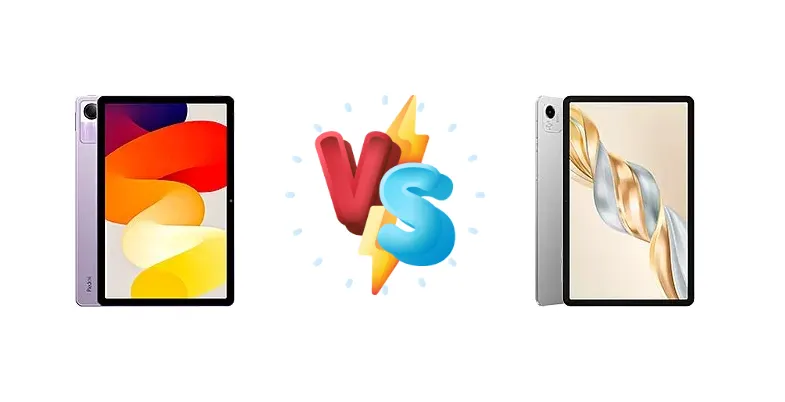
The budget tablet market is fiercely competitive, and the Xiaomi Redmi Pad SE and Honor Pad X9a represent compelling options for users seeking affordability without sacrificing essential features. While both tablets leverage Qualcomm's Snapdragon 6-series chipsets, they diverge significantly in battery endurance and charging speed, creating a clear trade-off for potential buyers. This comparison will dissect their strengths and weaknesses to determine which tablet delivers the best overall value.
🏆 Quick Verdict
For the average user prioritizing all-day battery life and fast charging, the Honor Pad X9a emerges as the winner. Its impressive 92:29h endurance and 35W charging significantly outweigh the Redmi Pad SE’s slightly brighter display. However, users focused on maximizing screen brightness and potentially benefiting from a marginally more efficient chipset may find the Redmi Pad SE a suitable alternative.
| Network |
|---|
| 2G bands | N/A | N/A |
| 3G bands | N/A | N/A |
| 4G bands | N/A | N/A |
| EDGE | N/A | No |
| GPRS | N/A | No |
| Technology | No cellular connectivity | No cellular connectivity |
| Launch |
|---|
| Announced | 2023, August 15 | 2025, March 21 |
| Status | Available. Released 2023, September | Available. Released 2025, March 26 |
| Body |
|---|
| Build | Glass front, aluminum back, aluminum frame | Glass front, aluminum frame, aluminum back |
| Dimensions | 255.5 x 167.1 x 7.4 mm (10.06 x 6.58 x 0.29 in) | 267.3 x 167.4 x 6.8 mm (10.52 x 6.59 x 0.27 in) |
| SIM | No | No |
| Weight | 478 g (1.05 lb) | 475 g (1.05 lb) |
| Display |
|---|
| Protection | - | Mohs level 4 |
| Resolution | 1200 x 1920 pixels, 16:10 ratio (~207 ppi density) | 1504 x 2508 pixels, 5:3 ratio (~254 ppi density) |
| Size | 11.0 inches, 347.5 cm2 (~81.4% screen-to-body ratio) | 11.5 inches, 376.3 cm2 (~84.1% screen-to-body ratio) |
| Type | IPS LCD, 90Hz, 400 nits (typ) | TFT LCD, 120Hz, 400 nits (peak) |
| Platform |
|---|
| CPU | Octa-core (4x2.4 GHz Kryo 265 Gold & 4x1.9 GHz Kryo 265 Silver) | Octa-core (4x2.8 GHz Cortex-A73 & 4x1.9 GHz Cortex-A53) |
| Chipset | Qualcomm SM6225 Snapdragon 680 4G (6 nm) | Qualcomm SM6225 Snapdragon 685 (6 nm) |
| GPU | Adreno 610 | Adreno 610 |
| OS | Android 13, upgradable to Android 15, HyperOS 2 | Android 15, MagicOS 9 |
| Memory |
|---|
| Card slot | microSDXC | No |
| Internal | 128GB 4GB RAM, 128GB 6GB RAM, 128GB 8GB RAM, 256GB 8GB RAM | 128GB 6GB RAM, 128GB 8GB RAM |
| Main Camera |
|---|
| Single | 8 MP, f/2.0, (wide), 1/4.0", 1.12µm, AF | 8 MP, f/2.0, (wide), 1/5.0" |
| Video | 1080p@30fps | 1080p@30fps |
| Selfie camera |
|---|
| Single | 5 MP, f/2.2, (ultrawide), 1/5.0", 1.12µm | 5 MP, f/2.2 |
| Video | 1080p@30fps | 1080p@30fps |
| Sound |
|---|
| 35mm jack | Yes | No |
| Loudspeaker | Yes, with stereo speakers (4 speakers) | Yes, with stereo speakers (4 speakers) |
| Comms |
|---|
| Bluetooth | 5.0, A2DP, LE | 5.1, A2DP, LE |
| NFC | No | No |
| Positioning | No | No |
| Radio | Yes | No |
| USB | USB Type-C, OTG | USB Type-C |
| WLAN | Wi-Fi 802.11 a/b/g/n/ac, dual-band | Wi-Fi 802.11 a/b/g/n/ac, dual-band |
| Features |
|---|
| Sensors | Accelerometer, proximity (accessories only) | Accelerometer |
| Battery |
|---|
| Charging | 18W Quick Charge 3.0 | 35W wired |
| Type | Li-Po 8000 mAh | Li-Ion 8300 mAh |
| Misc |
|---|
| Colors | Lavender Purple, Graphite Gray, Mint Green | Gray |
| Models | 23073RPBFG | ELN2-W29 |
| Price | About 200 EUR | About 210 EUR |
| SAR EU | 0.37 W/kg (body) | - |
| EU LABEL |
|---|
| Battery | - | 92:29h endurance, 1200 cycles |
| Energy | - | Class F |
| Free fall | - | Class E (10 falls) |
| Repairability | - | Class C |
Xiaomi Redmi Pad SE
- Brighter display for better visibility in bright conditions.
- Slightly more modern chipset architecture (Snapdragon 680).
- Potentially better contrast ratio for richer visuals.
- Significantly shorter battery life compared to the Honor Pad X9a.
- Slower charging speed (18W vs 35W).
Honor Pad X9a
- Exceptional battery life (92:29h endurance).
- Faster 35W wired charging.
- Longer battery lifespan (1200 charge cycles).
- Display brightness likely lower than the Redmi Pad SE.
- Chipset is a slightly older generation (Snapdragon 685).
Display Comparison
The Redmi Pad SE boasts a measured peak brightness of 402 nits and a 1595:1 contrast ratio, offering a visually punchy experience, particularly for media consumption. While the Honor Pad X9a’s display specifications aren’t provided, the Redmi Pad SE’s higher brightness is a clear advantage in scenarios with strong ambient light. Both tablets likely utilize IPS LCD panels, common in this price bracket, but the Redmi Pad SE’s contrast ratio suggests potentially better black levels. The lack of information regarding the X9a’s panel type or brightness makes a definitive comparison challenging, but the Redmi Pad SE holds a measurable lead in this category.
Camera Comparison
Given the budget nature of these tablets, camera performance isn't a primary focus. Detailed camera specifications are unavailable, making a direct comparison difficult. It’s safe to assume both tablets feature basic camera setups suitable for casual snapshots and video calls. Without sensor size or aperture information, it’s impossible to determine which tablet captures better images. Focusing on the core strengths of these devices – battery and performance – is more relevant than scrutinizing their camera capabilities.
Performance
Both tablets are powered by Qualcomm Snapdragon 6-series chipsets fabricated on a 6nm process, ensuring reasonable efficiency. However, the Honor Pad X9a features the Snapdragon 685, while the Redmi Pad SE utilizes the Snapdragon 680. The 685 represents a slight iterative improvement, offering marginally higher clock speeds (up to 2.8 GHz vs 2.4 GHz) in its Cortex-A73 performance cores. This translates to a potentially snappier experience in demanding applications. The Redmi Pad SE’s CPU configuration, with 4x2.4 GHz Kryo 265 Gold and 4x1.9 GHz Kryo 265 Silver cores, is paired with the Snapdragon 680, while the X9a uses 4x2.8 GHz Cortex-A73 and 4x1.9 GHz Cortex-A53 cores. While both utilize an octa-core setup, the X9a’s faster A73 cores provide a performance edge. The impact on real-world usage will be most noticeable in multitasking and graphically intensive games.
Battery Life
The Honor Pad X9a dominates in battery endurance, boasting an impressive 92:29h of usage. This is a substantial leap over the Redmi Pad SE’s 13:56h active use score. The X9a also benefits from 35W wired charging, enabling significantly faster replenishment compared to the Redmi Pad SE’s 18W Quick Charge 3.0. The X9a’s claimed 1200 charge cycles also suggest a longer lifespan for the battery itself. While the Redmi Pad SE’s chipset might be marginally more efficient, the X9a’s larger battery capacity and faster charging capabilities provide a far superior user experience for those prioritizing longevity and convenience.
Buying Guide
Buy the Xiaomi Redmi Pad SE if you need a tablet with a brighter display for outdoor use or in well-lit environments and prioritize a slightly more modern chipset architecture. Buy the Honor Pad X9a if you prefer exceptional battery life, rapid charging capabilities, and a tablet that can easily last through multiple days of moderate use. The X9a is ideal for travelers, students, or anyone who dislikes frequent charging.
Frequently Asked Questions
❓ Does the Snapdragon 685 in the Honor Pad X9a offer a noticeable performance improvement over the Snapdragon 680 in the Redmi Pad SE for gaming?
While both chipsets are capable of handling casual gaming, the Snapdragon 685’s faster Cortex-A73 cores in the Honor Pad X9a will provide a slight edge in more demanding titles. Expect smoother frame rates and reduced stuttering, particularly in games optimized for the ARM Cortex-A73 architecture. However, neither tablet is designed for high-end gaming experiences.
❓ How long does it realistically take to fully charge the Honor Pad X9a with the 35W charger?
While Honor doesn't provide an exact 0-100% charging time, with 35W charging, you can expect a full charge in approximately 1 hour and 45 minutes to 2 hours, depending on background processes and battery temperature. This is significantly faster than the Redmi Pad SE’s 18W charging, which will likely take over 3 hours for a complete recharge.
❓ Is the 92:29h battery endurance of the Honor Pad X9a achievable in real-world usage?
The 92:29h endurance is based on Honor’s testing methodology, which likely involves a mix of standby, web browsing, video playback, and other common tasks. Real-world usage will vary depending on your usage patterns. However, even with heavy use, the Honor Pad X9a should easily last a full day, and potentially multiple days, on a single charge.