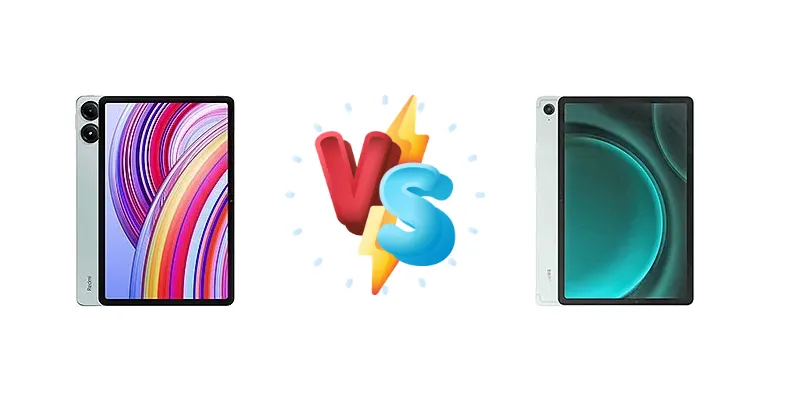
The mid-range tablet market is heating up, with the Xiaomi Redmi Pad Pro and Samsung Galaxy Tab S9 FE vying for dominance. Both offer compelling features at attractive price points, but cater to slightly different needs. The Redmi Pad Pro focuses on delivering strong performance and a vibrant display for media consumption, while the Galaxy Tab S9 FE aims for a more balanced experience with Samsung’s ecosystem integration and potential for stylus use.
🏆 Quick Verdict
For the average user prioritizing raw performance and screen quality for media, the Xiaomi Redmi Pad Pro emerges as the winner. Its Snapdragon 7s Gen 2 chipset and higher peak brightness offer a noticeable advantage. However, Samsung’s ecosystem and 45W charging are compelling reasons to consider the Tab S9 FE.
| Network |
|---|
| 2G bands | N/A | GSM 850 / 900 / 1800 / 1900 |
| 3G bands | N/A | HSDPA 850 / 900 / 1700(AWS) / 1900 / 2100 |
| 4G bands | - | 1, 2, 3, 4, 5, 7, 8, 12, 13, 17, 20, 26, 28, 32, 38, 40, 41, 66 |
| 5G bands | - | 1, 3, 5, 7, 8, 20, 28, 38, 40, 41, 66, 77, 78 SA/NSA/Sub6 |
| EDGE | N/A | - |
| GPRS | N/A | - |
| Speed | - | HSPA, LTE, 5G - cellular model only |
| Technology | No cellular connectivity | GSM / HSPA / LTE / 5G |
| Launch |
|---|
| Announced | 2024, April 10 | 2023, October 04 |
| Status | Available. Released 2024, April 15 | Available. Released 2023, October 16 |
| Body |
|---|
| Build | Glass front (Gorilla Glass 3), aluminum frame, aluminum back | Glass front, aluminum back, aluminum frame |
| Dimensions | 280 x 181.9 x 7.5 mm (11.02 x 7.16 x 0.30 in) | 254.3 x 165.8 x 6.5 mm (10.01 x 6.53 x 0.26 in) |
| SIM | No | Nano-SIM + eSIM (cellular model only) |
| Weight | 571 g (1.26 lb) | 523 g or 524 g (1.15 lb) |
| Display |
|---|
| Protection | Corning Gorilla Glass 3 | - |
| Resolution | 1600 x 2560 pixels, 16:10 ratio (~249 ppi density) | 1440 x 2304 pixels, 16:10 ratio (~249 ppi density) |
| Size | 12.1 inches, 424.5 cm2 (~83.4% screen-to-body ratio) | 10.9 inches, 344.5 cm2 (~81.7% screen-to-body ratio) |
| Type | IPS LCD, 68B colors, 120Hz, Dolby Vision, 600 nits (HBM) | IPS LCD, 90Hz |
| Platform |
|---|
| CPU | Octa-core (4x2.40 GHz Cortex-A78 & 4x1.95 GHz Cortex-A55) | Octa-core (4x2.4 GHz Cortex-A78 & 4x2.0 GHz Cortex-A55) |
| Chipset | Qualcomm SM7435-AB Snapdragon 7s Gen 2 (4 nm) | Exynos 1380 (5 nm) |
| GPU | Adreno 710 | Mali-G68 MP5 |
| OS | Android 14, HyperOS | Android 13, up to 4 major Android upgrades, One UI 6 |
| Memory |
|---|
| Card slot | microSDXC (dedicated slot) | microSDXC (dedicated slot) |
| Internal | 128GB 6GB RAM, 128GB 8GB RAM, 256GB 8GB RAM | 128GB 6GB RAM, 128GB 8GB RAM, 256GB 8GB RAM |
| Main Camera |
|---|
| Features | LED flash | - |
| Single | 8 MP, f/2.0, (wide), 1/4.0", 1.12µm | 8 MP, (wide) |
| Video | 1080p@30fps | 4K@30fps, 1080p@30fps |
| Selfie camera |
|---|
| Single | 8 MP, f/2.3, (wide), 1/4.0", 1.12µm | 12 MP, (ultrawide) |
| Video | 1080p@30fps | Yes |
| Sound |
|---|
| 35mm jack | Yes | No |
| Loudspeaker | Yes, with stereo speakers (4 speakers) | Yes, with stereo speakers |
| Comms |
|---|
| Bluetooth | 5.2, A2DP, LE, aptX HD, aptX Adaptive | 5.3, A2DP, LE |
| NFC | No | No |
| Positioning | No | GPS, GALILEO, GLONASS, BDS, QZSS - cellular model only |
| Radio | No | No |
| USB | USB Type-C 2.0 | USB Type-C 2.0, magnetic connector |
| WLAN | Wi-Fi 802.11 a/b/g/n/a/6, dual-band, Wi-Fi Direct | Wi-Fi 802.11 a/b/g/n/ac/6, dual-band, Wi-Fi Direct |
| Features |
|---|
| Sensors | Accelerometer, gyro, proximity (accessories only), compass | Fingerprint (side-mounted), accelerometer, gyro, compass, proximity (accessories only) |
| Battery |
|---|
| Charging | 33W wired, PD3.0, QC3+ | 45W wired, QC2.0 |
| Type | 10000 mAh | Li-Po 8000 mAh |
| Misc |
|---|
| Colors | Dark Gray, Blue, Green | Mint, Silver, Gray, Lavender |
| Models | - | SM-X510, SM-X516B |
| Price | About 200 EUR | About 300 EUR |
| SAR | - | 1.55 W/kg (body) |
| SAR EU | - | 0.59 W/kg (body) |
Xiaomi Redmi Pad Pro
- Brighter and higher contrast display for superior media consumption.
- More efficient Snapdragon 7s Gen 2 chipset for better performance and thermal management.
- Excellent battery life (9:36h active use).
- Slower 33W charging compared to the Tab S9 FE.
- Less integration with the Samsung ecosystem.
Samsung Galaxy Tab S9 FE
- Faster 45W charging for quicker top-ups.
- Seamless integration with Samsung’s ecosystem.
- Potential for stylus support (sold separately).
- Less powerful Exynos 1380 chipset compared to the Snapdragon 7s Gen 2.
- Likely lower peak brightness and contrast ratio on the display.
Display Comparison
The Redmi Pad Pro boasts a display capable of reaching 654 nits of peak brightness, significantly outshining the Tab S9 FE (brightness data unavailable, but typically lower in this segment). This translates to better visibility outdoors and a more immersive viewing experience. Furthermore, the Redmi Pad Pro’s 1454:1 contrast ratio ensures deeper blacks and more vibrant colors. While the Tab S9 FE likely offers Samsung’s typically accurate color calibration, the Redmi Pad Pro’s raw brightness and contrast give it an edge for multimedia. Bezels are comparable, and both lack LTPO technology, meaning refresh rates are fixed, impacting battery life during dynamic content.
Camera Comparison
Camera performance is unlikely to be a deciding factor for most tablet buyers, but the Redmi Pad Pro and Tab S9 FE both feature modest camera setups. Specific details are limited, but the focus should be on video conferencing capabilities rather than photography. The Tab S9 FE’s camera specs are unavailable, but Samsung generally prioritizes image processing for natural-looking results. The Redmi Pad Pro’s camera is also likely optimized for video calls and basic snapshots. Given the lack of detailed information, it’s safe to assume camera quality will be comparable and adequate for basic use cases.
Performance
Both tablets utilize octa-core CPUs with a similar core configuration (4x Cortex-A78 & 4x Cortex-A55), but the underlying chipsets differ significantly. The Redmi Pad Pro’s Snapdragon 7s Gen 2, built on a 4nm process, offers a more efficient architecture than the Tab S9 FE’s 5nm Exynos 1380. This translates to potentially better thermal management and sustained performance under load. While the Exynos 1380’s clock speeds are slightly higher (2.4 GHz vs 2.40 GHz), the Snapdragon’s architectural advantages and more modern process node likely result in superior real-world performance, particularly in graphically intensive tasks. The Redmi Pad Pro is expected to handle demanding games and multitasking with greater ease.
Battery Life
The Redmi Pad Pro demonstrates impressive battery life, achieving 9:36 hours of active use. While the Tab S9 FE’s battery capacity is unknown, its 45W charging capability is a significant advantage over the Redmi Pad Pro’s 33W charging. This means the Tab S9 FE can replenish its battery faster, minimizing downtime. The Snapdragon 7s Gen 2’s 4nm process also contributes to better power efficiency, potentially offsetting any capacity difference. The Redmi Pad Pro’s longer active use time suggests it can comfortably last a full day of moderate use, while the Tab S9 FE prioritizes quicker top-ups.
Buying Guide
Buy the Xiaomi Redmi Pad Pro if you need a tablet primarily for streaming video, casual gaming, and general productivity tasks, and value a bright, high-contrast display above all else. Buy the Samsung Galaxy Tab S9 FE if you’re already invested in the Samsung ecosystem, appreciate faster charging speeds, and anticipate using a stylus for note-taking or creative work (sold separately).
Frequently Asked Questions
❓ Does the Exynos 1380 in the Galaxy Tab S9 FE tend to overheat during prolonged gaming sessions?
While the Exynos 1380 is a capable chip, its 5nm process isn't as thermally efficient as the 4nm Snapdragon 7s Gen 2 in the Redmi Pad Pro. Expect some throttling during extended gaming, potentially leading to frame rate drops. The Redmi Pad Pro is likely to maintain more consistent performance over longer periods.
❓ How much does the optional stylus for the Galaxy Tab S9 FE cost, and what features does it offer?
The Samsung S Pen for the Galaxy Tab S9 FE is sold separately and typically costs around $60-$100. It offers features like pressure sensitivity, tilt detection, and air actions, enabling precise note-taking, drawing, and navigation. The Redmi Pad Pro does not have official stylus support.
❓ What kind of video codecs and resolutions does the Redmi Pad Pro support for media playback?
The Redmi Pad Pro supports a wide range of video codecs, including H.264, H.265 (HEVC), and VP9. It can handle resolutions up to 4K at 60fps, making it ideal for streaming high-quality content from services like Netflix, YouTube, and Amazon Prime Video.