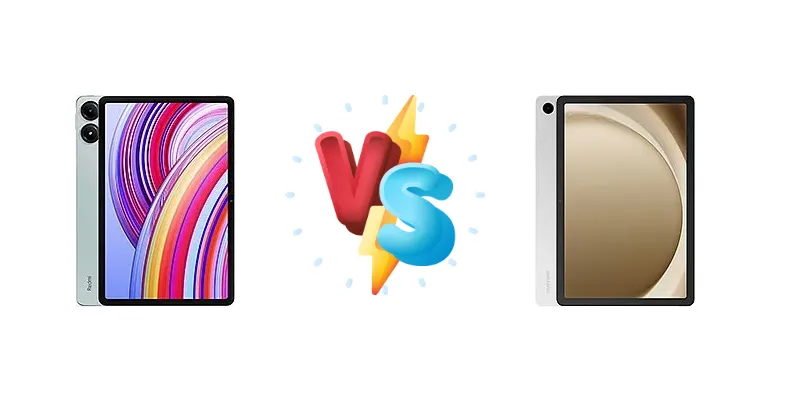
The mid-range tablet market is heating up, with the Xiaomi Redmi Pad Pro and Samsung Galaxy Tab A9+ vying for dominance. Both offer compelling features at attractive price points, but cater to slightly different priorities. This comparison dives deep into their specifications and performance to determine which tablet best suits your needs.
🏆 Quick Verdict
For most users, the Xiaomi Redmi Pad Pro emerges as the stronger contender. Its significantly more powerful Snapdragon 7s Gen 2 chipset and brighter display deliver a smoother, more immersive experience, justifying its slightly higher price. However, the Tab A9+ remains a viable option for those prioritizing Samsung's ecosystem and 5G connectivity.
| Network |
|---|
| 2G bands | N/A | GSM 850 / 900 / 1800 / 1900 |
| 3G bands | N/A | HSDPA 850 / 900 / 1700(AWS) / 1900 / 2100 |
| 4G bands | - | 1, 2, 3, 4, 5, 7, 8, 12, 13, 17, 20, 26, 28, 38, 40, 41, 66 |
| 5G bands | - | 1, 3, 5, 7, 8, 20, 28, 38, 40, 41, 66, 77, 78 SA/NSA/Sub6 |
| EDGE | N/A | - |
| GPRS | N/A | - |
| Speed | - | HSPA, LTE, 5G - cellular model only |
| Technology | No cellular connectivity | GSM / HSPA / LTE / 5G |
| Launch |
|---|
| Announced | 2024, April 10 | 2023, October 05 |
| Status | Available. Released 2024, April 15 | Available. Released 2023, October 17 |
| Body |
|---|
| Build | Glass front (Gorilla Glass 3), aluminum frame, aluminum back | - |
| Dimensions | 280 x 181.9 x 7.5 mm (11.02 x 7.16 x 0.30 in) | 257.1 x 168.7 x 6.9 mm (10.12 x 6.64 x 0.27 in) |
| SIM | No | Nano-SIM + eSIM (cellular model only) |
| Weight | 571 g (1.26 lb) | 480 g or 492 g (1.06 lb) |
| Display |
|---|
| Protection | Corning Gorilla Glass 3 | - |
| Resolution | 1600 x 2560 pixels, 16:10 ratio (~249 ppi density) | 1200 x 1920 pixels, 16:10 ratio (~206 ppi density) |
| Size | 12.1 inches, 424.5 cm2 (~83.4% screen-to-body ratio) | 11.0 inches, 350.9 cm2 (~80.9% screen-to-body ratio) |
| Type | IPS LCD, 68B colors, 120Hz, Dolby Vision, 600 nits (HBM) | TFT LCD, 90Hz |
| Platform |
|---|
| CPU | Octa-core (4x2.40 GHz Cortex-A78 & 4x1.95 GHz Cortex-A55) | Octa-core (2x2.2 GHz Kryo 660 Gold & 6x1.8 GHz Kryo 660 Silver) |
| Chipset | Qualcomm SM7435-AB Snapdragon 7s Gen 2 (4 nm) | Qualcomm SM6375 Snapdragon 695 5G (6 nm) |
| GPU | Adreno 710 | Adreno 619 |
| OS | Android 14, HyperOS | Android 13, upgradable to Android 15, One UI 7 |
| Memory |
|---|
| Card slot | microSDXC (dedicated slot) | microSDXC (dedicated slot) |
| Internal | 128GB 6GB RAM, 128GB 8GB RAM, 256GB 8GB RAM | 64GB 4GB RAM, 128GB 4GB RAM, 128GB 8GB RAM, 256GB 8GB RAM |
| Main Camera |
|---|
| Features | LED flash | - |
| Single | 8 MP, f/2.0, (wide), 1/4.0", 1.12µm | 8 MP, AF |
| Video | 1080p@30fps | 1080p@30fps |
| Selfie camera |
|---|
| Single | 8 MP, f/2.3, (wide), 1/4.0", 1.12µm | 5 MP |
| Video | 1080p@30fps | 1080p@30fps |
| Sound |
|---|
| 35mm jack | Yes | Yes |
| Loudspeaker | Yes, with stereo speakers (4 speakers) | Yes, with stereo speakers (4 speakers) |
| Comms |
|---|
| Bluetooth | 5.2, A2DP, LE, aptX HD, aptX Adaptive | 5.1, A2DP, LE |
| NFC | No | No |
| Positioning | No | GPS, GLONASS, GALILEO, BDS, QZSS - cellular model only |
| Radio | No | No |
| USB | USB Type-C 2.0 | USB Type-C 2.0 |
| WLAN | Wi-Fi 802.11 a/b/g/n/a/6, dual-band, Wi-Fi Direct | Wi-Fi 802.11 a/b/g/n/ac, dual-band, Wi-Fi Direct |
| Features |
|---|
| Sensors | Accelerometer, gyro, proximity (accessories only), compass | Accelerometer, gyro, proximity (accessories only), compass |
| Battery |
|---|
| Charging | 33W wired, PD3.0, QC3+ | 15W wired |
| Type | 10000 mAh | Li-Po 7040 mAh |
| Misc |
|---|
| Colors | Dark Gray, Blue, Green | Graphite, Silver, Navy |
| Models | - | SM-X210, SM-X215, SM-X216B |
| Price | About 200 EUR | $ 199.99 |
| SAR | - | 0.42 W/kg (body) |
| SAR EU | - | 1.19 W/kg (body) |
Xiaomi Redmi Pad Pro
- Significantly faster processor for smoother performance
- Brighter and higher contrast display for better viewing
- Faster 33W charging with Quick Charge support
- Samsung ecosystem integration is absent
- No 5G connectivity
Samsung Galaxy Tab A9+
- Samsung One UI experience
- 5G connectivity for on-the-go use
- Familiar Samsung brand
- Less powerful processor for demanding tasks
- Slower 15W charging
- Likely lower display brightness and contrast
Display Comparison
The Redmi Pad Pro boasts a significantly brighter display, reaching a measured 654 nits, compared to the Tab A9+'s unspecified brightness (estimated around 500 nits based on Samsung's typical A-series displays). This translates to better visibility outdoors and a more dynamic viewing experience. While both likely utilize IPS LCD panels, the Redmi Pad Pro’s 1454:1 contrast ratio suggests superior black levels and richer colors. The lack of detailed display specs for the Tab A9+ makes a precise comparison difficult, but the Redmi Pad Pro clearly holds an advantage in raw display quality.
Camera Comparison
Neither tablet excels in the camera department, but the Redmi Pad Pro likely has a slight edge due to its potentially larger sensor (specs not provided). The Tab A9+'s camera specs are not available, making a detailed comparison impossible. However, given Samsung’s history with A-series tablets, it likely features a basic camera setup suitable for casual snapshots. The Redmi Pad Pro’s camera is expected to perform similarly, focusing on basic functionality rather than high-quality photography.
Performance
The performance gap between these tablets is substantial. The Redmi Pad Pro’s Qualcomm Snapdragon 7s Gen 2 (4nm) is a far more capable chipset than the Tab A9+'s Snapdragon 695 5G (6nm). The 7s Gen 2 features newer Cortex-A78 cores clocked at 2.40 GHz, alongside more efficient Cortex-A55 cores, resulting in significantly faster CPU performance. The 6nm process node of the Snapdragon 695 offers some efficiency gains, but it can't compensate for the architectural advantages of the 7s Gen 2. This difference will be most noticeable in demanding applications, gaming, and multitasking. The Redmi Pad Pro will handle graphically intensive games with higher frame rates and smoother performance.
Battery Life
The Redmi Pad Pro delivers an impressive 9:36h of active use, showcasing excellent battery life. While the Tab A9+'s battery capacity is unknown, its less power-hungry chipset and lower screen brightness may offer comparable endurance. However, the Redmi Pad Pro’s 33W wired charging with PD3.0 and QC3+ support is a significant advantage, allowing for much faster charging times compared to the Tab A9+'s slower 15W charging. This means less downtime and more time enjoying your tablet.
Buying Guide
Buy the Xiaomi Redmi Pad Pro if you need a tablet primarily for demanding tasks like gaming, video editing, or multitasking, and value a vibrant, high-brightness display. Buy the Samsung Galaxy Tab A9+ if you prefer the Samsung One UI experience, require 5G connectivity for on-the-go use, and prioritize a familiar brand ecosystem, even if it means sacrificing some raw performance.
Frequently Asked Questions
❓ Will the Snapdragon 695 in the Galaxy Tab A9+ struggle with graphically intensive games like Genshin Impact?
Yes, the Snapdragon 695 is a mid-range chipset and will likely struggle to run Genshin Impact at high settings. Expect lower frame rates and potential stuttering. The Redmi Pad Pro’s Snapdragon 7s Gen 2 will provide a much smoother gaming experience.
❓ Does the Redmi Pad Pro support stylus input, and if so, is a stylus included in the box?
While the Redmi Pad Pro’s display is compatible with stylus input, a stylus is *not* included in the box and must be purchased separately. Samsung does not offer stylus support for the Tab A9+.
❓ How much faster is the 33W charging on the Redmi Pad Pro compared to the 15W charging on the Galaxy Tab A9+?
The 33W charging on the Redmi Pad Pro will significantly reduce charging times. Expect a full charge in approximately 1.5-2 hours, while the Tab A9+ with 15W charging will likely take 3-4 hours to reach 100%.