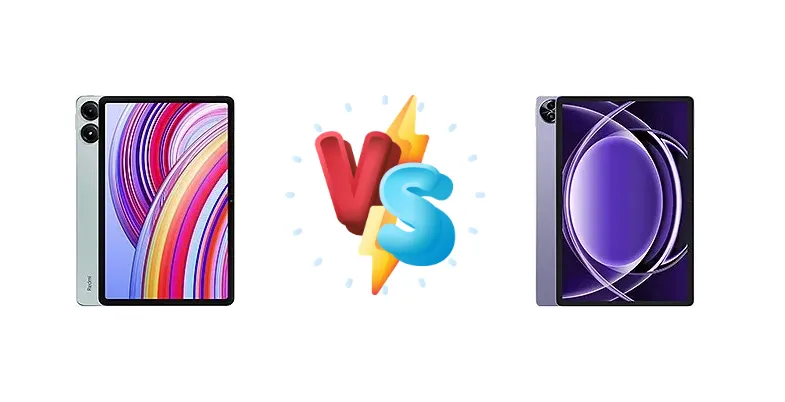
The tablet market is heating up, with Xiaomi and Realme offering compelling options at competitive price points. We pit the Xiaomi Redmi Pad Pro, powered by the Snapdragon 7s Gen 2, against the Realme Pad 2 Lite, featuring the MediaTek Helio G99, to determine which tablet delivers the best balance of performance, features, and value for everyday users.
🏆 Quick Verdict
For most users, the Xiaomi Redmi Pad Pro emerges as the superior choice. Its Snapdragon 7s Gen 2 chipset provides a noticeable performance advantage, coupled with a brighter, higher-contrast display and faster 33W charging. While the Realme Pad 2 Lite offers a respectable experience, it falls short in processing power and charging speed.
| Network |
|---|
| 2G bands | N/A | GSM 850 / 900 / 1800 / 1900 |
| 3G bands | N/A | HSDPA 850 / 900 / 2100 |
| 4G bands | - | 1, 3, 5, 7, 8, 20, 28, 38, 40, 41 |
| EDGE | N/A | - |
| GPRS | N/A | - |
| Speed | - | HSPA, LTE |
| Technology | No cellular connectivity | GSM / HSPA / LTE |
| Launch |
|---|
| Announced | 2024, April 10 | 2024, September 13 |
| Status | Available. Released 2024, April 15 | Available. Released 2024, September 26 |
| Body |
|---|
| Build | Glass front (Gorilla Glass 3), aluminum frame, aluminum back | - |
| Dimensions | 280 x 181.9 x 7.5 mm (11.02 x 7.16 x 0.30 in) | 258 x 169.5 x 8.3 mm (10.16 x 6.67 x 0.33 in) |
| SIM | No | No |
| Weight | 571 g (1.26 lb) | 525 g (1.16 lb) |
| Display |
|---|
| Protection | Corning Gorilla Glass 3 | - |
| Resolution | 1600 x 2560 pixels, 16:10 ratio (~249 ppi density) | 1200 x 1920 pixels, 16:10 ratio (~207 ppi density) |
| Size | 12.1 inches, 424.5 cm2 (~83.4% screen-to-body ratio) | 10.95 inches, 347.7 cm2 (~79.5% screen-to-body ratio) |
| Type | IPS LCD, 68B colors, 120Hz, Dolby Vision, 600 nits (HBM) | IPS LCD, 1B colors, 90Hz, 450 nits (peak) |
| Platform |
|---|
| CPU | Octa-core (4x2.40 GHz Cortex-A78 & 4x1.95 GHz Cortex-A55) | Octa-core (2x2.2 GHz Cortex-A76 & 6x2.0 GHz Cortex-A55) |
| Chipset | Qualcomm SM7435-AB Snapdragon 7s Gen 2 (4 nm) | Mediatek Helio G99 (6 nm) |
| GPU | Adreno 710 | Mali-G57 MC2 |
| OS | Android 14, HyperOS | Android 14, Realme UI 5.0 for Pad |
| Memory |
|---|
| Card slot | microSDXC (dedicated slot) | Unspecified |
| Internal | 128GB 6GB RAM, 128GB 8GB RAM, 256GB 8GB RAM | 128GB 4GB RAM, 128GB 8GB RAM |
| Main Camera |
|---|
| Features | LED flash | Panorama |
| Single | 8 MP, f/2.0, (wide), 1/4.0", 1.12µm | 8 MP, f/2.0 |
| Video | 1080p@30fps | 1080p@30fps |
| Selfie camera |
|---|
| Features | - | Panorama |
| Single | 8 MP, f/2.3, (wide), 1/4.0", 1.12µm | 5 MP, f/2.2 |
| Video | 1080p@30fps | 1080p@30fps |
| Sound |
|---|
| 35mm jack | Yes | No |
| Loudspeaker | Yes, with stereo speakers (4 speakers) | Yes, with stereo speakers (4 speakers) |
| Comms |
|---|
| Bluetooth | 5.2, A2DP, LE, aptX HD, aptX Adaptive | 5.2, A2DP, LE |
| NFC | No | No |
| Positioning | No | GPS, GALILEO, GLONASS, BDS |
| Radio | No | No |
| USB | USB Type-C 2.0 | USB Type-C |
| WLAN | Wi-Fi 802.11 a/b/g/n/a/6, dual-band, Wi-Fi Direct | Wi-Fi 802.11 a/b/g/n/ac, dual-band |
| Features |
|---|
| Sensors | Accelerometer, gyro, proximity (accessories only), compass | Accelerometer |
| Battery |
|---|
| Charging | 33W wired, PD3.0, QC3+ | 15W wired |
| Type | 10000 mAh | 8300 mAh |
| Misc |
|---|
| Colors | Dark Gray, Blue, Green | Nebula Purple, Space Grey |
| Models | - | RMP2402 |
| Price | About 200 EUR | About 160 EUR |
Xiaomi Redmi Pad Pro
- Superior performance with Snapdragon 7s Gen 2
- Brighter and higher contrast display
- Faster 33W charging with PD3.0/QC3+ support
- Potentially higher price point
- Larger size may not suit all users
Realme Pad 2 Lite
- More affordable price
- Lightweight and portable design
- Decent performance for basic tasks
- Slower performance compared to the Redmi Pad Pro
- Slower 15W charging
Display Comparison
The Redmi Pad Pro boasts a significantly brighter display, reaching a measured 654 nits, compared to the Realme Pad 2 Lite (brightness data unavailable, but expected to be lower based on chipset and price). This translates to better visibility outdoors and a more immersive viewing experience. Furthermore, the Redmi Pad Pro’s 1454:1 contrast ratio ensures deeper blacks and more vibrant colors. While both likely utilize IPS LCD panels, the Redmi Pad Pro’s superior brightness and contrast give it a clear edge for media consumption and creative tasks. The absence of refresh rate data for both tablets suggests standard 60Hz panels, which is typical for this price segment.
Camera Comparison
Neither tablet is positioned as a photography powerhouse, and detailed camera specs are limited. However, the focus should be on video conferencing capabilities. While specific sensor details are unavailable, the Redmi Pad Pro’s stronger processing power will likely result in better image processing for video calls. The Realme Pad 2 Lite will suffice for basic video calls, but may exhibit more noise or lag in low-light conditions. The absence of detailed camera information suggests both tablets prioritize functionality over photographic excellence.
Performance
The core difference lies in the chipsets. The Redmi Pad Pro’s Qualcomm Snapdragon 7s Gen 2 (4nm) is architecturally superior to the Realme Pad 2 Lite’s MediaTek Helio G99 (6nm). The Snapdragon 7s Gen 2 features a prime Cortex-A78 core clocked at 2.40 GHz, offering a substantial performance boost over the Helio G99’s Cortex-A76 cores at 2.2 GHz. The 4nm process node of the Snapdragon also contributes to better power efficiency and thermal management, potentially leading to less throttling during sustained workloads. This means the Redmi Pad Pro will handle demanding games and multitasking with greater ease. The Realme Pad 2 Lite will be adequate for everyday tasks, but will likely struggle with more intensive applications.
Battery Life
The Redmi Pad Pro delivers an impressive 9 hours and 36 minutes of active use, showcasing excellent battery optimization alongside the efficient Snapdragon 7s Gen 2. While the Realme Pad 2 Lite’s battery capacity is unknown, its less powerful chipset and lack of fast charging (15W vs. 33W on the Redmi Pad Pro) suggest a longer full charge time. The Redmi Pad Pro’s support for PD3.0 and QC3+ further enhances its charging versatility, allowing for faster charging with compatible adapters. The faster charging of the Redmi Pad Pro is a significant convenience factor for users who need to quickly top up their device.
Buying Guide
Buy the Xiaomi Redmi Pad Pro if you prioritize performance for gaming, multitasking, or demanding applications, and value a brighter, more vibrant display for media consumption. Buy the Realme Pad 2 Lite if you're on a tighter budget and primarily need a tablet for basic tasks like web browsing, video calls, and light content consumption, and aren't concerned with top-tier performance.
Frequently Asked Questions
❓ Will the Helio G99 in the Realme Pad 2 Lite struggle with graphically intensive games like Genshin Impact?
Yes, the MediaTek Helio G99 is a capable chip for casual gaming, but it will likely struggle with demanding titles like Genshin Impact, even at lower settings. Expect noticeable frame drops and potential overheating during extended gaming sessions. The Snapdragon 7s Gen 2 in the Redmi Pad Pro offers a significantly smoother gaming experience.
❓ Does the Redmi Pad Pro support stylus input or keyboard attachments for increased productivity?
While Xiaomi doesn't heavily market stylus or keyboard support for the Redmi Pad Pro, it is compatible with many third-party accessories. However, the experience may not be as seamless as with tablets specifically designed for stylus input. The lack of official accessories suggests it's not a primary focus for this device.
❓ How significant is the difference in charging time between the 33W and 15W charging speeds?
The difference is substantial. The Redmi Pad Pro’s 33W charging will significantly reduce the time to fully charge the device compared to the Realme Pad 2 Lite’s 15W charging. Expect a 0-100% charge to take roughly 1.5-2 hours on the Redmi Pad Pro, while the Realme Pad 2 Lite could take 3+ hours.