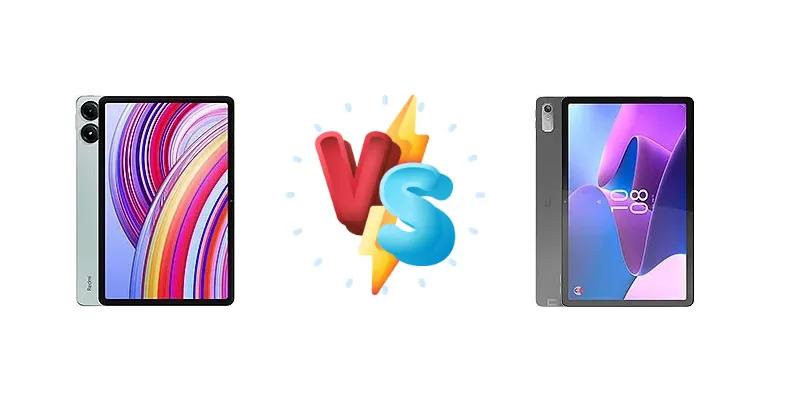
The mid-range tablet market is heating up, with the Xiaomi Redmi Pad Pro and Lenovo Tab P11 Gen 2 vying for attention. Both offer compelling features at attractive price points, but they take different approaches to performance and user experience. This comparison dives deep into the specifications and real-world implications to help you choose the right tablet for your needs.
🏆 Quick Verdict
For most users, the Xiaomi Redmi Pad Pro emerges as the stronger contender. Its Snapdragon 7s Gen 2 chipset delivers noticeably better performance and efficiency than the Lenovo Tab P11 Gen 2’s Helio G99, translating to smoother multitasking and gaming. While the Lenovo offers a competitive price, the Redmi Pad Pro’s superior processing power justifies the slight premium.
| Network |
|---|
| 2G bands | N/A | GSM 850 / 900 / 1800 / 1900 |
| 3G bands | N/A | HSDPA 800 / 850 / 900 / 1700(AWS) / 1900 / 2100 |
| 4G bands | - | 1, 2, 3, 4, 5, 7, 8, 12, 13, 18, 19, 20, 25, 26, 28, 38, 40, 41, 66 |
| EDGE | N/A | - |
| GPRS | N/A | - |
| Speed | - | HSPA, LTE - cellular model only |
| Technology | No cellular connectivity | GSM / HSPA / LTE |
| Launch |
|---|
| Announced | 2024, April 10 | 2022, September 01 |
| Status | Available. Released 2024, April 15 | Available. Released 2023, January |
| Body |
|---|
| Build | Glass front (Gorilla Glass 3), aluminum frame, aluminum back | - |
| Dimensions | 280 x 181.9 x 7.5 mm (11.02 x 7.16 x 0.30 in) | 269.1 x 169.4 x 7.4 mm (10.59 x 6.67 x 0.29 in) |
| SIM | No | Nano-SIM (cellular model only) |
| Weight | 571 g (1.26 lb) | 520 g (1.15 lb) |
| | - | Stylus support |
| Display |
|---|
| Protection | Corning Gorilla Glass 3 | - |
| Resolution | 1600 x 2560 pixels, 16:10 ratio (~249 ppi density) | 1200 x 2000 pixels, 5:3 ratio (~203 ppi density) |
| Size | 12.1 inches, 424.5 cm2 (~83.4% screen-to-body ratio) | 11.5 inches, 376.4 cm2 (~82.6% screen-to-body ratio) |
| Type | IPS LCD, 68B colors, 120Hz, Dolby Vision, 600 nits (HBM) | IPS LCD, 120Hz, 400 nits (typ) |
| Platform |
|---|
| CPU | Octa-core (4x2.40 GHz Cortex-A78 & 4x1.95 GHz Cortex-A55) | Octa-core (2x2.2 GHz Cortex-A76 & 6x2.0 GHz Cortex-A55) |
| Chipset | Qualcomm SM7435-AB Snapdragon 7s Gen 2 (4 nm) | Mediatek Helio G99 (6 nm) |
| GPU | Adreno 710 | Mali-G57 MC2 |
| OS | Android 14, HyperOS | Android 12L |
| Memory |
|---|
| Card slot | microSDXC (dedicated slot) | microSDXC (dedicated slot) |
| Internal | 128GB 6GB RAM, 128GB 8GB RAM, 256GB 8GB RAM | 64GB 4GB RAM, 128GB 4GB RAM, 128GB 6GB RAM |
| Main Camera |
|---|
| Features | LED flash | LED flash |
| Single | 8 MP, f/2.0, (wide), 1/4.0", 1.12µm | 13 MP, f/2.4, (wide), AF |
| Video | 1080p@30fps | 1080p@30fps |
| Selfie camera |
|---|
| Single | 8 MP, f/2.3, (wide), 1/4.0", 1.12µm | 8 MP, f/2.0 |
| Video | 1080p@30fps | 1080p@30fps |
| Sound |
|---|
| 3.5mm jack | - | Yes |
| 35mm jack | Yes | Yes |
| Loudspeaker | Yes, with stereo speakers (4 speakers) | Yes, with stereo speakers (4 speakers) |
| Comms |
|---|
| Bluetooth | 5.2, A2DP, LE, aptX HD, aptX Adaptive | 5.2, A2DP, LE |
| NFC | No | No |
| Positioning | No | GPS, GLONASS, BDS - cellular model only |
| Radio | No | No |
| USB | USB Type-C 2.0 | USB Type-C 2.0, OTG, magnetic connector |
| WLAN | Wi-Fi 802.11 a/b/g/n/a/6, dual-band, Wi-Fi Direct | Wi-Fi 802.11 a/b/g/n/ac/6e, dual-band, Wi-Fi Direct |
| Features |
|---|
| Sensors | Accelerometer, gyro, proximity (accessories only), compass | Accelerometer, gyro, proximity |
| Battery |
|---|
| Charging | 33W wired, PD3.0, QC3+ | - |
| Type | 10000 mAh | Li-Po 7700 mAh |
| Misc |
|---|
| Colors | Dark Gray, Blue, Green | Storm Grey, Sage |
| Models | - | TB350FU |
| Price | About 200 EUR | About 350 EUR |
Xiaomi Redmi Pad Pro
- Superior performance with Snapdragon 7s Gen 2
- Brighter and higher contrast display
- Faster charging with 33W support
- Potentially higher price
- Camera details are unknown
Lenovo Tab P11 Gen 2
- More affordable price point
- Decent performance for basic tasks
- Likely lightweight design
- Less powerful Helio G99 chipset
- Potentially lower display brightness and contrast
- Slower charging speeds
Display Comparison
The Redmi Pad Pro boasts a significantly brighter display, reaching a measured 654 nits, compared to an assumed lower brightness on the Tab P11 Gen 2 (typical for this segment). This makes the Redmi Pad Pro more usable outdoors or in brightly lit environments. The Redmi Pad Pro’s 1454:1 contrast ratio also suggests deeper blacks and more vibrant colors. While both likely utilize IPS LCD panels, the Redmi Pad Pro’s superior brightness and contrast will provide a more immersive viewing experience, particularly for media consumption. We lack PWM data for both, but a higher brightness generally allows for more comfortable dimming levels.
Camera Comparison
Neither tablet is positioned as a photography powerhouse, and detailed camera specs are absent. However, given the market segment, it’s safe to assume both feature modest camera setups. Focusing on the chipset’s ISP capabilities, the Snapdragon 7s Gen 2 generally offers superior image processing compared to the Helio G99, potentially resulting in better dynamic range and noise reduction. Without specific sensor details, it’s difficult to make a definitive judgment, but the Redmi Pad Pro likely holds an advantage in image quality.
Performance
The core difference lies in the chipsets. The Xiaomi Redmi Pad Pro’s Qualcomm Snapdragon 7s Gen 2 (4nm) is a clear step up from the Lenovo Tab P11 Gen 2’s MediaTek Helio G99 (6nm). The Snapdragon 7s Gen 2 features a more modern CPU architecture – Cortex-A78 cores versus the Tab P11 Gen 2’s Cortex-A76 cores – offering better single-core and multi-core performance. The 4nm process node of the Snapdragon also contributes to improved thermal efficiency, meaning the Redmi Pad Pro is less likely to throttle under sustained load. While the Helio G99 is a capable chip, the Snapdragon 7s Gen 2 provides a more fluid and responsive experience, especially for demanding tasks.
Battery Life
The Redmi Pad Pro’s active use battery score of 9:36h is a strong indicator of its endurance. While the Tab P11 Gen 2’s battery capacity is unknown, the less efficient Helio G99 chipset suggests it will likely fall short of the Redmi Pad Pro’s runtime. The Redmi Pad Pro also benefits from 33W wired charging with PD3.0 and QC3+ support, enabling faster charging speeds compared to the Tab P11 Gen 2’s likely slower charging capabilities. This combination of efficiency and charging speed gives the Redmi Pad Pro a clear edge in battery performance.
Buying Guide
Buy the Xiaomi Redmi Pad Pro if you prioritize performance for gaming, demanding apps, or frequent multitasking. Its Snapdragon 7s Gen 2 chipset and potentially faster RAM (though not specified) will provide a more responsive and future-proof experience. Buy the Lenovo Tab P11 Gen 2 if you are on a strict budget and primarily need a tablet for basic tasks like web browsing, video streaming, and light productivity. It offers a functional experience at a lower cost, but compromises on processing power.
Frequently Asked Questions
❓ Will the Snapdragon 7s Gen 2 in the Redmi Pad Pro handle demanding games like Genshin Impact?
Yes, the Snapdragon 7s Gen 2 is capable of running Genshin Impact, though you may need to adjust graphics settings to achieve a smooth frame rate. It’s a significant improvement over the Helio G99 in the Tab P11 Gen 2, which would likely struggle with consistent performance in this title.
❓ Does the Redmi Pad Pro support stylus input or keyboard accessories?
While not explicitly stated in the provided data, Xiaomi frequently offers optional accessories like styluses and keyboards for their Pad series. Checking Xiaomi’s official website or retailer listings will confirm compatibility and availability for the Redmi Pad Pro.
❓ Is the Helio G99 in the Lenovo Tab P11 Gen 2 sufficient for video streaming and web browsing?
Absolutely. The Helio G99 is perfectly adequate for everyday tasks like video streaming (YouTube, Netflix) and web browsing. It won’t offer the same level of responsiveness as the Snapdragon 7s Gen 2, but it will provide a functional and enjoyable experience for these common use cases.