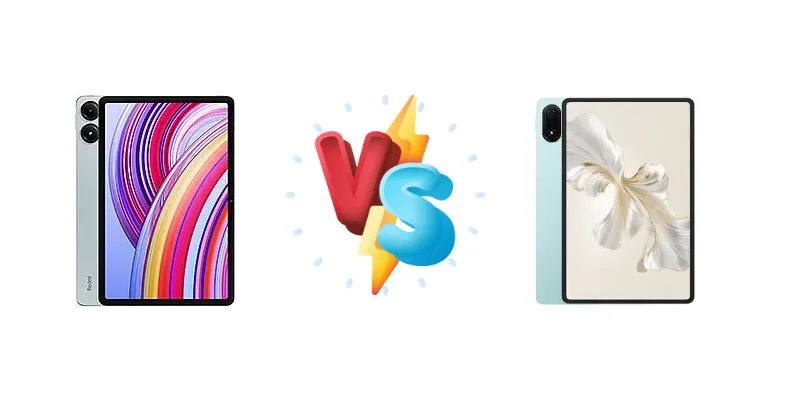
The Android tablet market is heating up, with both Xiaomi and Honor offering compelling options in the mid-range. The Xiaomi Redmi Pad Pro and the Honor Pad 9 Pro represent strong contenders, but cater to slightly different priorities. The Redmi Pad Pro focuses on delivering solid all-around performance at an aggressive price, while the Honor Pad 9 Pro aims for a more premium experience with a more powerful chipset.
🏆 Quick Verdict
For the average user prioritizing sustained performance and a brighter display, the Honor Pad 9 Pro emerges as the winner. Its Dimensity 8100 chipset provides a noticeable performance edge, especially in demanding tasks. However, the Redmi Pad Pro remains a strong value proposition for those on a tighter budget.
| Network |
|---|
| 2G bands | N/A | N/A |
| 3G bands | N/A | N/A |
| EDGE | N/A | No |
| GPRS | N/A | No |
| Technology | No cellular connectivity | No cellular connectivity |
| Launch |
|---|
| Announced | 2024, April 10 | 2024, July 12 |
| Status | Available. Released 2024, April 15 | Available. Released 2024, July 12 |
| Body |
|---|
| Build | Glass front (Gorilla Glass 3), aluminum frame, aluminum back | Glass front, aluminum frame, aluminum back |
| Dimensions | 280 x 181.9 x 7.5 mm (11.02 x 7.16 x 0.30 in) | 277 x 179.9 x 6.6 mm (10.91 x 7.08 x 0.26 in) |
| SIM | No | No |
| Weight | 571 g (1.26 lb) | 589 g (1.30 lb) |
| Display |
|---|
| Protection | Corning Gorilla Glass 3 | - |
| Resolution | 1600 x 2560 pixels, 16:10 ratio (~249 ppi density) | 1600 x 2560 pixels, 16:10 ratio (~249 ppi density) |
| Size | 12.1 inches, 424.5 cm2 (~83.4% screen-to-body ratio) | 12.1 inches, 424.5 cm2 (~85.2% screen-to-body ratio) |
| Type | IPS LCD, 68B colors, 120Hz, Dolby Vision, 600 nits (HBM) | IPS LCD, 1B colors, 144Hz |
| Platform |
|---|
| CPU | Octa-core (4x2.40 GHz Cortex-A78 & 4x1.95 GHz Cortex-A55) | Octa-core (4x2.85 GHz Cortex-A78 & 4x2.0 GHz Cortex-A55) |
| Chipset | Qualcomm SM7435-AB Snapdragon 7s Gen 2 (4 nm) | Mediatek Dimensity 8100 (5 nm) |
| GPU | Adreno 710 | Mali-G610 MC6 |
| OS | Android 14, HyperOS | Android 14, Magic OS 8.1 |
| Memory |
|---|
| Card slot | microSDXC (dedicated slot) | No |
| Internal | 128GB 6GB RAM, 128GB 8GB RAM, 256GB 8GB RAM | 256GB 12GB RAM, 256GB 8GB RAM |
| Main Camera |
|---|
| Features | LED flash | HDR |
| Single | 8 MP, f/2.0, (wide), 1/4.0", 1.12µm | 13 MP, f/2.0, (wide), AF |
| Video | 1080p@30fps | 4K@30fps, 1080p@30fps |
| Selfie camera |
|---|
| Single | 8 MP, f/2.3, (wide), 1/4.0", 1.12µm | 5 MP, f/2.2, (wide) |
| Video | 1080p@30fps | 1080p@30fps |
| Sound |
|---|
| 35mm jack | Yes | No |
| Loudspeaker | Yes, with stereo speakers (4 speakers) | Yes, with stereo speakers (8 speakers) |
| Comms |
|---|
| Bluetooth | 5.2, A2DP, LE, aptX HD, aptX Adaptive | 5.2, A2DP, LE |
| NFC | No | No |
| Positioning | No | No |
| Radio | No | No |
| USB | USB Type-C 2.0 | USB Type-C 2.0, OTG |
| WLAN | Wi-Fi 802.11 a/b/g/n/a/6, dual-band, Wi-Fi Direct | Wi-Fi 802.11 a/b/g/n/ac/6, dual-band, Wi-Fi Direct |
| Features |
|---|
| Sensors | Accelerometer, gyro, proximity (accessories only), compass | Accelerometer |
| Battery |
|---|
| Charging | 33W wired, PD3.0, QC3+ | 35W wired |
| Type | 10000 mAh | Li-Po 10050 mAh |
| Misc |
|---|
| Colors | Dark Gray, Blue, Green | Sky Blue, Star Gray |
| Price | About 200 EUR | About 290 EUR |
Xiaomi Redmi Pad Pro
- Excellent battery life (9:36h active use)
- Bright display (654 nits)
- Aggressive pricing for the features offered
- Less powerful chipset compared to the Honor Pad 9 Pro
- Display specs are limited
Honor Pad 9 Pro
- More powerful Dimensity 8100 chipset
- Faster 35W charging
- Likely superior display quality (based on brand reputation)
- Battery life likely shorter than the Redmi Pad Pro
- Price is likely higher than the Redmi Pad Pro
Display Comparison
The Honor Pad 9 Pro doesn't list display specs, but Honor typically prioritizes display quality. The Redmi Pad Pro boasts a 654-nit peak brightness, providing good visibility even in brightly lit environments, and a 1454:1 contrast ratio for punchy visuals. While the Redmi Pad Pro’s brightness is a quantifiable advantage, the Honor Pad 9 Pro likely benefits from Honor’s display tuning expertise. The absence of refresh rate data for the Honor Pad 9 Pro is a notable omission; the Redmi Pad Pro’s refresh rate is not specified, but is likely standard 60Hz. Both tablets likely utilize IPS LCD panels, given their price points, but the Honor Pad 9 Pro may offer slightly better color accuracy.
Camera Comparison
Neither tablet is positioned as a photography powerhouse, and detailed camera specs are unavailable. Given the market segment, both likely feature similar camera setups focused on basic video calls and casual snapshots. Without specific sensor details, it’s difficult to make a meaningful comparison. Image processing will likely be the differentiating factor, and Honor’s software optimizations may provide a slight edge.
Performance
The core difference lies in the chipsets. The Honor Pad 9 Pro’s MediaTek Dimensity 8100 (5nm) features a more powerful CPU configuration – 4x2.85 GHz Cortex-A78 cores versus the Redmi Pad Pro’s 4x2.40 GHz Cortex-A78 cores. This translates to faster processing speeds and improved multitasking capabilities. The 5nm process node of the Dimensity 8100 also offers better power efficiency compared to the Redmi Pad Pro’s Snapdragon 7s Gen 2 (4nm), potentially leading to better sustained performance under load. While the Snapdragon 7s Gen 2 is a capable chip, the Dimensity 8100 provides a clear advantage for demanding applications and gaming.
Battery Life
The Redmi Pad Pro shines in battery life, achieving an impressive 9:36h of active use. While the Honor Pad 9 Pro’s battery capacity is not specified, the more power-hungry Dimensity 8100 chipset will likely result in shorter battery life. However, the Honor Pad 9 Pro compensates with 35W wired charging, slightly faster than the Redmi Pad Pro’s 33W charging. Both support PD3.0 and QC3+, ensuring compatibility with a wide range of chargers. The Redmi Pad Pro’s longer runtime makes it ideal for users who prioritize all-day battery life.
Buying Guide
Buy the Xiaomi Redmi Pad Pro if you need a reliable tablet for everyday tasks like browsing, streaming, and light productivity, and value exceptional battery life. It’s ideal for students or families who need a durable and affordable tablet. Buy the Honor Pad 9 Pro if you prioritize smoother multitasking, gaming, and a brighter, more vibrant display. This tablet is best suited for power users and media enthusiasts who demand a more responsive and immersive experience.
Frequently Asked Questions
❓ Will the Dimensity 8100 in the Honor Pad 9 Pro experience thermal throttling during extended gaming sessions?
While the Dimensity 8100 is a powerful chip, sustained performance depends on the tablet's thermal design. Honor typically implements effective cooling solutions, but prolonged, demanding gaming may still lead to some throttling. The 5nm process node helps mitigate this compared to older, larger node chipsets.
❓ Is the 33W charging on the Redmi Pad Pro fast enough for quick top-ups throughout the day?
33W charging is respectable, but not exceptionally fast. A full charge will take approximately 1.5-2 hours. However, the Redmi Pad Pro’s excellent battery life means you likely won’t need frequent top-ups, making the charging speed less critical.
❓ Does either tablet support stylus input or a keyboard cover for enhanced productivity?
Neither Xiaomi nor Honor explicitly advertise stylus or keyboard cover support for these specific models in the provided data. However, given the tablet form factor and the market segment, it's likely that compatible accessories are available through third-party vendors, though official support cannot be confirmed.