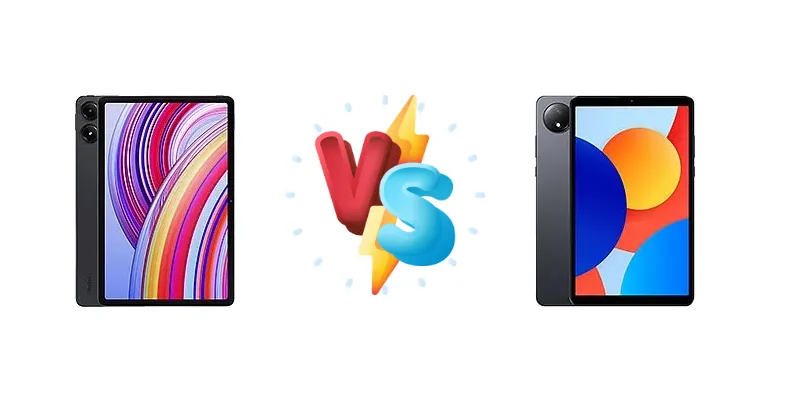
Xiaomi’s Redmi Pad lineup offers compelling tablet options at aggressive price points. The Redmi Pad Pro 5G aims for a more premium experience with 5G connectivity and a powerful Snapdragon chipset, while the Redmi Pad SE 8.7 focuses on affordability and portability. This comparison dissects the key differences to determine which tablet best suits your needs.
🏆 Quick Verdict
For most users, the Xiaomi Redmi Pad Pro 5G is the superior choice. Its Snapdragon 7s Gen 2 chipset delivers significantly better performance, and the 33W charging is a substantial upgrade over the SE 8.7’s slower charging speeds. While the SE 8.7 is more affordable, the Pro 5G offers a more future-proof and enjoyable user experience.
| Network |
|---|
| 2G bands | GSM 850 / 900 / 1800 / 1900 | GSM 850 / 900 / 1800 / 1900 |
| 3G bands | HSDPA 850 / 900 / 2100 | HSDPA 800 / 850 / 900 / 1700(AWS) / 1900 / 2100 |
| 4G bands | 1, 3, 5, 8, 34, 38, 39, 40, 41 | 1, 2, 3, 4, 5, 7, 8, 13, 18, 19, 20, 26, 28, 38, 40, 41, 66 |
| 5G bands | 1, 3, 5, 8, 28, 41, 77, 78 SA/NSA | - |
| Speed | HSPA, LTE, 5G | HSPA, LTE - cellular model only |
| Technology | GSM / CDMA / HSPA / CDMA2000 / LTE / 5G | GSM / HSPA / LTE |
| Launch |
|---|
| Announced | 2024, May 30 | 2024, July 29 |
| Status | Available. Released 2024, May 30 | Available. Released 2024, August 08 |
| Body |
|---|
| Build | Glass front (Gorilla Glass 3), aluminum frame, aluminum back | Glass front (Gorilla Glass 3) |
| Dimensions | 280 x 181.9 x 7.5 mm (11.02 x 7.16 x 0.30 in) | 211.6 x 125.5 x 8.8 mm (8.33 x 4.94 x 0.35 in) |
| SIM | Nano-SIM + Nano-SIM | Nano-SIM + Nano-SIM (cellular model only) |
| Weight | 566 g (1.25 lb) | 370 / 373 / 375 g (13.05 oz) |
| Display |
|---|
| Protection | Corning Gorilla Glass 3 | Corning Gorilla Glass 3 |
| Resolution | 1600 x 2560 pixels, 16:10 ratio (~249 ppi density) | 800 x 1340 pixels, 5:3 ratio (~179 ppi density) |
| Size | 12.1 inches, 424.5 cm2 (~83.4% screen-to-body ratio) | 8.7 inches, 214.9 cm2 (~80.9% screen-to-body ratio) |
| Type | IPS LCD, 120Hz, Dolby Vision, 600 nits | IPS LCD, 1B colors, 90Hz, 600 nits (HBM) |
| Platform |
|---|
| CPU | Octa-core (4x2.40 GHz Cortex-A78 & 4x1.95 GHz Cortex-A55) | Octa-core (2x2.0 GHz Cortex-A75 & 6x1.8 GHz Cortex-A55) |
| Chipset | Qualcomm SM7435-AB Snapdragon 7s Gen 2 (4 nm) | Mediatek Helio G85 (12 nm) |
| GPU | Adreno 710 | Mali-G52 MC2 |
| OS | Android 14, HyperOS | Android 14, HyperOS |
| Memory |
|---|
| Card slot | microSDXC (dedicated slot) | microSDXC (dedicated slot) |
| Internal | 128GB 6GB RAM, 128GB 8GB RAM, 256GB 8GB RAM | 64GB 4GB RAM, 128GB 4GB RAM, 128GB 6GB RAM |
| Main Camera |
|---|
| Features | LED flash, HDR | LED flash |
| Single | 8 MP | 8 MP, f/2.0, (wide), 1/4.0", 1.12µm |
| Video | 1080p@30fps | 1080p@30fps |
| Selfie camera |
|---|
| Single | 8 MP | 5 MP, f/2.2, (wide), 1/5.0", 1.12µm |
| Video | 1080p@30fps | 1080p@30fps |
| Sound |
|---|
| 35mm jack | Yes | Yes |
| Loudspeaker | Yes, with stereo speakers (4 speakers) | Yes, with stereo speakers |
| Comms |
|---|
| Bluetooth | 5.2, A2DP, LE | 5.3, A2DP, LE |
| Infrared port | - | Yes |
| NFC | No | No |
| Positioning | GPS, GALILEO, GLONASS, BDS, QZSS | GPS, GALILEO, GLONASS, BDS - cellular model only |
| Radio | No | FM radio |
| USB | USB Type-C 2.0 | USB Type-C 2.0 |
| WLAN | Wi-Fi 802.11 a/b/g/n/a/6, dual-band, Wi-Fi Direct | Wi-Fi 802.11 a/b/g/n/ac, dual-band |
| Features |
|---|
| Sensors | Accelerometer, gyro, proximity (accessories only), compass | Accelerometer, proximity (accessories only), compass |
| Battery |
|---|
| Charging | 33W wired, PD3.0, QC3+ | 18W wired (Int'l)
10W wired (India) |
| Type | 10000 mAh | 6650 mAh |
| Misc |
|---|
| Colors | Dark Gray | Aurora Green (Forest Green), Sky Blue (Ocean Blue), Graphite Gray (Urban Grey) |
| Models | 24074RPD2G, 24074RPD2I, 24074RPD2C | 220233L2G |
| Price | About 250 EUR | About 120 EUR |
| SAR | 1.09 W/kg (head) 1.01 W/kg (body) | 0.90 W/kg (head) 0.65 W/kg (body) |
| SAR EU | 0.98 W/kg (head) 1.00 W/kg (body) | 0.40 W/kg (head) 0.99 W/kg (body) |
Xiaomi Redmi Pad Pro 5G
- Significantly faster processor for gaming and multitasking
- Faster 33W charging with PD3.0/QC3+ support
- 5G connectivity for on-the-go access
- Likely higher price point
- Larger size may be less portable
Xiaomi Redmi Pad SE 8.7
- More affordable price
- Compact 8.7-inch display for portability
- Sufficient for basic tasks like media consumption
- Slower processor struggles with demanding tasks
- Slow 10W/18W charging
- Lacks 5G connectivity
Display Comparison
While both tablets are likely to feature IPS LCD panels (based on market segment), the differences lie in their size and potential quality. The Redmi Pad Pro 5G’s larger display will offer a more immersive viewing experience. The Redmi Pad SE 8.7’s 8.7-inch screen prioritizes portability. The absence of detailed display specs necessitates assuming the Pro 5G benefits from a higher resolution and potentially better color accuracy due to its positioning. Bezels are likely similar, given Xiaomi’s design language.
Camera Comparison
Given the tablet market, camera performance isn’t a primary focus. However, the Redmi Pad Pro 5G is likely to feature a more capable camera system, potentially with a higher resolution main sensor. The Helio G85’s ISP is less sophisticated than the Snapdragon’s, resulting in lower image quality, especially in low-light conditions. Expect both tablets to include basic camera functionality suitable for casual snapshots and video calls, but don't expect flagship-level photography.
Performance
The core difference lies in the chipsets. The Redmi Pad Pro 5G’s Qualcomm Snapdragon 7s Gen 2 (4nm) is a significant leap over the Redmi Pad SE 8.7’s MediaTek Helio G85 (12nm). The 4nm process node of the Snapdragon translates to superior power efficiency and reduced thermal throttling during sustained workloads. The Snapdragon’s CPU, featuring Cortex-A78 cores, offers a substantial performance advantage over the Helio G85’s Cortex-A75 cores. This difference will be most noticeable in demanding games and multitasking scenarios. The Pro 5G likely utilizes faster LPDDR5x RAM, further enhancing performance.
Battery Life
The Redmi Pad Pro 5G’s 33W wired charging (with PD3.0 and QC3+ support) is a major advantage over the Redmi Pad SE 8.7’s 18W (International) or 10W (India) charging. This translates to significantly faster charging times, minimizing downtime. While battery capacity isn’t specified, the more powerful chipset in the Pro 5G may offset any capacity difference with improved power efficiency. The faster charging speed is a practical benefit for users who rely on their tablets throughout the day.
Buying Guide
Buy the Xiaomi Redmi Pad Pro 5G if you prioritize performance for gaming and multitasking, require 5G connectivity for on-the-go productivity, and value faster charging. Buy the Xiaomi Redmi Pad SE 8.7 if you’re on a tight budget, primarily need a tablet for basic media consumption and light tasks, and prefer a more compact 8.7-inch form factor.
Frequently Asked Questions
❓ Will the Snapdragon 7s Gen 2 in the Redmi Pad Pro 5G handle demanding games like Genshin Impact at high settings?
Yes, the Snapdragon 7s Gen 2 is capable of running Genshin Impact and similar titles at medium to high settings with playable frame rates. While it won't match the performance of flagship chipsets, it provides a significantly better gaming experience than the Helio G85 in the SE 8.7, which would likely struggle with consistent performance.
❓ Is the difference in charging speed between 33W and 10W/18W really that noticeable in real-world use?
Absolutely. The Redmi Pad Pro 5G’s 33W charging can replenish the battery from 0-100% in approximately 90-120 minutes, while the SE 8.7’s 10W/18W charging can take upwards of 3-5 hours. This difference is crucial for users who need to quickly top up their tablet before heading out.
❓ Does the Redmi Pad Pro 5G support expandable storage via microSD card?
While not explicitly stated in the provided specs, Xiaomi tablets often include microSD card support. Checking official product listings or reviews is recommended to confirm if the Redmi Pad Pro 5G offers this feature.
❓ How does the 5G connectivity on the Redmi Pad Pro 5G benefit everyday users?
5G connectivity allows for faster download and upload speeds, smoother video streaming, and lower latency when connected to a 5G network. This is particularly beneficial for users who frequently travel or work remotely and rely on a stable internet connection.