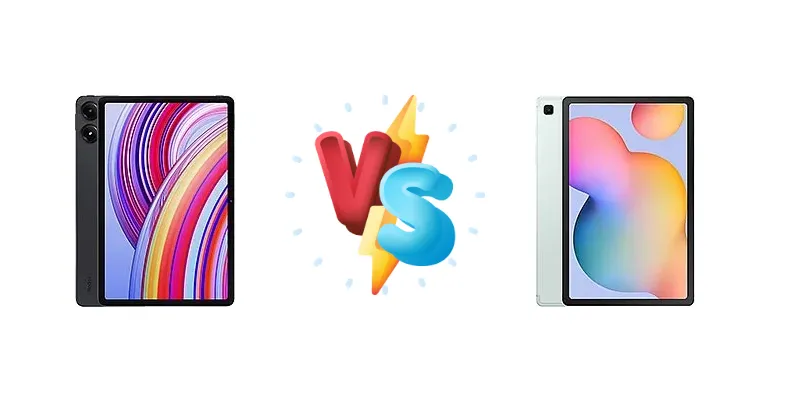
The mid-range tablet market is heating up, with the Xiaomi Redmi Pad Pro 5G and the refreshed Samsung Galaxy Tab S6 Lite (2024) vying for dominance. The Redmi Pad Pro 5G brings 5G connectivity and a newer chipset to the table, while the Tab S6 Lite (2024) leverages Samsung’s established ecosystem and refined software. This comparison dissects their key differences to help you choose the right tablet for your needs.
🏆 Quick Verdict
For the average user prioritizing performance and future-proofing, the Xiaomi Redmi Pad Pro 5G emerges as the winner. Its Snapdragon 7s Gen 2, built on a more efficient 4nm process, offers a noticeable performance edge and faster charging, making it ideal for demanding tasks and extended use. However, Samsung’s software experience remains a strong draw for those invested in the ecosystem.
| Network |
|---|
| 2G bands | GSM 850 / 900 / 1800 / 1900 | GSM 850 / 900 / 1800 / 1900 |
| 3G bands | HSDPA 850 / 900 / 2100 | HSDPA 850 / 900 / 1700(AWS) / 1900 / 2100 |
| 4G bands | 1, 3, 5, 8, 34, 38, 39, 40, 41 | 1, 2, 3, 4, 5, 7, 8, 12, 17, 20, 25, 26, 28, 38, 40, 41, 66 |
| 5G bands | 1, 3, 5, 8, 28, 41, 77, 78 SA/NSA | - |
| Speed | HSPA, LTE, 5G | HSPA, LTE - cellular model only |
| Technology | GSM / CDMA / HSPA / CDMA2000 / LTE / 5G | GSM / HSPA / LTE |
| Launch |
|---|
| Announced | 2024, May 30 | 2024, March 26 |
| Status | Available. Released 2024, May 30 | Available. Released 2024, March 28 |
| Body |
|---|
| Build | Glass front (Gorilla Glass 3), aluminum frame, aluminum back | Glass front, aluminum back, aluminum frame |
| Dimensions | 280 x 181.9 x 7.5 mm (11.02 x 7.16 x 0.30 in) | 244.5 x 154.3 x 7 mm (9.63 x 6.07 x 0.28 in) |
| SIM | Nano-SIM + Nano-SIM | Nano-SIM (cellular model only) |
| Weight | 566 g (1.25 lb) | 465/467 g (1.03 lb) |
| Display |
|---|
| Protection | Corning Gorilla Glass 3 | - |
| Resolution | 1600 x 2560 pixels, 16:10 ratio (~249 ppi density) | 1200 x 2000 pixels, 5:3 ratio (~224 ppi density) |
| Size | 12.1 inches, 424.5 cm2 (~83.4% screen-to-body ratio) | 10.4 inches, 307.9 cm2 (~81.6% screen-to-body ratio) |
| Type | IPS LCD, 120Hz, Dolby Vision, 600 nits | TFT LCD |
| Platform |
|---|
| CPU | Octa-core (4x2.40 GHz Cortex-A78 & 4x1.95 GHz Cortex-A55) | Octa-core (2x2.4 GHz Cortex-A78 & 6x2.0 GHz Cortex-A55) |
| Chipset | Qualcomm SM7435-AB Snapdragon 7s Gen 2 (4 nm) | Exynos 1280 (5 nm) |
| GPU | Adreno 710 | Mali-G68 |
| OS | Android 14, HyperOS | Android 14, upgradable to Android 15, One UI 7 |
| Memory |
|---|
| Card slot | microSDXC (dedicated slot) | microSDXC (dedicated slot) |
| Internal | 128GB 6GB RAM, 128GB 8GB RAM, 256GB 8GB RAM | 64GB 4GB RAM, 128GB 4GB RAM |
| Main Camera |
|---|
| Features | LED flash, HDR | HDR, panorama |
| Single | 8 MP | 8 MP, (wide), 1/4.0", 1.12µm, AF |
| Video | 1080p@30fps | 1080p@30fps |
| Selfie camera |
|---|
| Single | 8 MP | 5 MP, (wide), 1/5.0", 1.12µm |
| Video | 1080p@30fps | 1080p@30fps |
| Sound |
|---|
| 35mm jack | Yes | Yes |
| Loudspeaker | Yes, with stereo speakers (4 speakers) | Yes, with stereo speakers |
| Comms |
|---|
| Bluetooth | 5.2, A2DP, LE | 5.3, A2DP, LE |
| NFC | No | No |
| Positioning | GPS, GALILEO, GLONASS, BDS, QZSS | GPS, GLONASS, BDS, GALILEO, QZSS - cellular model only |
| Radio | No | No |
| USB | USB Type-C 2.0 | USB Type-C 2.0 |
| WLAN | Wi-Fi 802.11 a/b/g/n/a/6, dual-band, Wi-Fi Direct | Wi-Fi 802.11 a/b/g/n/ac, dual-band, Wi-Fi Direct |
| Features |
|---|
| Sensors | Accelerometer, gyro, proximity (accessories only), compass | Accelerometer, proximity, gyro (wi-fi model only) |
| Battery |
|---|
| Charging | 33W wired, PD3.0, QC3+ | 15W wired |
| Type | 10000 mAh | Li-Po 7040 mAh |
| Misc |
|---|
| Colors | Dark Gray | Gray, Mint, Rose Gold |
| Models | 24074RPD2G, 24074RPD2I, 24074RPD2C | SM-P620, SM-P625 |
| Price | About 250 EUR | $ 215.00 |
| SAR | 1.09 W/kg (head) 1.01 W/kg (body) | 0.95 W/kg (body) |
| SAR EU | 0.98 W/kg (head) 1.00 W/kg (body) | - |
Xiaomi Redmi Pad Pro 5G
- Faster Snapdragon 7s Gen 2 processor for smoother performance.
- Significantly faster 33W charging for reduced downtime.
- 5G connectivity for on-the-go productivity.
- Software experience may not be as refined as Samsung’s One UI.
- Brand recognition and ecosystem support are less established than Samsung.
Samsung Galaxy Tab S6 Lite (2024)
- Refined Samsung One UI software experience.
- Seamless integration with other Samsung devices.
- Potentially more compact and portable design.
- Slower Exynos 1280 processor compared to the Snapdragon 7s Gen 2.
- Significantly slower 15W charging.
- Lacks 5G connectivity.
Display Comparison
While both tablets likely feature LCD panels (specific panel details are unavailable), the focus shifts to processing power impacting UI smoothness. The Redmi Pad Pro 5G’s Snapdragon 7s Gen 2 should deliver a more responsive experience when navigating the interface and multitasking. Bezels are likely comparable given the price points, and color accuracy will depend on software calibration, a known strength for Samsung. The lack of high refresh rate information for both devices suggests a standard 60Hz experience.
Camera Comparison
Camera performance is unlikely to be a deciding factor for most tablet buyers. Both devices likely feature modest camera setups. Given the context, detailed sensor information is missing, but it's safe to assume both will offer acceptable image quality for video calls and casual snapshots. The focus should be on video conferencing capabilities rather than photographic prowess.
Performance
The core of the difference lies in the chipsets. The Redmi Pad Pro 5G’s Qualcomm SM7435-AB Snapdragon 7s Gen 2 (4nm) boasts a more modern architecture and a smaller fabrication node compared to the Samsung Galaxy Tab S6 Lite (2024)’s Exynos 1280 (5nm). The Snapdragon’s octa-core configuration (4x2.40 GHz Cortex-A78 & 4x1.95 GHz Cortex-A55) is paired against the Exynos’ (2x2.4 GHz Cortex-A78 & 6x2.0 GHz Cortex-A55). The 4nm process of the Snapdragon translates to better thermal efficiency, potentially reducing throttling during sustained workloads like gaming. While both utilize Cortex-A78 cores, the Snapdragon’s more efficient manufacturing process gives it an edge. The Redmi Pad Pro 5G is likely to exhibit superior sustained performance.
Battery Life
The Redmi Pad Pro 5G’s 33W wired charging is a significant advantage over the Tab S6 Lite (2024)’s 15W charging. This translates to substantially faster charging times, minimizing downtime. While battery capacity isn’t specified, the Snapdragon 7s Gen 2’s efficiency could offset a potentially smaller battery size in the Redmi Pad Pro 5G, resulting in comparable real-world battery life. The faster charging speed, however, provides a tangible benefit for users who frequently use their tablets throughout the day.
Buying Guide
Buy the Xiaomi Redmi Pad Pro 5G if you need a tablet capable of handling demanding apps, benefit from 5G connectivity for on-the-go productivity, and value faster charging speeds. Buy the Samsung Galaxy Tab S6 Lite (2024) if you prioritize a refined software experience, seamless integration with other Samsung devices, and a more compact form factor for portability, even if it means sacrificing some raw processing power.
Frequently Asked Questions
❓ Does the Exynos 1280 in the Galaxy Tab S6 Lite (2024) overheat during prolonged gaming sessions?
The Exynos 1280 is a capable chip, but its 5nm process is less efficient than the Snapdragon 7s Gen 2’s 4nm process. This means it's more likely to generate heat during extended gaming. While it won't necessarily overheat to the point of shutting down, users may experience some performance throttling to manage temperatures.
❓ How much faster is the 33W charging on the Redmi Pad Pro 5G compared to the 15W charging on the Tab S6 Lite (2024)?
The difference is substantial. 33W charging will significantly reduce the time it takes to fully charge the Redmi Pad Pro 5G. Expect a 0-100% charge in approximately 90-120 minutes, while the Tab S6 Lite (2024) will likely take over 3 hours. This is a major convenience factor for users who need to quickly top up their tablet's battery.
❓ Is the 5G connectivity on the Redmi Pad Pro 5G worth the extra cost if I primarily use Wi-Fi?
If you consistently have access to reliable Wi-Fi, the 5G connectivity may not be essential. However, 5G provides a valuable backup option for connectivity when Wi-Fi is unavailable, offering a significant advantage for users who travel frequently or work remotely in areas with limited Wi-Fi access.